Culture and UNESCO present Mondiacult 2025, the world conference to gather more than 150 ministers of culture in Barcelona
News - 2025.9.4
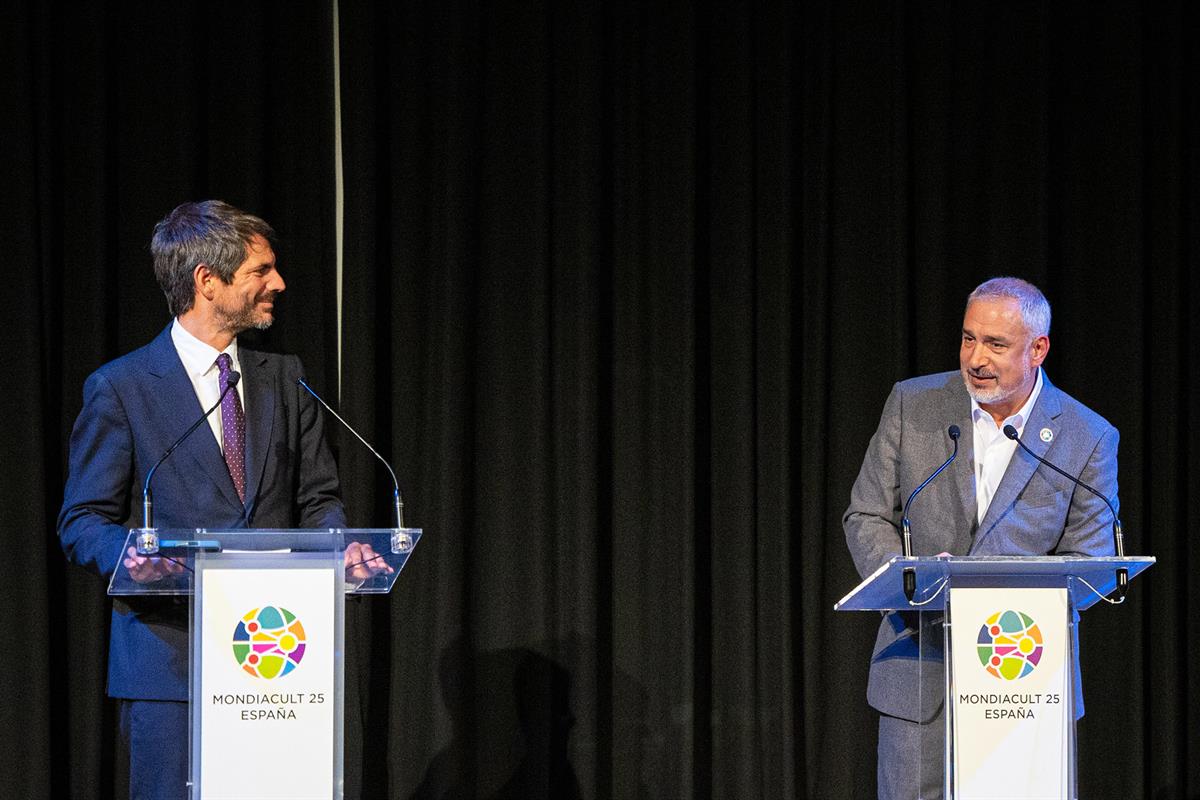 The Minister for Culture, Ernest Urtasun, and UNESCO's Assistant Director-General for Culture, Ernesto Ottone, present Mondiacult 2025





The Minister for Culture, Ernest Urtasun, and UNESCO's Assistant Director-General for Culture, Ernesto Ottone, have presented the programme and objectives of Mondiacult 2025, UNESCO's World Conference on Cultural Policies and Sustainable Development, to be held in Barcelona from 29 September to 1 October, and which will be attended by more than 150 culture ministers from all over the world.
Mondiacult, UNESCO's World Conference on Cultural Policies and Sustainable Development, is the leading international meeting on cultural policies. It has been held twice so far, both times in Mexico in 1982 and 2022, and this September it will be held in Barcelona.
Mondiacult will bring together ministers from around the world to work together on defining cultural policies for the coming years and implementing a global agenda for culture based on human rights, inclusion and sustainable development, under the consideration of culture as a global public good. The Minister for Culture, Ernest Urtasun, stressed that "Mondiacult 2025 is not just a summit, it is a collective journey in progress, which invites us to envisage together a new global agenda for culture", and for this "the protagonist will be the cultural world in all its plurality and diversity".
In addition, and taking advantage of the presence of political leaders and influential people in the field of culture, two of the priority objectives of the meeting will be explained: to present the first World Report on the State of Culture, and to promote the creation of a specific Sustainable Development Goal for culture. As the Minister for Culture pointed out, "Mondiacult 2025 is not just another event on the international agenda, it is one of the greatest exercises in multilateralism and cultural diplomacy we have ahead of us in the coming years".
The thematic axes to be addressed in Mondiacult 2025 will be cultural rights, culture in the digital era, the integration of culture in education, the economy of culture, the cultural dimensions of climate change, and the defence of heritage in crisis and emergency situations.
Two topical issues of great interest to the culture sector, artificial intelligence and the culture of peace, have also been included at Spain's request. Urtasun pointed out that "culture has proven to be a powerful channel for dialogue, reconciliation and understanding, and we want to strengthen its role in building more democratic, inclusive and sustainable societies".
In addition to ministers of culture and government delegations from around the world, Mondiacult will be attended by cultural professionals, artists, academics, researchers, and representatives of civil society and the private sector. The programme will be structured around plenary sessions, thematic sessions, side events and cultural activities.
Plenary sessions, thematic sessions and side events
For three days, the Barcelona International Convention Centre (CCiB) will host the Mondiacult programme, which includes plenary sessions and thematic sessions on the central themes of the conference, in which the ministers of culture and their delegations will speak and debate.
New for 2025, in this edition the thematic sessions with ministers will be preceded by interventions by thinkers from different fields and territories, such as the Indian philosopher Gayatri Spivak, the Mozambican writer Mia Couto, researchers in digital culture and AI such as Helen Hester, Marta Peirano and Lluís Nacenta, the Mexican linguist Yásnaya Aguilar, and other leading experts in peace and heritage culture, including Jorge Melguizo and Manuel Borja-Villel.
The programme is complemented by a series of around 75 parallel events that make up an extended programme, the aim of which is to deepen the debates on the main themes of Mondiacult and showcase cultural proposals and best practices. These events have been organised at the proposal of states, international organisations, civil society organisations, academia and the private sector, as well as local and regional administrations.
Cultural programme
Mondiacult will also offer conference attendees a series of artistic and cultural events. The programme will kick off with an opening ceremony in which, in addition to speeches by the authorities, artists such as Frederic Amat, María Arnal, Tarta Relena and Miguel Poveda with Yerbabuena will take part.
It also includes a major concert by the conductor Jordi Savall, which will take place on Tuesday 30 September at the Palau de la Música. It is a concert for peace and dialogue featuring a diverse repertoire in terms of provenance and period, in which Savall will be accompanied by musicians from all over the world.
Spain's intangible heritage will also be a main feature of the programme throughout the conference, with a dance display of jotas and tamborradas, as well as human castles and a taste of the Mare de Déu de la Salut festival, from the Valencian town of Algemesí.
Mondiayouth: young Mondiacult
As another novelty in this edition of Mondiacult, a conference promoted by the Ministry of Culture will be held in which young people will play a leading role.
The Mondiayouth space has been designed as a parallel space to the plenary sessions where young people between the ages of 18 and 25 from different regions of the world can actively take part by debating and contributing their views on the major challenges of global cultural policy. The aim of their participation is not only to reflect on the themes of Mondiacult, but also to formulate concrete proposals and conclusions, which will be presented at the closing of the conference on 1 October.
Ágora Cívica: a space for citizenship
To promote the participation of civil society in Mondiacult's debates on cultural policies, Ágora Cívica will be held in parallel, a space open to citizens and cultural agents that seeks to promote international debate on cultural policies from the perspective of civil society, cities and professionals in the sector.
Ágora Cívica will be held from 26 September to 1 October at various venues in Barcelona, with the collaboration and joint leadership of the Ministry of Culture, Barcelona City Council, Barcelona Provincial Council and the Generalitat de Catalunya.
The Ágora Cívica programme will consist of round tables, conferences, debates, presentations, participatory sessions and other activities. All of them will be structured around six thematic axes that will address major cultural challenges and debates at international level, with a local perspective. All the information can be consulted on the Ágora Cívica website.
Non official translation