





In 2024, a total of 173,286 organ transplants were performed worldwide, an increase of 2% over the previous year's activity. This record high was due to the expansion of asystole donations (organ donation after death due to cardio-respiratory arrest), which increased by 17% last year. Spain reaffirmed its position as international leader in deceased donations and once again recorded the highest number of asystole donations and transplants globally.
This is what can be concluded from the latest Records of the Global Observatory on Donation and Transplantation, which is managed by the National Transplant Organization (ONT) as a collaborating centre of the World Health Organization (WHO) and whose data is published annually in the Council of Europe's Transplant Newsletter.
In view of these figures, the Minister for Health, Mónica García, stated that "Spain's transplant programme should be a source of great pride; our leadership in the world is possible thanks to a committed society, the excellent work of our healthcare professionals and a model based on the organisation of highly complex processes and a continuous commitment to innovation."
The Spanish organisational model is based on the network of hospital transplant coordinators, mainly led by specialists in intensive care medicine, who receive ongoing support from the ONT and the Autonomous Transplant Coordinators. Innovation has focused in recent years on asystole donation, donation-oriented intensive care programmes and complex organ transplantation. García confirmed the Ministry of Health's commitment "to continue implementing measures that allow patients who need a transplant in Spain to receive it on time and with the greatest guarantees of success, and to continue developing international cooperation programmes that allow for the expansion of transplants in other countries."
All-time high for transplants
In 2024, a total of 173,286 organ transplants were performed in the 91 countries that had provided their data to the Global Registry by 10 August 2025. Of these transplants, 110,021 were kidney transplants (37% living donor); 42,494 were liver transplants (23% living donor); 10,286 were heart transplants; 8,236 were lung transplants; 2,075 were pancreas transplants; and 174 were intestine transplants. These procedures were made possible by the 47,175 people who donated their organs after death and the 50,588 who donated an organ during their lifetime (40,706 kidney, 9,864 liver and 18 lung). Transplant activity in 2024 increased by 2% compared to the previous year. As in 2023, the largest increase last year was in lung transplantation, which grew by 6%, followed by liver (5%), heart (2%) and pancreas (2%).
Asystole donation increases by 17% globally
The growth in overall transplantation activity was due to a 3% increase in deceased organ donation, mainly due to the expansion of asystole donation. Specifically, the number of asystole donors increased from 11,395 in 2023 to 13,366 in 2024, an increase of 17%. Asystole donation accounted for about 30% of deceased donors worldwide. However, this type of donation continued to be carried out in a limited number of countries due to the lack of appropriate regulatory frameworks and its technical complexity. Of the 26 countries reporting asystole donors in 2024, Spain had the highest activity, with 1,316 asystole donors and a rate of 27.7 per million population (p.m.p.). Our country thus contributed 50% of the donors in the European Union (EU) as a whole and 10% of the world's donors in asystole.
Asystole donors enabled 27,373 transplants of all types of organs to be carried out. The transformation of asystole donation into a multi-organ donation process over the years has been made possible by the introduction of preservation systems to reduce the impact of ischaemia and to verify the viability of organs prior to transplantation. Because of the technological sophistication required to ensure adequate results, the progressive growth of asystole heart transplantation is particularly noteworthy. While in 2023, 823 heart transplants were performed from asystole donors, in 2024, 1,073 procedures were performed in nine countries (Australia, Austria, Belgium, Spain, the United States, the Netherlands, Italy, the United Kingdom and Switzerland), of which 101 (9%) were performed in Spain.
In 2024, Spain was once again the country with the highest transplantation activity from asystole donors. The rate of organ transplants obtained from these donors was 59.8 p.m.p. in Spain, followed by the United States and the Netherlands, which performed 38.1 and 38.0 p.m.p. of such transplants, respectively.
Organ donation and transplantation grows in the European Union
Donation and transplantation activity in the 27 EU countries returned to record highs in 2024 (Table 1). With 10,847 deceased donors and 3,581 living donors, 32,222 organ transplants were carried out last year in the EU. The increase in both donation and transplantation was more than 5% over the activity recorded in 2023.

The EU countries with the highest rate of organ donation and transplantation in 2024 are represented in Table 2:
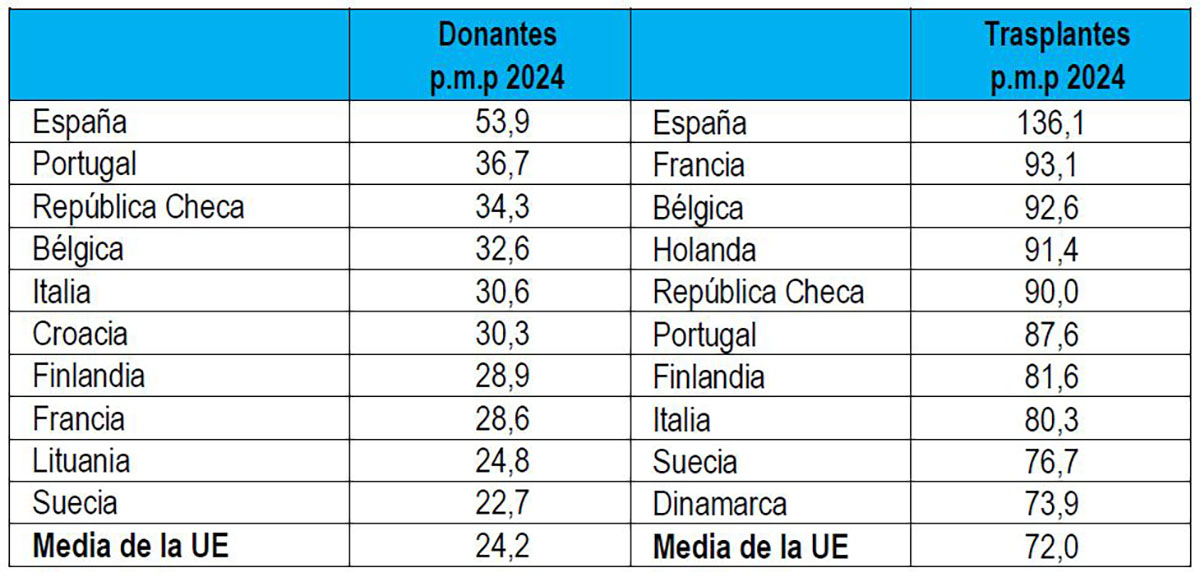
Despite the growth noted, it is important to remember that, at 31 December 2024, there were 52,538 patients in the EU on the waiting list for an organ transplant. According to data from the Global Observatory, nine patients died every day in the EU while waiting for a transplant.
Stability in Latin America
Latin America, with which Spain has been collaborating for 20 years within the Ibero-American Network/Council for Donation and Transplantation (RCIDT) by providing technical advice and training health professionals in transplant coordination through the Alianza Programme, maintained a very stable situation after the growth observed in 2023. In 2024, the region recorded 6,023 deceased donors (9.9 p.m.p). A total of 17,432 organ transplants were performed (28.6 p.m.p.). The country with the highest donation activity was Uruguay, with 19.7 donors p.m.p., followed by Argentina and Brazil, with 17.4 and 17.3 donors p.m.p., respectively. Argentina, with 36 asystole donors, consolidated its position as a benchmark for this type of donation in the region.
Global Registry
The Global Registry confirms Spain's important contribution to organ donation from deceased persons: with 2,562 donors, Spain accounted for 24% of donations in the EU last year and 5% of those registered in the world, despite Spain barely representing 11% of the European population and 0.6% of the world's population. With a rate of 53.9 donors p.m.p. in 2024, Spain remained the country with the highest deceased donation activity globally, followed by the United States, with 49.7 donors p.m.p., and several of the European countries highlighted in Table 2.
In terms of transplant activity, Spain performed 6,463 transplants, which meant a rate of 136.1 transplants p.m.p. in 2024, a figure only surpassed by the United States, with 143.2 transplants p.m.p. (48,935 transplants). The difference in transplant rates between the two countries is due to the fact that the US has a higher live donation activity and to its different profile of deceased donors, who are younger and often die of preventable causes. Thus, last year, donors aged 60 years or older accounted for 58% of donors in Spain versus 25% in the United States. Regarding causes of death, in the United States 12% of donors died from drug overdose and 5% from firearms injuries, which are exceptional causes of death among organ donors in our country.
Globally, in addition to activity in the United States and the EU, the volume of transplants performed in China and India played an important role. In 2024, 24,684 transplants (17.2 p.m.p.) were performed in China, mainly from deceased donors. In India, 18,911 organ transplants were performed (13.1 p.m.p.), with living donation predominating. Other countries with a significant volume of transplants were Brazil (8,910; 40.9 p.m.p.), Türkiye (5,268; 61 p.m.p.), United Kingdom (4,637; 68.2 p.m.p.), Republic of Korea (3,357; 64.9 p.m.p.), Canada (3,243; 82.9 p.m.p.) and Mexico (3,080; 23.8 p.m.p.).
The 2025 edition of the Newsletter Transplant, the official publication of the Council of Europe's Transplantation Committee, will soon be available on the ONT website. Activity data can also be consulted in the Global Observatory on Donation and Transplantation.
Explanatory note: Donation and transplant rates for Spain differ slightly from those provided by the ONT in its annual report, because the Global Observatory uses the UN Fund's population figures for all participating countries. The evolutionary data for 2023 has been calculated taking into account those countries that provided data for both 2023 and 2024.
Non official translation
Surgeons in the operating room