2024 Summit of the International Transport Forum, Leipzig (Germany)
Óscar Puente highlights the great progress of Spanish infrastructure and high-speed rail as a model to achieve more sustainable transport
News - 2024.5.22
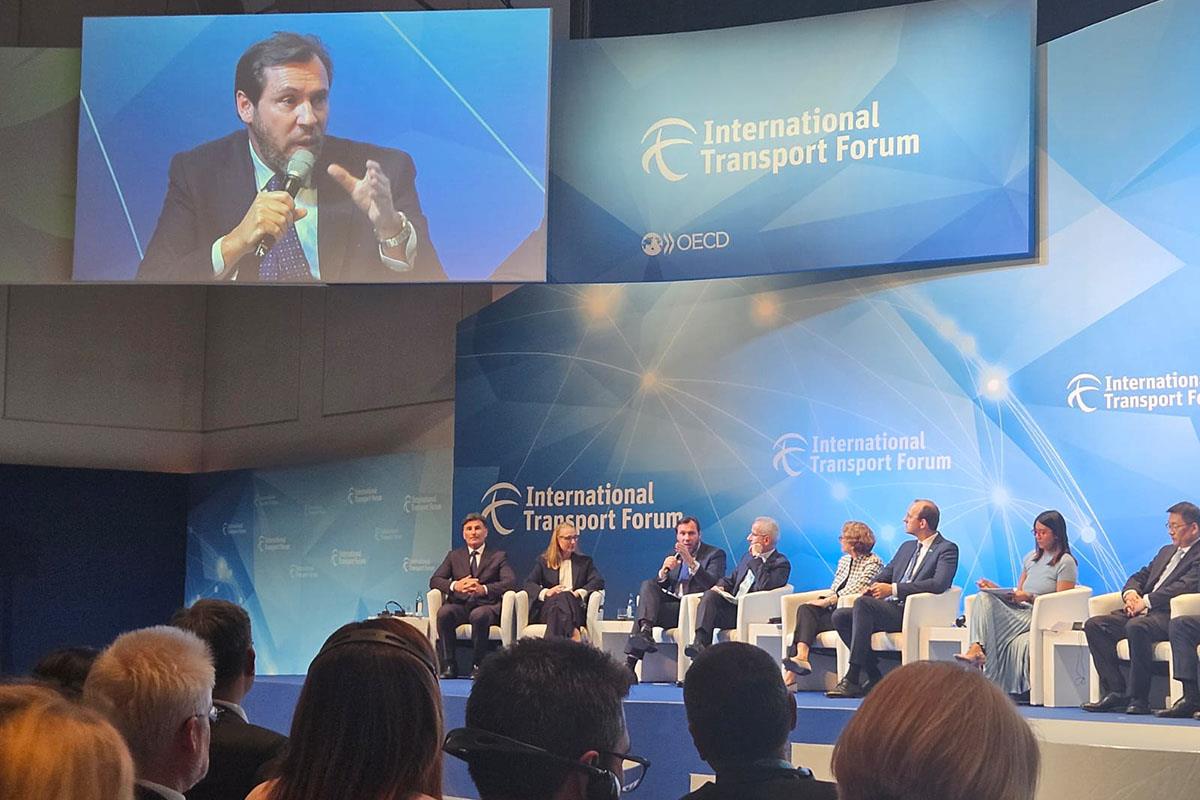 The Minister for Transport and Sustainable Mobility, Óscar Puente, during his speech at the 2024 Summit of the International Transport Forum





In Leipzig, Óscar Puente has highlighted the "great progress" of Spanish infrastructure and high-speed rail as a key and model to follow in order to achieve more sustainable and efficient transport.
He pointed out that since the first high-speed line between Madrid and Seville was put into service in 1992, the service has been extended all over the country thanks to more than 4,000 kilometres of high-speed tracks and high-speed trains with movable tracks.
"High-speed trains already reach 70% of the population and we will continue working to get closer to 100% of the population", said the Minister for Transport and Sustainable Mobility during his speech before the Plenary of the 2024 Summit of the International Transport Forum (ITF), which is being held today and tomorrow in the German city under the theme "Greening transport: keeping the focus in times of crisis".
In this sense, the minister of Lithuania, the country holding the presidency of the ITF, and the representative of the USA have placed the Spanish high-speed network as an example to follow in order to develop this type of service in their countries and thereby promote more sustainable, efficient and quality mobility, while bringing cohesion to their territories.
Likewise, during his speech, Óscar Puente defended the importance of governance and international collaboration to strengthen investments in infrastructures and zero-emission transport.
"Collaboration between different actors and multilateral governance instruments are essential in post-crisis stages with new and more ambitious targets" to decarbonise transport, the minister said. As an example of this, the Connecting Europe Facility, the Global Gateway strategy or the policies of international financial institutions stand out.
This is the first time that a Spanish government minister has participated in this Forum, which brings together ministers from all over the world and is the main global transport policy event, where the role of the sector in environmental sustainability and the impacts of the climate, health and geopolitical crises are being addressed.
Óscar Puente also participated this morning in the Ministerial Round Table on "Transport and climate change: moving forward from COP 28" where he highlighted the joint work of the public and private sectors as a formula to progress the decarbonisation of transport, through planning that balances ambition and realism and investment in projects and technology, with open spaces for dialogue on an international scale, such as the ITF, being fundamental.
Towards a more resilient and sustainable system
In the opening plenary, the minister advocated striking a balance between the short and long term to ensure the transition to a new, more resilient and sustainable transport and mobility system.
This is not a simple objective, he said, as policies to combat climate change may have undesirable effects in the short term, especially on the competitiveness of the sector.
This is why good governance is key, which requires a framework, clear objectives and standards on a global scale, which also take into account the initial situation of the different countries and their own specifics.
In this regard, he stressed that international organisations such as IMO, ICAO and UNECE have a very important role to play in future transport policies due to their regulatory and consensus-building capacity. He also pointed to the important role of the European Union, where ambitious environmental transport policies are being pursued.
Óscar Puente stressed the need for decision-making processes in emergencies to be flexible so that administrations can act more quickly. He highlighted our country's response to the volcanic eruption that required the construction of a new road to restore mobility in the Aridane valley of La Palma. This is an unprecedented project, with many technical and environmental challenges, in which sustainability was a priority and which was developed in full collaboration between the regional and state administrations.
In addition, the minister focused on digitalisation and on creating a seamless global framework for innovation, and highlighted the importance of, among others, the digital platforms for the traceability of goods and the monitoring of the logistics chain, or the Public Procurement of Innovation Programmes that allow exploring the capabilities of public-private partnership to develop innovative solutions that facilitate better management of infrastructures, through the incorporation of processes and latest-generation technologies.
Accelerating the pace of decarbonisation
Óscar Puente mentioned key aspects such as the creation of a global legal security framework with clear, long-term rules that provide certainty for investments; the modernisation of business models and cultures, so that there is a real corporate social commitment to climate objectives; and the provision of funding by the public sector to encourage the transition required by the change of model.
He pointed out that international actions require legislation, strategies and financial instruments in national roadmaps, citing, in the case of Spain, the Sustainable Mobility Law, the Safe, Sustainable and Connected Mobility Strategy and the Recovery, Transformation and Resilience Plan.
He has been inclined to maintain a holistic approach to the transport and energy sectors, stating that energy alternatives are a key element for cost-effective and energy-efficient supply chains.
Bilateral meetings
Throughout the day, the minister held bilateral meetings with his counterparts from Colombia, Morocco and Saudi Arabia and with senior representatives of the United Nations Economic Commission for Europe (UNECE) and BP, with whom he discussed the company's plans to invest in Spain in sustainable fuels and recharging infrastructure.
Óscar Puente took advantage of his meeting with the Colombian Minister for Transport, William Camargo, to highlight the importance of developing collaboration between administrations within the framework of the Memorandum of Understanding signed in 2023. In addition, he expressed the full willingness of Puertos del Estado to continue collaborating with Colombia in the port sector.
During his meeting with the Moroccan Minister for Transport and Logistics, Mohammed Abdeljalil, Óscar Puente welcomed the progress made in the framework of the Memorandum of Understanding signed last year, and the collaboration between the two countries. The minister also took the opportunity to highlight the companies' expertise in the railway sector and the engineering and knowledge they can contribute to the development of the high-speed network.
In this vein, the minister discussed the success of the Haramain high-speed line project linking Mecca and Medina with his Saudi Arabian counterpart, Saleh bin Nasser Al-Jasser, which was executed by a Spanish-Saudi consortium, as well as the good progress of the commercial exploitation of the so-called Desert AVE, operated by Renfe. Not surprisingly, the line had almost 7 million passengers in 2023, reaching a record high, and this year it exceeded 1 million passengers for the first time during Ramadan.
Finally, he met with Tatiana Molcean, Executive Secretary General of the United Nations Economic Commission for Europe (UNECE), for the first time to whom he conveyed the Government of Spain's firm commitment to UNECE.
Non official translation