Telecoms and digital ministers agree first European declaration to protect digital rights in the development of neurotechnology
News - 2023.10.24






At the informal ministerial meeting held in León, the European Telecommunications and Digital Affairs Ministers agreed on a Joint Declaration promoted by the Spanish presidency of the Council of the EU for the development of a humanist neurotechnology that protects people's fundamental rights and contributes to Europe's competitiveness and open strategic autonomy.
With it, ministers commit to fostering public-private partnerships for the development of cyber-secure neurotechnologies, paying attention to the challenges in areas such as education, health and entertainment. It is also proposed to promote a dynamic ecosystem that aligns R&D&I and the market and support and investment measures, via incubators and accelerators of neurotechnologies in the EU. Venture capital investments and guarantee funds in the creation and growth phases of the projects will also be fostered.
The aim is for the EU to become a key player in fostering innovation and promoting investment in this field, respecting the EU's fundamental rights and democratic values - including the European Declaration on Digital Rights and Principles - thereby ensuring a humanistic approach.
The 'León Declaration' encourages dialogue between the European Commission and member states to maintain a common position in international fora, and urges European innovators to protect human rights in the development of their products.
The First Vice-President and Acting Minister for the Economy and Digital Transformation, Nadia Calviño, said that "it is time for the EU to anticipate the challenges of the future and to strengthen its leadership in this area, which is so important for the lives of European citizens".
Ireland was unable to sign up to the declaration at the meeting as neurotechnology falls under the remit of another government department, but is expected to adhere to the document in the near future.
A rights-oriented European neurotechnology
Non-invasive neurotechnologies can be used to connect the brain to computers, to take part in virtual worlds and to enhance brain functions.
The declaration sets out the challenges posed by its development at the social, legal and ethical levels, and in areas such as cybersecurity and health, in particular in the processing and use of personal data.
The two days of work during the informal meeting of telecommunications ministers in León also included discussions on the protection and promotion of digital rights, the sustainability of the telecommunications sector and the progress of digitisation in Europe.
Future of telecommunications
Ministers addressed the need for telecoms regulation in the EU over the next decade to ensure the sustainability of the sector and globally competitive digital infrastructure investment for digital sovereignty.
Ministers agreed on the need to continue improving telecommunications infrastructures, broadband networks, mobile connectivity and the deployment of 5G, and on the desire to further strengthen public-private partnerships in the promotion of these infrastructures, accelerating the necessary investments.
Artificial intelligence
One of the most pressing priorities is the regulation of the development of artificial intelligence, which is being negotiated during the Spanish presidency of the EU.
The new regulation, which is being negotiated in trilogue format in Brussels, should regulate artificial intelligence with the aim of creating a rights-based ecosystem and a stable European competitive environment for European suppliers and customers.
In the margins of the meetings held in León, which were attended by the European Commissioner for the Internal Market, Thierry Breton, progress was made in the negotiations on this new regulation, which will be discussed this Tuesday in a trilogue in Brussels.
This dossier, which is a priority for the Spanish Presidency, aims to strengthen the European regulatory framework to promote innovation while guaranteeing citizens' rights and protecting their privacy and security.
Representatives of international and national organisations such as the International Telecommunications Union (ITU), the Organisation for Economic Co-operation and Development (OECD), the global association GSMA and the Spanish Competition Commission (CNMC) also took part in the meeting.
Non official translation
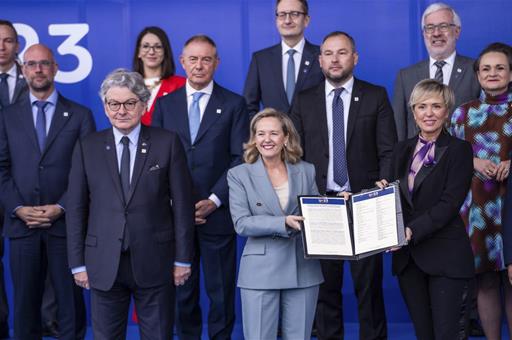
The First Vice-President and acting Minister for the Economy and Digital Transformation, with the Joint Declaration agreed with the European Telecommunications and Digital Affairs Ministers