




The Spanish State Meteorological Agency (AEMET) has released its forecast for the three-month period comprising June, July, and August, which constitutes the meteorological summer. The most likely scenario is that temperatures will be above average across the country, with a higher probability along the Mediterranean coast and in the archipelagos. Regarding rainfall, there is no clear trend; in general, summers in Spain are characterized by dry periods occasionally interrupted by storms.
As part of the measures related to the summer period, the Council of Ministers approved the 2025 Action Plan for the Prevention and Control of Forest Fires on June 10th. The Plan, in which ten ministries are participating, includes measures for anticipation, operational deployment, and structural reinforcement. At the press conference following the Council of Ministers meeting, the Government spokesperson, Pilar Alegría, highlighted the increased investment compared to the previous year, with more than 115 million euros allocated primarily to preventative and cleanup work.
The 2025 Plan maintains the rapid intervention contingent of the Military Emergency Unit (UME), comprised of some 1,400 personnel and a state fleet of 14 firefighting aircraft, along with 63 aircraft coordinated by the Ministry for Ecological Transition. These resources are complemented by the support system for the autonomous communities, which includes the Forest Fire Reinforcement Brigades (BRIF).
Furthermore, the State Meteorological Agency (AEMET) will provide daily fire risk forecasts; drones will be used to monitor high-risk areas; the Environmental Prosecutor's Office will intensify oversight of compliance with municipal plans and criminal investigations; and the Civil Guard, through its Nature Protection Service (SEPRONA), will focus on identifying the causes of and those responsible for fires, among other actions.
The Council of Ministers also approved the report on the implementation of the 2024 Plan. Last year, as the government spokesperson emphasized, the lowest number of fires in a decade was recorded (6,134). In addition, there were 5 deaths, nearly 7,000 people evacuated, and 306 people arrested or under investigation.
What is a forest fire?
A forest fire is a fire that spreads uncontrolled through forest land that was not intended to burn. In addition to the forest and environmental damage it causes, there are also consequences for the civilian population and their property.
What are the possible origins of a forest fire?
The heat source that ignites combustible plant material may be of natural origin (e.g. lightning), but most forest fires have a human origin, either due to negligence in fire management (agricultural and livestock burning, burning of rubbish, cigarette butts, pyrotechnics, etc.), by chance (sparks from power lines, vehicle accidents, etc.) or intentionally.
What are the basic recommendations for dealing with forest fires?
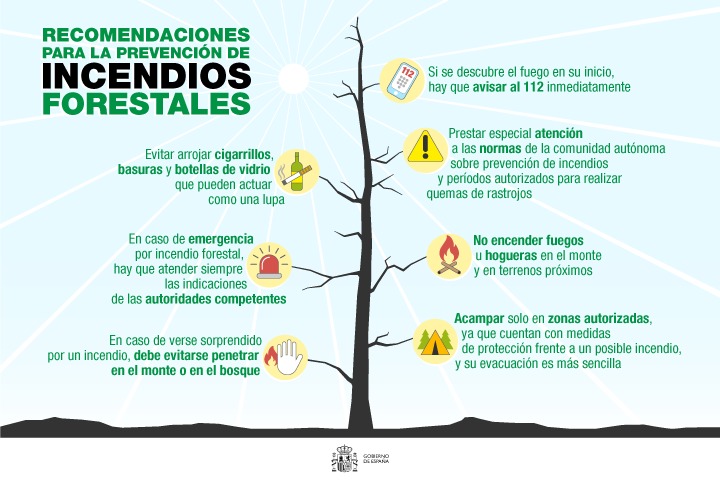
- Avoid throwing cigarettes, litter and glass bottles that can act as a magnifying glass.
- No fires or bonfires in the bush and on nearby land.
- Pay special attention to the rules of the Autonomous Community on fire prevention and authorised periods for stubble burning.
- Camp only in authorised areas, as they have fire protection measures in place, and evacuation is easier.
- If the fire is discovered when it is just taking hold, call 112 immediately.
- In the event of a fire, avoid entering the bush or forest.
- In the event of a forest fire emergency, always follow the instructions of the competent authorities.
What preventive measures should be taken in the vicinity of a country house?
- Do not burn leaves or other plant debris on hot or windy days or without permission.
- Have a plan of action in case of forest fires.
- Know the possible evacuation routes
- Keep access roads to houses clear of grass or weeds.
- Keep roofs clear of combustible materials.
What preventive measures should be taken in the bush?
- Do not light a fire
- Put out matches and cigarettes properly and never throw them out of the car window.
- Do not leave bottles, glass objects or rubbish behind.
- Only burn stubble or plant debris with authorisation and under safe conditions. Keep an eye on the burning and do not leave until it is completely extinguished, checking the embers thoroughly. Care should also be taken with machinery that can generate sparks or electric shocks.
How should you act in the vicinity of a forest fire?
- Call 112 as a matter of urgency
- If the fire is very small or incipient, try to put it out, always prioritising safety.
- If the fire becomes larger, move away in the opposite direction to the smoke and breathe through your nose, taking care to cover it with a damp cloth.
- Always run downhill and do not seek refuge in deep areas.
- Do not attempt to cross the flames; if there is no other way out, cross where the front is weakest.
- In the event that the fire catches up with you, you need to situate yourself in the area that is already burned and always turn away from the prevailing wind.
- If your clothes catch fire, do not run, but roll on the ground and, if you have a blanket, cover yourself with it.
What should be done if a fire breaks out near a house?
- Use hoses to wet the roof and surrounding area
- Do not throw water in areas where there may be electrical wires.
- Close all doors, windows and shutters to prevent air currents and flames from entering.
- Plug cracks on the outside with water-soaked cloths.
- Disconnect all supplies
- ¡In the event of an evacuation order, the instructions of the competent authority must be followed. In the absence of such an order, it is advisable not to leave the house.
Non official translation