





The Minister for Defence, Margarita Robles, has visited the Cerro Muriano Base in Cordoba, where she was briefed on the final shooting and firing tests carried out a few days ago on the six 2A4 Leopard vehicles that Spain plans to send to Ukraine, and she watched a tactical exercise on NATO's Very High Readiness Joint Force (VJTF).
The programme to test the operation of the different systems of the six battle tanks was carried out on 26 and 29 March at the base and at the Cerro Muriano manoeuvring and firing range, after they had been fine-tuned at the installations of the GDELS-Santa Bárbara Sistemas (SBS) weapons factory in Alcalá de Guadaíra (Seville).
On her arrival at the base, Robles was received by the head of the 'Guzmán el Bueno' X Brigade (BRI X), Brigadier General Ignacio Olazábal. The minister was accompanied on the visit by the Chief of the Army (JEME), General Amador Enseñat.
Robles attended a presentation on the results of the validation tests for the manoeuvring and firing of the 'Leopard' tanks, which have been prepared and coordinated under the direction of the Armoured Systems Maintenance Centre and Park 1 (PCMASA 1). The minister was also briefed on NATO's Very High Readiness Joint Force (VJTF), which in this rotation falls under the responsibility of BRI X.
The minister pointed out that "by means of the corresponding manoeuvres, it has been verified that the 'Leopards' are in perfect working order", adding that they will leave "in a few days" for Ukraine, which she described as "very good news".
"On the issue of tanks, we can be satisfied with the repairs that have been made," said Robles, who added that 20 TOA vehicles will soon be sent to Ukraine for the essential purpose of transporting troops and the sick. "Spain will continue to cooperate within its capacity, of course with great prudence and discretion," she said.
"Magnificent" result
During his presentation, General Olazábal explained that the purpose of the tests carried out was to determine the consistency of the undercarriages and the firing efficiency of the guns. Once the programme had been completed, the battle tanks were redeployed to the GDELS-SBS facilities, which Robles visited on 23 March, for another overhaul and to correct the minor deficiencies observed on the ground that could not be repaired on site.
The overall assessment after the test firing was "very satisfactory", he said, highlighting the quality of the material from which the weapons are made, which has not been compromised in the time they have been deactivated.
"The result was magnificent. This means that it is a vehicle that is still as good as it ever was. They are not obsolete by any means. They are a very powerful element, and they are in very good condition to be used", said the head of BRI X about the battle tanks, the minor repairs to which were carried out at the Cordoba base.
The general pointed out that few engine failures were detected during the tests. Some of those that occurred were dealt with on the spot, while on other occasions certain elements had to be changed.
Robles was interested in the interoperability between the Leopard 2A4 and 2A6, and also between the different US, British and French tank systems that are likewise on their way to Ukraine, vehicles which, according to the general, are from "the same generation of tanks, providing the same ranges, the same reliability and the same all-terrain speeds".
Six 'Leopard' crews from the Canary Islands Command and specialist personnel from the Transmissions and Armament and Artillery Material Maintenance Parks and Centres took part in the programme, among other units.
Very high availability joint force
During the visit, the minister witnessed an exercise by the VJTF-24 Armoured/Mechanised Tactical Group to demonstrate the use of the Leopard battle tanks and Pizarro infantry fighting vehicles in combat in urban areas.
In this rotation, the army's contribution to this VJTF 24 falls to the 'Guzmán el Bueno' X Brigade, which will provide an Armoured/Mechanised Tactical Group, a Field Artillery Battery, an Anti-aircraft Artillery Battery (Mistral) and a Sapper Company, which will be reinforced by the specific capabilities of other units of the Land Force.
"Next year, we will be on permanent alert with a very high degree of readiness," said the head of BRI X.
Robles was able to talk to personnel from the Tactical Subgroup, whom she thanked for their work, adding that "we are a point of reference" and that she was interested in their experience in battle tanks and their destinations.
Since the creation of the NATO Response Force (NRF) at the 2002 Prague Summit, Spain has contributed forces to successive battlegroups that have rotated in generation and readiness.
The eNRF is structured in three tiers according to their degree of readiness: the very high readiness joint force, an initial follow-on force and a follow-on force.
The VJTF is a very high readiness joint-combined force that primarily serves collective defence missions under Article 5 of the North Atlantic Treaty.
Non official translation
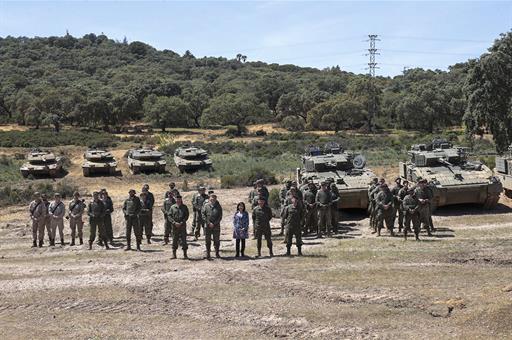
The Minister for Defence, Margarita Robles, during her visit to the 'Cerro Muriano' Base, in Córdoba