Rail planning
Transport, Mobility and Urban Agenda approves the Indicative Railway Strategy 2021-2026 with €24.2 billion in investments
News - 2022.12.30





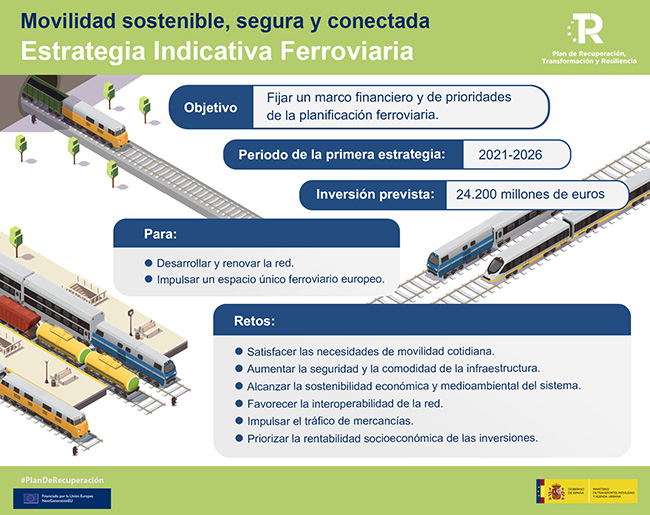
The Ministerial Order signed by the Minister Raquel Sánchez on 23 December 2022 has been published in the BOE, giving the green light to the strategy for the development, maintenance and renewal of the railway infrastructure which, in turn, establishes the financial framework and priorities for action on the railway network to meet future mobility needs, the sustainability of the system and the achievement of a single European railway area.
The challenge of the strategy, which envisages mobilising €24.2 billion in investments between 2021 and 2026, is to draw the first step of railway planning to constitute a coherent and effective system, incorporating social, environmental and economic efficiency objectives with the same importance as functional and territorial ones.
It is the highest-ranking instrument within railway sector planning and constitutes a fundamental lever for the change of paradigm in transport policy promoted by the Safe, Sustainable and Connected Mobility Strategy 2030, to adapt it to the present situation and to the new challenges facing the transport system.
This paradigm shift involves moving towards sustainable mobility, considering the need to reduce energy consumption and decarbonise the economy in the fight against climate change. It also places the citizen and the user at the centre of the whole system, with a special focus on everyday mobility.
Among other objectives, the strategy aims to strengthen the freight network, European corridors and interoperability to create a single railway area throughout the EU. At the same time, it seeks to correct the shortcomings and imbalances of the rail network, where very modern infrastructure coexists with relatively obsolete infrastructure stretched to the limit of their capacity with others that are clearly underused.
In this respect, eight major strategic objectives have been set out:
- To promote sustainable urban and metropolitan mobility, through the Cercanías service, and to increase accessibility and social cohesion levels through a quality railway system.
- To improve the maintenance of the entire network to avoid decapitalisation and increase the reliability, comfort and safety of rail transport.
- To enable the economic sustainability of the rail network by prioritising the efficient use of resources.
- To ensure national and international interoperability with the development of the TEN-T corridors, and promote actions in favour of intermodal transport.
- To boost rail freight traffic, enhancing its environmental sustainability, improving its productivity and developing new management and operating formulas.
- To enhance operational safety in rail transport through the implementation of measures aimed at improving its operation and reducing accidents.
- To promote the digitisation of transport and innovation to ensure connected mobility.
- To strengthen the environmental sustainability of the entire railway system.
The aim is thereby to encourage investment policy to optimise resources and the use of existing infrastructures, and to prioritise plans and investments in the actions that benefit the greatest possible number of users, are efficient and increase social cohesion.
Although with less prominence than in previous plans, the development of the high-speed network is also expected to continue, so that corridors can be completed and the investments already made can be put to good use, and the development of the European corridors likewise completed. An improvement in the maintenance of the network is also foreseen to increase the reliability, quality and safety of the network, taking into account the environmental variable from the planning phase of each action.
Regulatory framework
This approval complies with the provisions of the Rail Sector Act 38/2015, which in turn transposes Directive 2012/34/EU of the European Parliament and of the Council establishing a single European railway area. Its elaboration was also foreseen in the aforementioned Mobility Strategy and in the Plan for Recovery, Transformation and Resilience, one of the reforms being included in component 6, Sustainable, safe and connected mobility.
The Indicative Strategy has been subject to a Strategic Environmental Assessment, a process during which it was submitted to public information (BOE of 27 November 2021), and it has obtained a Strategic Environmental Declaration by Resolution of the Directorate General for Environmental Quality and Assessment of 17 August 2022 (BOE of 22 August 2022).
Non official translation