Signing of the protocol with the Community of Madrid and the Autonomous University of Madrid, first milestone
The Government of Spain launches the National Neurotechnology Centre, Spain Neurotech, a pioneer in Europe
News - 2022.12.22





The new centre will be a pioneer in Spain and a benchmark in Europe for the development of technological tools based on the fundamentals of the human brain. There are only five research centres in the world specialising in this discipline.
The presentation and signing ceremony was led by the First Vice-President of the Government and Minister for the Economy and Digital Transformation, Nadia Calviño, the Vice-President of the Community of Madrid, Enrique Ossorio, and the Rector of the Autonomous University of Madrid, Amaya Mendikoetxea. The event was attended by the renowned neurobiologist Rafael Yuste, from Columbia University (USA), and was attended by senior officials such as the Secretary of State for Digitalisation and Artificial Intelligence, Carme Artigas, and representatives from the academic and scientific world, such as the renowned neurobiologists José Manuel Carmena and Álvaro Pascual-Leone, from the universities of Berkeley and Harvard.
The National Neurotechnology Centre - Spain Neurotech - will promote the consolidation of a scientific community that is being supported by the significant investment of European funds and the general state budget, and by reforms such as the Science Law. The creation of Spain Neurotech, which is one of the milestones of the Recovery Plan, will make it possible to set up and promote a network of public and private specialised centres throughout the country.
The First Vice-President underlined that one of the aims of this initiative is to "connect the research community with the public sector, business and society to convert knowledge into innovative solutions with social and economic impact".
Advances in chronic diseases, Parkinson's, Alzheimer's and depression
Areas such as neuroscience and Artificial Intelligence are enabling the development of technological tools based on the fundamentals of the human brain and at the service of health and the fight against certain clinical pathologies.
Thanks to the future creation of this pioneering centre, major advances are expected in the early stages of chronic diseases, and in neurodevelopmental disorders, autism spectrum disorders, Parkinson's, Alzheimer's, depression, sleep disorders, circadian rhythm pathologies and acute brain damage.
Network of public excellence in innovative and disruptive areas
The protocol signed today between the three institutions is the outcome of collaboration between the Administration and the University to generate a network of public excellence in innovative and disruptive areas. The initiative seeks to bring together the best professionals in the field of neurotechnologies, enabling important advances and solutions applied to the interaction between digital devices and the nervous system, through the use of artificial intelligence to improve people's quality of life. In fact, the creation of this National Neurotechnology Centre responds to the principles and priorities of Spain's Digital Rights Charter and the humanist approach that permeates this government's digitisation strategy.
Neurotechnology is expected to be one of the pillars of Spain's scientific and economic development. To this effect, the future Centre will be the only one in Spain focused on this field, and will have a triple objective (scientific, medical and business), placing the country at the forefront of Europe and attracting talent from all over the world.
€200 million investment over 15 years and 200 researchers
The centre will have a planned initial investment of €40 million from the State, financed by European funds from the Recovery Plan. The Centre is expected to receive €200 million by 2037, of which the Government of Spain will contribute 60% and the remaining 40% between the UAM and the Community of Madrid.
The headquarters, located in the Zenit building on the Cantoblanco campus of the Universidad Autónoma de Madrid, will have around 200 researchers and associated staff, a surface area of 4,500 square metres and will begin its activity in 2023, starting with the recruitment of management staff and the creation of a scientific advisory committee.
- Among the objectives of Spain Neurotech are:
- Advancing the understanding of the human brain.
- Developing diagnostic methods and therapies for diseases of the nervous system.
- Fostering an innovation and entrepreneurship ecosystem.
- Developing the ethical and legal rules necessary for the application of new people-centred technologies, involving society in scientific activities.
- Attracting talent and training new generations of leaders in neurotechnology.
Spain, a pioneer in artificial intelligence
Neurotechnology research is one of the priorities of the National Strategy for Artificial Intelligence (ENIA), which envisages the creation of new national technology development centres in multidisciplinary fields. The ENIA aims to create an environment of trust in the development of inclusive and sustainable technology and its implementation has mobilised a state investment of €600 million until 2023.
Spain is laying the foundations for an ecosystem of excellence that hosts scientific research and innovation, the development of skills and talent, the deployment of data platforms and technological infrastructures, their integration into the economic fabric, the promotion of their use in the public sector and the establishment of an ethical and regulatory framework.
To this end, in mid-November the government also created 16 university-industry chairs for the development of artificial intelligence alongside other disciplines such as data economics, law, agriculture and music. This initiative has €22.5 million in funding and proposals will be open for submission from the beginning of 2023.
Non official translation
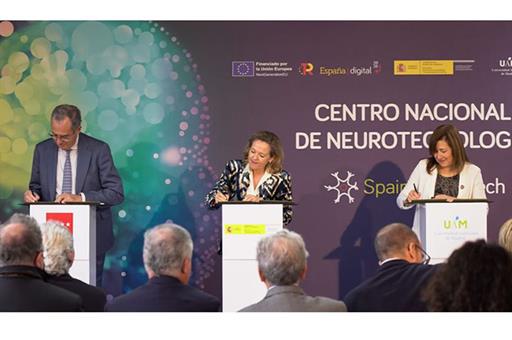
The First Vice-President of the Government and Minister for the Economy and Digital Transformation, Nadia Calviño, at the signing ceremony