44th World Heritage Committee
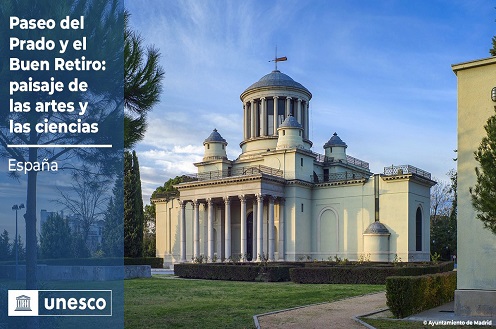
UNESCO declares El Paseo del Prado and El Buen Retiro in Madrid a World Heritage Site
News - 2021.7.25





The registration of the candidacy 'El Paseo del Prado y el Buen Retiro, Paisaje de las Artes y las Ciencias' is the result of close collaboration between the Ministry of Culture and Sport (Directorate General of Fine Arts), the Ministry of Foreign Affairs, European Union and Cooperation, the Community of Madrid and Madrid City Council.
The candidacy, promoted by Madrid City Council, constitutes the green heart of the Spanish capital. Its uniqueness lies in its essence as a space of urban nature that dates back to the mid-16th century when it emerged as a tree grove within the city walls, constituting the first promenade within the city limits of a European city or capital: a space in which all citizens, regardless of class or status, could enjoy leisure activities and take a stroll.
The walled grove model quickly spread throughout the Iberian Peninsula and the American continent. In the 17th century, the establishment of the Buen Retiro palace as the second largest public space within the city led to the use of the spaces located to the east of this large grove, creating an expansive green area within the city limits.
In the 18th century, the Enlightenment would give a new impetus to the entire area, undertaking a qualitative transformation by implementing a vast programme of scientific infrastructures in the Buen Retiro promenade and gardens. To this effect, an extraordinary urban landscape within the reach of all of society is created, integrating culture and nature, geography and history, the individual and the community, the arts and science.
In the current context of pandemic, the inscription of 'Paseo del Prado y Buen Retiro, Paisaje de las Artes y de la Ciencias' on the World Heritage List is particularly symbolic, as the space has fully fulfilled the function for which it was originally created, renewing its commitment to the citizens of Madrid and, from today, the world. In addition, Madrid has become the first declared historic urban landscape in Europe, and the second in the world after Rio de Janeiro.
During today's session, 25 July, the member countries of the committee supported and defended the inscription of the property on the World Heritage List, highlighting the relevance of combining nature, culture and science in an urban environment, which made Madrid the first sustainable capital of Europe as long ago as the 16th century.
The World Heritage Committee is composed of 21 countries elected by the 194 State Parties of the UNESCO Convention for the Protection of the World Cultural and Natural Heritage (1972) and is the executive body of this international convention. As such, it is responsible for deciding which new sites qualify for inscription on the World Heritage List, upon nomination by State Parties.
With this inscription, Spain now has 49 declared World Heritage sites, making it the country with the third highest number of properties inscribed by UNESCO.
Non official translation
Unesco