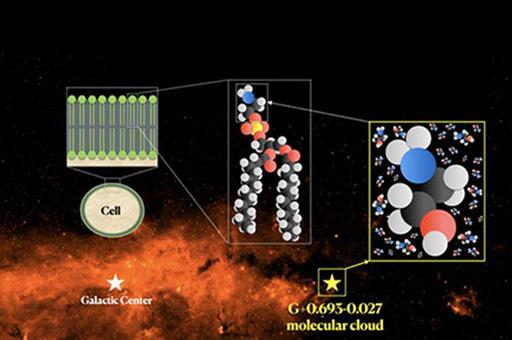
Ministry for Transport, Mobility and Urban Agenda participates in the discovery in space of ethanolamine - a key molecule in the origin of life
News - 2021.5.25



The emergence of cell membranes represents a fundamental milestone in the origin and early evolution of life on Earth, as they are responsible for maintaining stable conditions inside cells, protecting both genetic material and metabolic machinery.
This first detection in space of ethanolamine (NH2CH2CH2OH), a molecule containing four of the six building blocks for life, will help to understand how the first cell membranes could have formed. The high sensitivity of the Spanish 40m radio telescopes at the Yebes Observatory (Guadalajara), equipped with the Nanocosmo receiver, and the 30m radio telescope at the Institute for Millimetre Radio Astronomy (IRAM) on Pico Veleta (Granada) have been crucial in the discovery.
This finding of enormous importance for astrobiology has been made by an international and multidisciplinary scientific team of astrophysicists, including astronomers from the National Geographic Institute, astrochemists and biochemists. It has been led by the researcher of the Centre for Astrobiology (CAB, CSIC-INTA), Víctor. M. Rivilla and has been published in the journal 'Proceedings of the National Academy of Sciences' (PNAS).
The discovery of this important prebiotic molecule has taken place specifically in the molecular cloud G+0.693-0.027, located near the galactic centre, using the 30-metre diameter Pico Veleta radio telescope of the Institute of Millimetric Radio Astronomy, of which the IGN is a partner, and the 40-metre telescope of the Yebes Observatory (Guadalajara), the latter equipped with the Nanocosmos project receivers entirely developed by staff of the Observatory.
This finding opens the door to the future detection of increasingly complex molecules in space that could have given rise to the three basic molecular building blocks of life: lipids, nucleic acids RNA and DNA, and proteins.
Non official translation