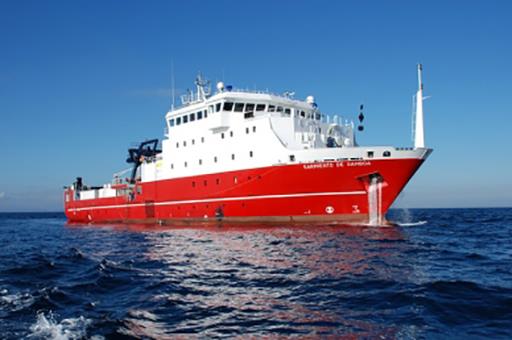
Sarmiento de Gamboa oceanographic research vessel leaves Vigo to begin 34th Spanish Antarctic Campaign
News - 2020.12.16





Upon reaching its destination, the Sarmiento de Gamboa is due to sail the waters of Antarctica for 20 days. Meanwhile, due to depart from Cartagena (Murcia) on 30 December, the oceanographic research vessel Hespérides will be in the same area for 70 days. The Spanish Antarctic bases will be open for approximately 80 days to support a campaign that will involve some 160 people, including scientific and technical personnel, ship's crews and support staff at the bases and on-board the vessels.
The Spanish Polar Commission coordinated preparations for the campaign, especially the adaptation of protocols and procedures to deal with the COVID-19 pandemic. The goal is to develop this scientific programme in Antarctica safely and in such a way that none of the people taking part come into contact with the disease, thereby ensuring that the continent remains free of the virus. The Secretary-General for Research and Chairman of the Spanish Polar Commission, Rafael Rodrigo, oversaw the organisation and supported the Spanish scientific community in performing its duties and upholding its commitment to protecting the continent. Institutional coordination was more essential this year than ever for the safe rollout of this campaign.
For this campaign, Spain has been forced to restrict participation by overseas projects at its installations due to the difficulties brought about by circumstances surrounding the pandemic. After receiving a PCR 72 test a few hours before they begin the journey, the Spanish participants will fly to Santiago de Chile and then travel on to Punta Arenas via a health-secure corridor, where a transport company will take them to their hotel for a full quarantine period of 14 days. Both the transport company and the hotel have COVID-19 protocols in place approved by the Chilean Health Ministry. They will receive a further three PCR tests during this quarantine period and only those who obtain negative results will be taken to the Port of Punta Arenas to board the oceanographic research vessels.
The 34th Spanish Antarctic Campaign will consist of 13 research projects, of which nine are financed by the Spanish State Research Agency (Spanish acronym: AEI) and four are the continuation of long-standing projects. Furthermore, as is the case each year, support will be provided by the Spanish State Meteorological Agency for predicting, observing and reporting on meteorology and the climate during the Antarctic campaign.
The Spanish Antarctic Campaign is a model of cooperation between various public and private institutions in the field of R&D+i within the framework of the State Plan for Scientific and Technical Research and Innovation. The Ministry of Science and Innovation finances the operation and maintenance of the Hespérides and Sarmiento de Gamboa, as well as the costs associated with the general logistics of the campaign, while also participating in the cost of the Spanish Antarctic bases Gabriel de Castilla and Juan Carlos I. In turn, the Spanish State Research Agency finances most of the research projects.
The activities undertaken by the various bodies during these campaigns are coordinated via the Spanish Polar Commission. The entities participating in these activities are: the Marine Technology Unit of the Higher Council of Scientific Research (Spanish acronym: CSIC), which manages the Sarmiento de Gamboa and the Juan Carlos I Spanish Antarctic Base on Livingston Island, and also coordinates the general logistics of the Antarctic campaign; the Spanish Army, which manages the Gabriel de Castilla Spanish Antarctic Base on Deception Island; and the Spanish Navy, which operates the oceanographic research vessel Hespérides. The two vessels and two Antarctic bases form part of Spain's map of Unique Science and Technology Infrastructures, a series of one-of-a-kind facilities, resources or services. The investment, maintenance and operating cost of these infrastructures is very high, but their importance and strategic nature fully justifies its availability for the entire R&D+i community.
Non official translation