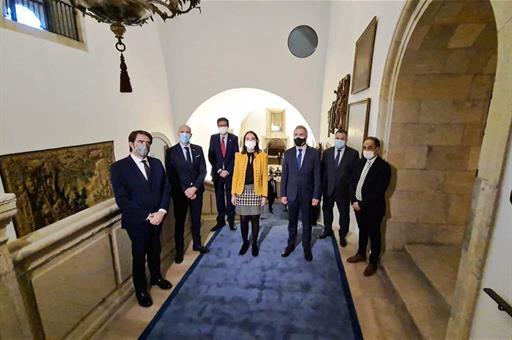




For Reyes Maroto, the reopening of San Marcos Hostal is great news; she expressed her satisfaction at meeting her commitment to open the Parador [luxury State-run hotel] in 2020, despite the difficulties stemming from the pandemic.
"Coming from Castile-Leon, I am emotional and looking forward to once again enjoying the marvels of this new Parador, which apart from being a hotel and a restaurant, is now home to a new museum for Leon. Thanks to an investment of 15 million euros, Leon has recovered one of the most emblematic establishments in the Parador chain, which for Castile Leon and Spain as a whole has great value from a tourism point of view, especially when taking into account Xacobeo 2021, which will turn Leon and its Parador into a meeting point for thousands of pilgrims which every year embark on St James' Way".
The minister also recalled that the Parador organisation has worked hard to become the safest tourist destination with the prime objective of guaranteeing the health of its staff and clients. "Together with safety, the social commitment of the Paradores organisation stands out, having continued to employ all its staff while the works lasted, thereby keeping our word".
For the President of the Paradores organisation, Óscar López, "the refurbishment was essential. The Parador is a marvel and it will now be much more so". Óscar López is convinced that "this refurbishment will make all the inhabitants of Leon, and indeed all the Spanish people, proud of San Marcos Hostal".
Leon Parador will exhibit more than 500 works of art. These are the most representative and important works, which, furthermore, are showcased in common areas to be enjoyed by clients and visitors alike.
The collection of pieces on display at San Marcos Hostal has been complemented by more than 60 other works which were previously housed in other Paradors. According to María Gimeno, curator of the company's artistic collections, "We were missing certain important names from the world of art that were housed in other establishments which now add to the narrative of the display in a way that makes much more sense. This means that visitors passing through this exhibition will enjoy it in a more active manner and better understand what they are seeing".
Other establishments in the chain have provided Leon with works by Pancho Cossío, Juan Barjola, Gloria Merino, Juana Francés, Rafael Canogar and Julio López Hernández, including, among others, two 15th Century choir books.
The Paradores organisation appointed a committee of experts of renowned prestige to choose the items to be displayed in the renovated San Marcos Hostal. Their brief was to create a coherent narrative in the exhibition and "give a museum-like feeling" to the works to create a collection that brings out the maximum enjoyment for those viewing it. "Having gathered together experts of this standing from the world of art, we are able to offer a proposal that is very similar to what can be found in a museum," highlighted María Gimeno. According to Luis Grau, Director of Leon Museum, "it is always complicated" to achieve a work of such magnitude, but here it has been possible to "combine" two very different collections in a building that "has its own limitations". I believe that this has been achieved with a certain touch of brilliance as today we can witness almost all the heritage that San Marcos had prior to commencing these works".
Passing through the rooms of Leon Parador allows us to once again travel back through Spain's history. Seven centuries of life make this a unique hotel in the world. Behind its walls, important episodes in the history of Spain have been forged: chapters from the Order of St James, illustrious imprisonments such as that of Quevedo and tragic episodes such as its use as a concentration camp during the Spanish Civil War.
A project designed by the architect Mina Bringas
Leon Parador was closed to the public three years ago, back in December 2017, to undergo extensive refurbishments to its installations, with the aim of making them suitable to meet new tourist demands. The renovation was very delicate due to the typology of the building. Various complications were encountered from the very start, obliging the architectural design to be adapted to the structural reality. The project chosen by public tender was that of the architect Mina Bringas, while the constructor chosen was FCC.
The central idea of the refurbishment project of San Marcos Hostal - explained Mina Bringas - is "to recover the original volumetry of the building, a building of perimeter corridors around a courtyard. This space has been recovered to form the heart of the building. We have referred to it as an atrium in reference to the Roman domus which was the centre of the building from which all its other uses extended out".
To do so, a closed interior atrium was built, but which receives natural light. Now, this newly recovered space houses the Parador cafeteria, above which, hanging from a great height, it is possible to contemplate the spectacular newly-restored ceiling by Lucio Muñoz in all its splendour, which has been restored. "The Parador previously had this impressive work by Lucio Muñoz in another room, but it has been moved to assume its crowning glory over this building", stated the architect.
Mina Bringas confirmed that the works have been carried out with the utmost respect for this historic building. It was been done "with care, always avoiding actions that affect the original parameters, reversible in every case and respectful of everything: with both the material itself and with the original volumetry of the original spaces". He describes the interior of the building as "a sober interior, with few materials, which does not compete with the exterior". The architect added "principally natural stone and natural wood have been used, and then a dark colour that I feel has a monastic air for a building of this type with cloisters, which has had many uses, having been both a convent and a hospital".
The Spanish place their trust in the Paradores organisation
This public enterprise has always been a benchmark in terms of quality and reliability, and now more than ever, it has maximised cleaning and disinfecting measures in all its establishments. As Óscar López, president of the hotel chain said, "we are a destination of trust. We have stepped up our hygiene and cleaning protocols so that our clients can rely on the utmost guarantees of safety with a personalised and quality treatment that characterises the Paradores organisation".
In a summer campaign marked by a fall in inbound tourists, the Spanish have shown their trust in the Paradores organisation, allowing us to reach occupancy levels of 72% in July, 82% in August and 67% in September. The fact that most of our establishments are somewhat remote, away from mass tourism, as well the size of the hotels, which are nearly all small- or medium-sized, allows us to implement rigorous safety and hygiene controls to make them the safest places for tourism, where it is possible to have a few restful days or to hold family or business meetings.
Non official translation