In the Main Hall of the University of Alcala
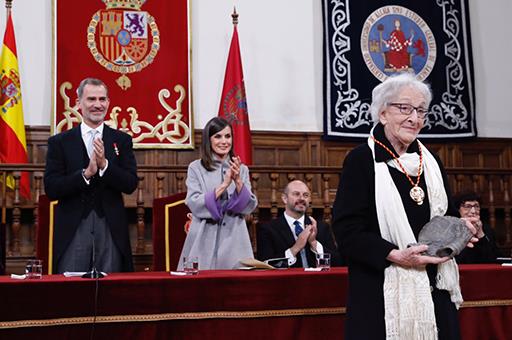
Their Majesties the King and Queen of Spain present 2018 Cervantes Prize to Ida Vitale
News - 2019.4.23





Paraninfo de la Universidad de Alcalá, Madrid
The Ministry of Culture and Sport bestows the Miguel de Cervantes Award to those writers who contribute through works of outstanding quality to enriching the Hispanic literary legacy. It was first awarded in 1976 to Jorge Guillén and since than 42 authors have won the prize. In 1979, the prize was awarded, ex aequo, to Jorge Luis Borges and Gerardo Diego. Since then, the rules of the prize do not allow it to be shared, declared void or awarded posthumously.
By presenting this prize, which comes with 125,000 euros, public recognition and admiration is paid each year to a writer who, through their work as a whole, has contributed to enriching the Hispanic literary legacy.
The Cervantes Prize can be presented to any author whose literary work is written totally or principally in Castilian Spanish. Nominees for the prize may be presented by the Spanish Language Academies, previous prize laureates, institutions that, by nature, purpose or content, are associated with literature in the Spanish language and members of the panel.
Biography
Born in Montevideo (Uruguay) in 1923. Ida Vitale is one of the great Latin American poets and the last survivor of the exceptional Generation '45, which included such outstanding intellects as Emir Rodríguez Monegal, Ángel Rama (her first husband), Mario Benedetti, Carlos Maggi, Manuel Claps and María Inés Silva, among others.
A poet, essayist, literary critic and translator, she has received numerous awards that include the International Octavio Paz Award for Poetry and Essays (shared with Ramón Xirau) in 2009; the Carlos Monsivais Award for Cultural Merit from Mexico City and the International Alfonso Reyes Award, both in 2014; the Reina Sofía Award for Ibero-American Poetry in 2015; the Federico García Lorca Award in 2016; the Max Jacobs Award (Paris) in 2017; and the Guadalajara Book Fair Award in 2018.
Author of such works as La luz de esta memoria and Procura de lo imposible, the work by Ida Vitale shows a precise, malleable language full of irony and subtlety that is intelligent and reflects a strong influence by Juan Ramón Jiménez, who the writer herself considers her poetry teacher.
Over the course of her lifetime, Ida Vitale has collaborated with numerous periodicals, such as the El País newspaper, the Marcha weekly, the Clinamen magazine (of which she was co-editor), the Jaque weekly (of which she was later cultural editor), the Plural and Vuelta magazines, and the El Sol y Diorama en la Cultura newspaper (cultural supplement in the Excelsior).
She has lived in various countries during her lifetime. Expelled by the dictatorship, she emigrated to Mexico (where she engaged in strong literary activity and was a literature teacher at the prestigious El Colegio de México). She also lived in Paris (France) for a time under a scholarship and, although she regularly returns to Uruguay and Mexico, she has lived in the United States since 1990.
The panel
The panel that awarded the 2018 Cervantes Prize to Ida Vitale consisted of: Carme Riera, representative of the Spanish Royal Academy; Rafael Ángel Rivas, on behalf of the Venezuelan Academy of Language; Aurora Egido, on behalf of the Conference of Vice-Chancellors of Spanish Universities (Spanish acronym: CRUE); Francisco Pérez-Arce, on behalf of the Union of Latin American Universities (Spanish acronym: UDUAL); Martín López-Vega, on behalf of the Cervantes Institute; José Manuel Blecua, member appointed by the Minister for Culture and Sport; Concha Barrigós, on behalf of the Spanish Federation of Journalists' Associations (Spanish acronym: FAPE); Norma Valle, on behalf of the Latin American Federation of Journalists (Spanish acronym: FELAP); and Christoph Strosetzki on behalf of the International Association of Hispanists. The last two authors to receive the award, Eduardo Mendoza (2016) and Sergio Ramírez (2017), also sat on the panel.
Non official translation
Casa de Su Majestad el Rey