43rd meeting of the World Heritage Committee in Baku (Azerbaijan)
Risco Caído added to UNESCO List of World Heritage Sites
News - 2019.7.7






As soon as he heard the news, the Acting Spanish Minister for Culture and Sport, José Guirao, congratulated the people of the Canary Islands "on having successfully conserved this enormous wealth of archaeological sites within such an overwhelmingly stunning landscape for centuries".
The minister further extended his congratulations to all Spaniards "because our country is a world leader in terms of World Heritage Sites. This is now our 48th. We are third in the world, after China and Italy, in terms of how many such sites we have but we are the world leader in terms of world heritage diversity".
José Guirao took the opportunity to say that the Government of Spain is going to "keep working to conserve, communicate and maintain this heritage wealth for future generations" and invited the whole world to "visit Risco Caído and all the sites recognised in Spain over the last few decades".
Satisfaction with this new addition to the list was also conveyed by the Spanish delegation in Baku to officially present the bid, which was made up by the Permanent Delegate Ambassador to UNESCO, Juan Andrés Perelló; the Director-General for Fine Arts, Román Fernández-Baca; the Deputy Director-General for Historic Heritage Protection, Elisa de Cabo; the Director-General for Cultural Heritage of the Regional Government of the Canary Islands, Miguel Ángel Clavijo; and the President of the Island Council of Gran Canaria, Antonio Morales.
The exceptional universal value of the ancient peoples of the Canary Islands
The archaeological sites contained within the Risco Caído cultural landscape reflect the culture of the ancient peoples of the island, a unique process of evolution undergone by the Amazigh people from North Africa who lived in isolation until they were conquered by the Crown of Castile in the 15th Century. The volcanic crater of Caldera de Tejeda watches over this area, which exists within the municipalities of Artenara, Tejeda, Agaete and Galdar.
UNESCO recognises the exceptional universal value of the bid and underlines the survival of traditional activities from those primitive communities, such as transhumance, crop cultivation on terraces and water management, as well as their close relationship with the steep orography and particular characteristics of the landscape, to which is given a sacred character that is closely tied to the sky and the observation of astronomical phenomena. This is the first site linked to the Amazigh culture of North Africa to be added to the List of World Heritage Sites.
Defined by UNESCO as the joint result of humanity and nature, the Sacred Mountains of Gran Canaria are made up by 1,500 caves, some 1,000 triangular pubic rock carvings (the largest concentration in the world) and vestiges that reflect a relict yet also living landscape full of temples, sanctuaries, fortified granaries, necropolises, vertical troglodyte settlements and cave dwellings, some of which have been permanently occupied for centuries right up to the present day.
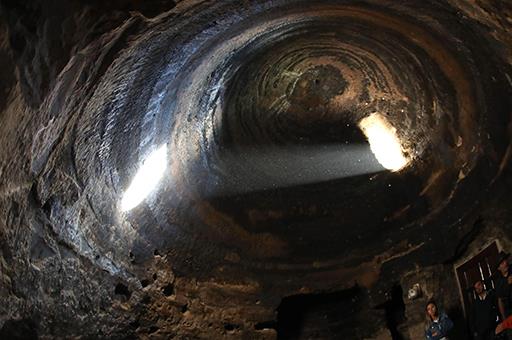
The cave of Risco Caído is the finest example of this landscape, comprising a parabolic dome that shows a striking tale of images for 180 days of the year thanks to the intervention of the sun, the moon and a series of 37 pubic triangles, orifices and niches.
Close on 1,100 assets make up the World Heritage List
The list includes 1,092 sites of "exceptional universal value" in 167 countries. This year, a total of 37 bids were presented for their potential inscription on the World Heritage List. Of these, six are natural assets, 30 are cultural assets and two are mixed assets (sharing both natural and cultural values). Besides Risco Caído, the assets now added to the list include Babylon (Iraq), the French Austral Lands and Seas, Vatnajökull National Park (Iceland), the ancient ferrous metallurgy sites of Burkina Faso (Burkina Faso), Bagan (Myanmar), the petroglyphs and pictograms of the Siksikáíítsitapi people (Canada) and the Water Management System of Augsburg (Germany).
Upcoming Spanish bids
In 2020, Spain expects to submit the 'Paseo del Prado and El Retiro. Landscape of Arts and Science' in Madrid to the committee. In 2021, it is expected that the cultural landscape of the Ribeira Sacra (Ourense and Lugo) will be submitted to the World Heritage Committee following a decision reached at the Spanish Historic Heritage Council in April.
A website for communicating heritage: somospatrimonio.es
In order to communicate all the assets declared as World Heritage Sites, especially among young people, the Spanish Ministry of Culture and Sport has created the SomosPatrimonio [We Are Heritage] website (www.somospatrimonio.es).
SomosPatrimonio.es highlights the variety and wealth of Spanish cultural heritage, which includes monuments, landscapes and cities, as well as artistic manifestations from Pre-history to the 20th Century.
Risco Caído and the sacred mountains of Gran Canaria will be added to the website within the coming days.
Non official translation
EFE