The Government increases the level of legal protection for 27 species of flora and fauna that are under threat in Spain
News - 2019.6.5





The Government has thus increased the level of legal protection for these species under the Natural Heritage and Biodiversity Act, which covers species of flora and fauna that due to their ecological value, special nature, scarcity or level of threat, or because they are included under international treaties or EU law, must be subject to special attention and require active conservation measures.
It is important to note that the inclusion of a species on this list and catalogue obliges the public authorities to monitor its state of conservation and the threats affecting them. The species included in the catalogue must also be the object of specific conservation or recovery action plans.
The 27 include both land marine species. The list of marine species consists of Mediterranean populations of the dark stinging sponge (Sarcotragus foetidus); and various species of coral: Antipathella subpinnata, Antipathes dichotoma, Leiopathes glaberrima, Parantipathes larix, Cladocora caespitosa (cushion coral), Cladocora debilis, Ellisella paraplexauroides, Lophelia pertusa; the soft corals Callogorgia verticillata (octocoral) and Ellisella paraplexauroides; and the stony coral Madrepora oculata (zigzag coral). These invertebrates are of great ecological value, as over the years their extensive colonies form complex habitats that are very important as the refuge for many other marine species.
Also included in the list is the olive ridley sea turtle (Lepidochelys olivacea), a species found in the Canary Islands and also seen in the Mediterranean; Cory's shearwater (Calonectris borealis), now also in the Mediterranean area; and the Mediterranean population of the lesser crested tern (Sterna bengalensis).
Continuing with the marine species, the inventory of those "in danger of extinction" includes the fan mussel (Pinna nobilis); and in the category of "vulnerable", the Canary populations of three species of marine algae: Cystoseira abies-marina, Gelidium arbusculum and Gelidium canariense, the latter endemic to the Canary Islands.
Three species of shark
Three species of shark are also included: the angelshark (Squatina squatina), sawback angelshark (Squatina aculeata) and the smoothback angelshark (Squatina oculata), all of them "in danger of extinction"). Angelsharks are flat sharks active at night. They reproduce is bays and shallow waters off our coasts and bury into the sand. They have practically disappeared from the Iberian waters and constitute the second most threatened group of sharks in the world. The serious threats to them from climate change, the destruction of their habitat, pollution and illegal trawling justify their special protection status.
Finally, included in the catalogue in the "vulnerable" category is Cuvier's beaked whale (Ziphius cavirostris), a species of beaked whale that is adapted to life in great depths. It has suffered a major reduction in its population in recent years, so its protection has to be increased.
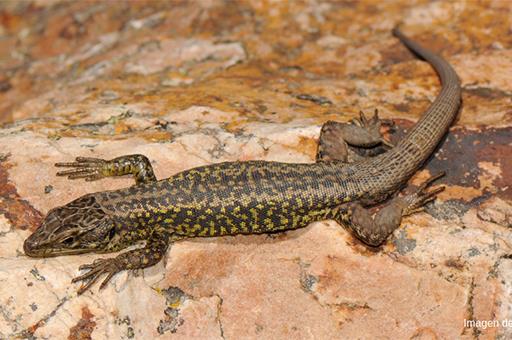
The land species included as "in danger of extinction" are the Spanish greenish black tip (Euchloe bazae), a rare butterfly that is solely found in two small and isolated populations (Los Monegros, Aragon and Hoya de Baza, Andalusia); and Martinez-Rica's rock lizard (Iberolacerta martinezricai), one of the rarest reptiles on continental Europe, of which fewer than 1,500 are estimated to survive, and only in Las Batuecas and Peña de Francia (Salamanca-Caceres). Also included in the catalogue, but in the category of "vulnerable" is the Leonese rock lizard (Iberolacerta galani).
Mammals included in the category of "vulnerable" are Cabrera's vole (Microtus cabrerae), a rodent that is only found on the Iberian peninsula. It lives in low meadows and rushes, a type of habitat that is being destroyed by intensive agriculture and the construction of infrastructures.
Special protection for the wolf, south of the Duero
Finally, to comply with the provisions of the EU Habitats Directive, the list includes all the populations of Iberian wolf in Spain south of the Duero.
In the Habitats Directive the Spanish wolf populations are included in two annexes, with different systems of protection, due to their different conservation status: those north of the Duero in Annex V (species that may be subject to management measures); and those south of the Duero (Extremadura, Andalusia, Madrid, Castile-Leon and Castile-La Mancha) in Annex IV (which are strictly protected).
Until now only the populations of wolves south of the Duero in Extremadura, Andalusia and Castile-La Mancha were included in the list. With the approval of the ministerial order the whole distribution of the species south of the Duero now enjoys special protection.
According to the latest census of wolves in Spain, carried out in 2014 by the Ministry for Ecological Transition and the autonomous regions, there were around 300 packs of wolves (between 2,000 and 2,500 individuals), distributed basically north of the Duro; south of the river there were around 30 packs.
The Ministry for Ecological Transition, together with the Ministry for Agriculture, Fisheries and Food and the autonomous regions, are working actively to promote the coexistence of human activities and the conservation of wolves and other carnivores. The national initiatives implemented include the creation of a catalogue of preventive measures by the Ministry for Ecological Transition, designed to reduce conflict between wolves and extensive livestock farming.
Livestock farmers can take out an agricultural insurance policy made available by the Ministry of Agriculture, Fisheries and Food to cover claims for damage caused by animals.
Non official translation
Ministerio para la Transición Ecológica