The decision was taken on Friday by the Historic Heritage Council
Ribeira Sacra, new Spanish candidate for UNESCO's World Heritage Site
News - 2019.4.5





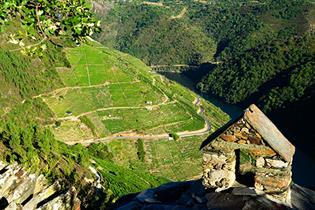
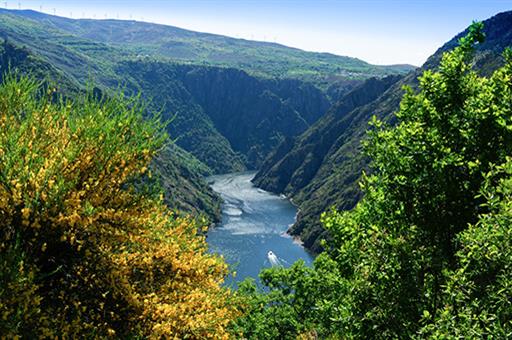
The cultural landscape of the Ribeira Sacra (Ourense) is the latest candidature chosen by the Historic Heritage Council to be added to the list of UNESCO World Heritage Sites. The decision was taken on Friday at the Santo Estevo Parador [luxury State-owned hotel] in Ourense, at the meeting of the Historic Heritage Council - chaired by the Director-General for Fine Arts, Román Fernández-Baca - with representatives of all regional governments. The Spanish candidature will be presented to the international body in February 2020, with the assessment on it inclusion to be made in 2021.
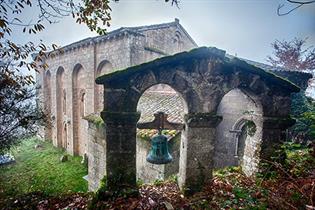
The Ribeira Sacra is the most westerly symbolic landscape of continental Europe. It lies in the Sil and del Miño valleys, and is home to a collection of hermitages, monasteries, churches, chapels and crossing points which, due to their variety and profusion, form a cultural space unique in the world, providing an example of primitive lifestyle that existed towards the end of the fourth century.
Glass blowing and the Spanish knot, proposed for Intangible Cultural Heritage
The Historic Heritage Council also agreed to apply for 'glass blowing' and the 'Spanish knot' to be declared as Representative Manifestations of Intangible Cultural Heritage in Spain. Two historic producers of blown glass representing this technique are the Centro Nacional del Vidrio de la Granja [La Granja National Glass Centre] in Segovia and Los Vidrios Gordiola in Majorca, although individual examples exist throughout the country in small artisan workshops, often associated with museums, which are trying to revive and showcase these production methods that were so characteristic of centres that no longer exist.
 Ministerio de Cultura y DeporteThe report highlights the fact that these glass blowing centres have been producing continuously over the last three centuries. It also emphasised the variety of their products, which still include traditional designs alongside new designs of all shapes and sizes.
The Spanish knot is a traditional textile method emblematic of our country, which has been used on the Iberian Peninsula since the 16th Century. Its origins can be traced back to the Spanish knotted-pile carpets although today there are very few craftsmen and women that command this technique. The Royal Tapestry Factory in Madrid is the only place that can provide training in this technique.
In conjunction with Mexico, the Historic Heritage Council has also announced the presentation of the international candidature for the 'Traditional skills for producing "Talavera" pottery in Puebla (Mexico) and in Talavera de la Reina and El Puente del Arzobispo (Spain)', which will be considered in December at the next meeting of the UNESCO Committee for Intangible Cultural Heritage to be held in Bogotá (Colombia).
In relation to underwater heritage, in June UNESCO will decide if the 'Nuestra Señora de la Mercedes project is a good practice in terms of underwater cultural heritage. This is a scientific response in very deep water as opposed to the plundering of Underwater Heritage', and takes into account the archaeological investigation campaigns carried out by the Ministry of Culture and Sport since 2015.
Finally the Council was familiarised with the details of the International Congress entitled 'The Spanish Armada of 1588 and the English "Counter Armada" of 1589', which will be held between 23 and 26 April at the site of ARQUA, the National Museum of Underwater Archaeology in Cartagena, Spain.
A website to showcase heritage: somospatrimonio.es
 Ministerio de Cultura y DeporteOn Friday, the Ministry of Culture and Sport launched the website Somos Patrimonio [We are Heritage] to raise awareness of the 47 Spanish sites included on the UNESCO World Heritage List.
Aimed principally at young people, and based on the map of Spain on the home page of this new digital platform, the user will discover the location of these sites declared to be Heritage of Humanity, spread over all 17 autonomous regions. Each icon will lead the visitor to a cultural asset where they can find out more information, from the date of registration on the list to the principal values that led to its declaration.
SomosPatrimonio.es highlights the variety and wealth of Spanish cultural heritage, which includes monuments, landscapes and cities, explaining artistic manifestations from prehistoric times up to the 20th Century. Spain is ranked third in the world in terms of number of assets included on the UNESCO List, behind only Italy and China.
Agreement with RTVE to broadcast the voting for the Eurovision song contest from a World Heritage Site.
During the meeting of the Historic Heritage Council, it was announced that RTVE [State owned public radio and television corporation] and the Ministry of Culture and Sport will shortly sign an agreement to the effect that each year the results of the votes cast in Spain in the song contest will be broadcast from one of the 47 World Heritage Sites in Spain.
For this year's final on Saturday, 18 May, the site chosen will be La Alhambra in Granada. With this cultural agreement aimed at promoting Spain, the two institutions seek to raise awareness as to outstanding sites that form part of our heritage before an audience in excess of 200 million. The agreement will be for a four-year term, and may be renewed.
Non official translation
Ministerio de Cultura y Deporte