Commencement of passage through Parliament
2016 General State Budget to consolidate growth of the economy and job creation, and preserve Welfare State
News - 2015.8.4





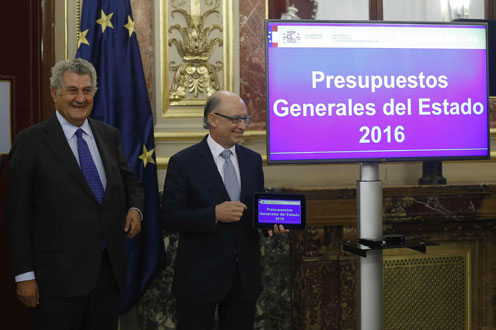
On Tuesday, the Minister for the Treasury and Public Administration Services, Cristóbal Montoro, handed over the Draft General State Budget for 2016 to Jesús Posada, Speaker of the Lower House of Parliament; these accounts contain a marked social component ratifying the suitability of the economic policy implemented over recent years by the government to help exit the crisis, reactivate the economy and create jobs. The 2016 Budget comes within the framework of the fiscal strategy to reduce the deficit whilst fostering economic activity and job creation and contains measures on revenue and spending necessary to maintain and drive the rate of economic growth as well as maintaining the stability targets approved by Parliament. Furthermore, this Budget has been brought forward two months to continue offering the credibility and confidence that have returned to the Spanish economy.
This economic policy, based on fiscal consolidation and structural reforms, has proved effective in reversing the process of jobs being shed as a result of the economic recession. All the economic indicators and the labour market not only currently support economic recovery, but also point to faster growth and its sustainability in the medium and long term, which are now founded on sounder and more stable bases. Growth has been driven by national demand with the recovery of private consumption and investment posted for the first time since 2007, and with that, job creation, which with the reforms undertaken, requires a lower growth threshold. Consequently, the economic context in which the 2016 General State Budget is framed is radically different to the context in which the first Budget of this term of office was presented back in 2012.
The reason this 2016 Budget has been brought forward in terms of its drafting and approval compared with its habitual timescale is simply to offer certainty, security and foreseeability, both within Spain and further afield, to the various economic agents. The current pace of growth of the Spanish economy requires a familiar and stable economic programme and should not be put at risk simply because this year's schedule for approval of the budget coincides with the elections.
As such the 2016 Budget continues along the lines undertaken in previous years, closes off a change in economic cycle and opens up a new cycle of consolidated growth and job creation. Furthermore, in this improved context, it continues to take steps towards repaying the sacrifice made by our citizens in the worst years of the economic crisis, both in terms of revenue, by bringing forward the tax reform, and in terms of expenditure, in this case through particular emphasis on public workers.
Similarly, the 2016 Budget has a clear social component, whereby the priority is to continue maintaining the Welfare State, while increasing the disposable income of families through bringing forward the Personal Income Tax element of the tax reform in a way that is compatible with meeting the stability targets agreed with our European partners.
Its drafting is framed and is in line with the fiscal consolidation targets contained in the 2015-2018 Stability Programme submitted by Spain to the European Commission in April, which includes the forecast trends of the public authorities as a whole.
It also provides continuity to the investments under the CRECE Plan (Measures to Drive Growth, Competitiveness and Efficiency), which seeks to align the aims of EU funding with the needs of national investments, supporting economic growth in the most effective manner possible.
State Budget
In terms of the State Budget, 42% of total spending is allocated to financing delegated areas exercised by the rest of the regional and local authorities, and the social security system. Hence, of the 157.19 billion euros in non-financial State expenditure, 34.72 billion will be allocated to the regional and local authorities, 17.68 billion to fund non-contributory pensions, minimum complements and unemployment benefits, and 13.76 billion as the Spanish contribution to the EU Budget. The State also assumes the lion's share of the burden of servicing debt.
In terms of available non-financial expenditure of the ministerial departments, this will rise by 2.56% to 40.48 billion euros, after excluding contributions to the social security system, transfers to the Public Employment Service and FOGASA (Wage Guarantee Fund), servicing debt and a series of non-ministerial expenses of an unavoidable nature (constitutional bodies, state pensions, and financial relations with the EU).
Regional financing
The Budget allocates 7.81% more in financial resources to the essential public services of healthcare, education and social services provided by regional governments and local authorities. Specifically, the resources made available to regional governments are increased by 7.46 billion euros, 8.75% higher than in the previous Budget. This increase is in addition to the saving in servicing debt by the regional governments as a result of the advantageous conditions set for 2016 in the financing mechanisms. This establishes an additional sum of resources available of 2.91 billion euros. As regards the local authorities, these will see their financing increase by 542 million euros, or 3.14% higher than in the previous Budget.
Revenue
Total non-financial revenue for 2016, after allocations to regional and local authorities, will amount to 134.77 billion euros, which represents an increase of 0.8% on the 2015 Budget.
A major part of the Budget is allocated to financing areas exercised by the rest of the regional and local authorities and the social security system, amounting to 42% of the State Budget. Hence, of the 157.19 billion euros in non-financial State expenditure, 34.72 billion will be allocated to the regional and local authorities, and 17.68 billion to fund non-contributory pensions, minimum complements and unemployment benefits, and 13.76 billion as the Spanish contribution to the EU Budget. The State also assumes the largest part of the burden of servicing debt, infrastructure policy, R&D and grants.
In terms of the overall spending of the ministerial departments, this will rise by 2.6% to 40.48 billion euros, after excluding contributions to the social security system, transfers to the Public Employment Service and FOGASA.
3.8% rise in social spending
The positive impact of growth and the effect of increased tax revenues have led to the expenditure budget having a markedly social effect. The reduction in spending on unemployment and the financial burden of the public debt will allow social spending to be increased by 3.8%, excluding the unemployment expense.
Budgeted spending on the pension system amounts to 135.45 billion euros, including a 0.25% rise. This policy increases by 2.9% on 2015 when adding contributory and non-contributory pensions under the social security system, together with the State pension system.
Funds allocated to covering the unemployment policy amount to 19.82 billion euros, a decrease of 21.7% on 2015. Of this amount, 19.52 billion euros will be allocated to paying out benefits, a decrease of 5.48 billion euros as a result of the positive trend of the labour market. This amount includes the provision aimed at the new economic subsidy under the Employment Activation Programme of 426 euros per month, designed for the long-term unemployed that lack any entitlement to receive any other subsidy or benefit or that have exhausted all this resources, which amounts to 350 million euros.
Active policies to boost employment
Job creation is the government's priority objective, and hence active policies to boost this are increased by almost 10% in 2016, to 5.22 billion euros. It should be recalled that in the last two Budgets, the provision for active employment policies has been increased by 1.14 billion euros, a rise of 28%.
Education and culture
The education policy had a budgetary provision in 2016 of 2.48 billion euros, 9.3% up on 2015, to improve the quality of education and to guarantee equal opportunities for all students. Grant and subsidy programmes for students are particularly noteworthy, representing 59.3% of the total policy, with a provision of 1.47 billion euros. Another 363 million euros will be allocated to implementing the Constitutional Law to Improve the Quality of Education (Spanish acronym: LOMCE).
The policy on culture has a provision of 803 million euros, up 7.3%, to support and guarantee the operation of major cultural institutions and services. Due to the significant amount involved the allocation to the Cinematography Programme is of particular note, having grown by 47% on 2015 to 75 million euros.
Furthermore, 11.35 million euros have also been allocated with the aim of boosting the preparation of Spanish athletes in collaboration with the sports federations in the lead-up to the Olympic Games in Río de Janeiro.
Spending policy on R&D+i
The provisions for Research, Development and Innovation post an increase of 2.2% to 5.79 billion euros. The sums under the non-financial budget for R&D+i for civilian research amount to 2.51 billion euros, a significant increase of 12%. This increase is mainly down to the 200-million euro provision to fund research projects in less developed and transitional areas.
Healthcare and social services
An allocation of 2.02 billion euros is made to finance the actions of the Department of Health, Social Services and Equality, an increase of 5.3%. The majority of this increase is contained in the funds transferred to the Institute for the Elderly and Social Services, (Spanish acronym: IMSERSO), and in the subsidies allocated to support families and infants.
Refugees
The mass arrival of asylum seekers to EU countries, which is requiring coordinated action to be taken throughout the EU, is reflected in the 2016 Budget, with an additional provision of 49 million euros to enable those applications already made to be processed, as well as the government's commitments at a European level to resettle and relocate 2,749 people.
EFE