Balance of fight against illegal immigration in 2014
Migratory pressure to Spain and increasing flow of citizens from Syria leads to 40.6% increase in arrival of illegal immigrants in 2014
News - 2015.5.29





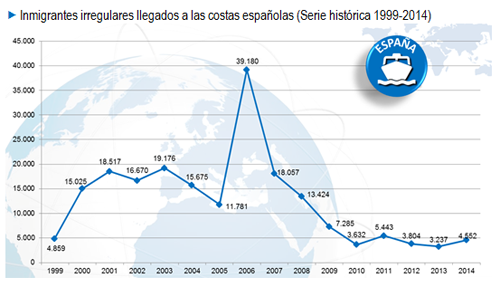
However, generally-speaking, when not taking into account the arrival of Syrian nationals and an upturn in August, 2014 posted similar results to those seen in 2013. A total of 5,443 illegal immigrants arrived in 2011, 3,804 in 2012, 3,237 in 2013 and 4,552 in 2014.
In 2014 specifically, a total of 4,552 illegal immigrants reached the coasts of Spain by boat, compared with the 3,237 who did so in 2013. This is an increase of 40.6%, i.e. 1,315 more than in the same period last year.
Nonetheless, the number of illegal immigrants who arrived in Spain by boat is significantly lower than the number posted for the central Mediterranean region at over 170,000, according to data from the European FRONTEX Agency.
Despite the increase posted in 2014, the model for managing immigration implemented by the Ministry of Home Affairs has been the main factor in maintaining the overall trend in global figures on illegal immigration from Africa.
The results obtained in recent years are based on a joint effort, efficiency and commitment, in which the following merit special mention:
- The daily work undertaken by the Spanish National Police Force and the Spanish Guardia Civil
- The responses adapted by the Ministry of Home Affairs to the new challenges posed by immigration networks
- The collaboration consolidated by Spain with the main countries of origin and transit for illegal immigration
Arrival of illegal immigrants to mainland Spain, the Balearic Islands and the Canary Islands
In 2014, a total of 4,256 illegal immigrants arrived on the coasts of mainland Spain and the Balearic Islands, compared with 3,041 in 2013. This total is 1,215 more than in the same period last year, representing an increase of 40%.
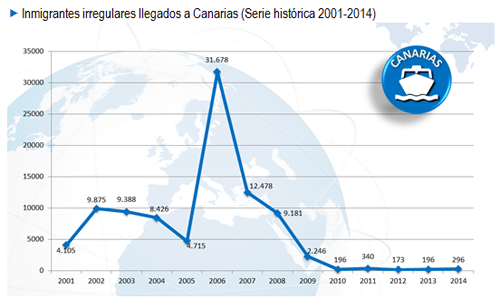
However, and despite the good results in the fight against illegal immigration in the Canary Islands over the last few years, 2014 closed with an increase of 100 more illegal immigrants, representing 51% more than in 2013 when 196 illegal immigrants arrived on the shores of the Canary Islands.
This increase in no way changes the downward trend that has been maintained year after year in the fight against illegal immigration in the Canary Islands as can be patently seen in the series of comparable data on 2001-2014.
 Ministerio del Interior
In this regard, the downward trend is particularly significant in the period 2006-2014. Whereas a total of 7,502 illegal immigrants arrived to mainland Spain and the Balearic Islands in 2006, this figure fell by 43% to 4,256 in 2014. As for the Canary Islands, this figure plummeted from 31,678 illegal immigrants in 2006 to only 296 in 2014, a fall of 99%.
 Ministerio del Interior
Entry of illegal immigrants in Ceuta and Melilla
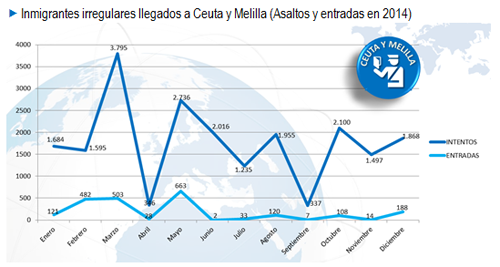
Ceuta and Melilla posted in 2014 a year-on-year increase compared with 2013 in the number of illegal immigrants that tried to gain access to these autonomous cities by swimming to shore, hidden in vehicles or other means of transport or by breaching the border in 2014. A total of 7,485 people arrived in Ceuta and Melilla unlawfully in 2014, rising from 4,235 in 2013, an increase of 77% or 3,250 more people than in 2013. It should be noted that, of the 4,235 illegal immigrants who arrived in Ceuta and Melilla in 2013, 273 came from Syria. This figure rose even further in 2014, when 3,305 of the total 7,485 illegal immigrants came from Syria as potential refugees.
The arrival of over 3,300 people from Syria to Ceuta and Melilla in 2014 was a new phenomenon that increased migratory flows in Ceuta and even more so in Melilla.
Despite this increase, if we compare the 2014 figures with those from 2005 - the year in which 5,566 illegal immigrants arrived in Ceuta and Melilla - this increase falls to 34%, at a total of 1,919 more illegal immigrants.
Close to 19,000 attempts to scale the fence in Melilla were recorded in 2014 (up 350% on 2013). Thanks to the deterrents and efforts by the State law enforcement agencies, 90% of these attempts to reach Ceuta and Melilla failed.
 Ministerio del Interior
Repatriations
The Ministry of Home Affairs carried out a total of 20,993 repatriations of illegal immigrants in 2014, a 12% decrease on the figure of 23,889 for 2013. The illegal arrival of over 3,300 citizens from Syria in 2014 (potential refugees) explains the decrease in the number of repatriations when compared with 2013.
- Entry denied
(People turned away from border posts such as ports and airports)
A decrease of 7.9% was recorded in terms of refused entry to the country. Hence, the total of 8,704 such cases in 2013 rose to 8,109 in 2014. This equates to 595 fewer refused entries.
- Readmission
(People who have crossed the border between Spain and France, or Spain and Portugal, and have been discovered and returned to their country of origin as a result of the agreements between the two countries)
There has been an 11% reduction in the number of readmissions. Hence, the total of 1,199 readmissions in 2013 fell to 1,067 in 2014. This equates to 132 fewer such cases than in 2013.
- Return
(People who tried to enter Spain at points not considered as border crossings)
The number of returns fell by 17.6%. In 2013, there were 5,002 recorded cases, which fell to 4,121 in 2014, a decrease of 881 people.
- Deportation
(People intercepted within Spain and lacking the appropriate documentation)
There were 7,696 expulsions in 2014, 1,288 fewer or down 14.3% on the total number of 8,984 expulsions recorded in 2013.
Qualified deportations
The Ministry of Home Affairs set up the Foreign Criminal Deportation Brigade (Spanish acronym: BEDEX) of the Spanish National Police Force in 2009, tasked with repatriating foreign criminal offenders with extensive criminal records linked to terrorism, organised gangs, gender-based violence or any other form of particularly serious criminal offences that represent a threat to public security. These deportations are subject to a judicial order and include a ban on re-entering Spain or the other Member States of the Schengen area.
Of the total number of deportations carried out in 2014 (7,696), 6,557 were qualified (85%) and 1,139 were non-qualified (15%). Although the figures are lower than those posted in 2013 - a year with 7,582 qualified deportations and 1,402 non-qualified deportations (of a total 8,984 deportations), qualified deportations in 2014 accounted for 85% of the total and increased on 2013 while non-qualified deportations decreased by 15%.
These figures consolidate the policy of the Ministry of Home Affairs to prioritise qualified deportations (persons connected with criminal activity) over those foreigners simply in an unlawful situation in Spain.
Main projects implemented in 2014
Creation of International Protection Offices at border posts in Ceuta and Melilla: At these offices, and always with assistance from legal and interpreting services, those people who could need international protection can formalise their application with the authorities in charge at the border post.
Support for the voluntary return programme of the International Organisation for Migration (IOM) in Morocco: In 2014, the Ministry of Home Affairs contributed a total of 600,000 euros to the international programme led by the IOM to help sub-Saharan immigrants who are in Morocco illegally, wishing to return to their country of origin to re-integrate themselves back into society and the labour market.
Improvements to infrastructures at the border posts of Ceuta and Melilla: Passive security measures at the border posts and increased police resources for protecting the borders in Ceuta and Melilla, thanks to an extraordinary financial aid package of 10 million euros from the European Commission.
Smart borders: Increased deployment of the ABC and API Systems for passenger control at border crossings set up at ports and airports.
Increased capacity of maritime surveillance resources: Fitted with optronic sensors, radar and satellite communication systems, these devices provide access from sea to the maritime surveillance services, Maritime Surveillance Control Centres and authorities involved in controlling the external border.
EUROSUR:
- Interconnection and real-time interoperability of the Spanish Integrated Exterior Surveillance System (Spanish acronym: SIVE) and the Portuguese Integrated Surveillance, Command and Control System (SIVICC).
- Developments for improving the capabilities of the SIVE.
PERSEUS: European system of maritime surveillance that aims to protect European seas and borders through the integration, under a single technological base, of the existing national and European systems.
CLOSEYE: This aims to incorporate new tools such as satellites, aerostats and drones, among other devices, into the current border surveillance systems in order to improve security at the external maritime borders of the European Union.
EFE