Awarded by the Ministry of Education, Culture and Sport, together with 125,000 euros
2014 Cervantes Prize awarded to Juan Goytisolo Gay
News - 2014.11.24






According to the minutes, the panel awarded him the prize "for the investigatory capacity in language and complex stylistic ideas that he develops through various genres of literature; for his desire to merge the two extremes - the heterodoxy of Spanish tradition, on the one hand, and its permanent commitment to inter-cultural dialogue on the other".
The panel
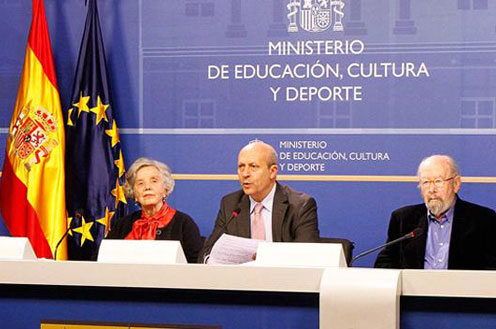
The panel consisted of: José Manuel Caballero Bonald, author and laureate in 2012; Elena Poniatowska, author and laureate in 2013; Soledad Puértolas Villanueva, member appointed by the Spanish Royal Academy; Inmaculada Lergo Martín, by the Paraguayan Academy of the Spanish Language; Fernando Galván Reula, by the Conference of Vice-Chancellors of Spanish Universities (Spanish acronym: CRUE); Carmen de Benavides, by the Union of Latin American Universities (Spanish acronym: UDUAL); Julio Martínez Mesanza, by the Director of the Cervantes Institute; Mercedes Monmany, by the Minister for Education, Culture and Sport; Fernando Segú y Martín, by the Spanish Federation of Journalists' Associations (Spanish acronym: FAPE); Jaime Reynaldo Iturri Salmón, by the Latin American Federation of Journalists (Spanish acronym: FELAP); and Elizabeth Marcela Pettinaroli, by the International Association of Hispanists.
Teresa Lizaranzu, Director-General of Cultural Policy and Industry and Books, acted as secretary (with no voting rights), while Mónica Fernández, Assistant Director-General for the Promotion of Books, Reading and Spanish Literature, acted as recording secretary.
Biographical information
Juan Goytisolo Gay (Barcelona, 1931) has lived away from Spain since a very young age. He arrived in Paris in 1956, where he worked as a literary consultant to the publishing house Gallimard. He later moved to the United States in 1969, where he became a professor at the university in La Jolla (California) and, subsequently, in Boston and New York. He currently resides in Marrakesh (Morocco).
Juan Goytisolo Gay forms part of the International Parliament of Writers and chairs the UNESCO panel that selects the Masterpieces of the Oral and Intangible Heritage of Humanity. A well-versed scholar of the Arab world, he contributed to revealing the reality of these peoples in Europe through numerous articles and essays. He worked towards the declaration by UNESCO of Djamaa el-Fna Square in Marrakesh as Oral Heritage of Humanity.
His first novels - Juegos de manos (1954), Duelo en el paraíso (1955), and the trilogy comprising El circo (1947), Fiestas (1958) and La resaca (1958) - are considered part of critical realism. After the trilogy comprising Señas de identidad, Reivindicación del conde don Julián (today entitled Don Julián) and Juan sin Tierra, he broke away from the Spanish literary tradition that had existed until that point. Since then, he has not stopped exploring new paths and has published such novels as Makbara, Paisajes después de la batalla, Las virtudes del pájaro solitario, La cuarentena, La saga de los Marx, El sitio de los sitios, Carajicomedia and Telón de boca. In the 1980s, he published his two autobiographies entitled Coto vedado and En los reinos de taifa. He has also written such essays as El furgón de cola, Blanco White, Contracorrientes, Crónicas sarracinas and Aproximaciones a Gaudí en Capadocia.
His numerous journalistic collaborations have been gathered together in Pájaro que ensucia su propio nido and Contra las sagradas formas. He experienced the conflicts in Bosnia and Chechnya between 1993 and 1996 first hand, leading to a series of reports published in the newspaper El País.
Among other awards, he received the 2002 Octavio Paz Essay and Poetry Prize, the 2004 Juan Rulfo Prize, the 2008 Spanish National Literature Prize, the 2009 Tres Culturas Foundation Arts and Cultures Prize and the 2010 Spanish Literature Quijote Prize for Lifetime Achievement from the Spanish Writers' Association (Spanish acronym: ACE).
The majority of his work has been translated into several languages: English, French, German, Polish, Slovak, Romanian, etc.
History of the prize
By presenting this prize, which comes with a cash amount of 125,000 euros, public recognition and admiration is paid each year to a writer who, through their work as a whole, has contributed to enriching the Hispanic literary legacy.
The Cervantes Prize can be presented to any author whose literary work is written totally or essentially in the Castilian Spanish language. Nominees for the prize may be presented by the Spanish Language Academies, previous prize laureates, institutions that, by nature, purpose or content, are associated with literature in the Spanish language and members of the panel.
The list of laureates bears witness to the significance of this prize for culture in the Castilian Spanish language:
1976 Jorge Guillén
1977 Alejo Carpentier
1978 Dámaso Alonso
1979 Jorge Luis Borges y Gerardo Diego
1980 Juan Carlos Onetti
1981 Octavio Paz
1982 Luis Rosales
1983 Rafael Alberti
1984 Ernesto Sábato
1985 Gonzalo Torrente Ballester
1986 Antonio Buero Vallejo
1987 Carlos Fuentes
1988 Maria Zambrano
1989 Augusto Roa Bastos
1990 Adolfo Bioy Casares
1991 Francisco Ayala
1992 Dulce María Loynaz
1993 Miguel Delibes
1994 Mario Vargas Llosa
1995 Camilo José Cela
1996 José García Nieto
1997 Guillermo Cabrera Infante
1998 José Hierro
1999 Jorge Edwards
2000 Francisco Umbral
2001 Álvaro Mutis
2002 José Jiménez Lozano
2003 Gonzalo Rojas
2004 Rafael Sánchez Ferlosio
2005 Sergio Pitol
2006 Antonio Gamoneda
2007 Juan Gelman
2008 Juan Marsé
2009 José Emilio Pacheco
2010 Ana María Matute
2011 Nicanor Parra
2012 José Manuel Caballero Bonald
2013 Elena Poniatowska
Ministerio de Educación, Cultura y Deporte