In Washington, Jorge Fernández Díaz highlights Spain's firm commitment to fight against terrorism, radicalisation and the phenomenon of returning Jihadi combatants
News - 2014.9.17





During his visit, Jorge Fernández Díaz met with the US Attorney General, Eric H. Holder, and with the Deputy Secretary of Homeland Security, Alejandro Mayorkas. At these meetings, they tackled issues related to combating Jihadi and ETA terrorism, drug trafficking, the fight against illegal immigration and stepping up police cooperation between the two countries, together with the fight against cyber-crime and data protection of air traffic passenger name records (PNR).
Jorge Fernández Díaz expressed to Eric Holder the mutual interest of both countries in strengthening and extending bilateral cooperation on security issues. The Minister for Home Affairs also explained to the US Attorney General that Spain is actively participating in various European projects against radicalisation over the Internet, such as the Dutch "Clean IT" project, the German "Check the Web" project and in the Radicalisation Awareness Network (RAN).
Fight against Jihadi terrorism
The Minister for Home Affairs, Jorge Fernández Díaz, informed the US Attorney General, Eric Holder, that the Spanish Ministry of Home Affairs increased the terrorist alert level by one notch on 9 September from low to high intensity inside Level 2, due to the analyses made by the Spanish Ministry of Home Affairs on the situation in Syria and Iraq, and the direct threats against the West made by the terrorist group the Islamic State.
Jorge Fernández Díaz explained to Eric Holder that Spain is particularly concerned by the terrorist threats from the Sahel region and from other conflict zones from which Jihadi combatants return, principally from Syria and Iraq. For that reason, "it is fundamental to control borders in an effective manner", asserted the Spanish minister.
In this regard, Jorge Fernández Díaz pointed out that Spain is working hard to combat the phenomenon of returning Jihadi combatants in various international forums such as the Joint Home Affairs and Justice European Councils (JHA), the G-10 (group made up of most concerned EU countries) and on the G-6 (the largest EU countries and the United States).
Furthermore, Jorge Fernández Díaz sought to highlight the bilateral cooperation with Morocco in the fight against Jihadi terrorism, which is producing optimal results, with numerous operations to dismantle networks operating in the two countries, such as those carried out in March, June and August this year.
At an operational level, the Minister for Home Affairs pointed out that between 2001 and 2014, 25 operations have been carried out in Spain against Jihadi terrorism, with a total of 123 arrests, of which 46 are related to the conflict in Syria. And since 2013, the Spanish National Police Force and the Guardia Civil have carried out various operations against this type of terrorism, leading to the arrest of 44 Jihadi terrorists for belonging to a terrorist gang.
During this meeting, Jorge Fernández Díaz highlighted the importance of the existence of a close and intense collaboration between Spain and the United States in the fight against terrorism and in particular, "the active exchange of information on the web of Jihadi terrorist networks with capacity to operate in Europe and the United States, as well as against the interests of both countries in the rest of the world".
Fight against ETA terrorism
In respect of the fight against ETA, Jorge Fernández Díaz expressed his satisfaction to Eric Holder at the excellent collaboration with the US services responsible for fighting terrorism.
The Minister for Home Affairs apprised him of the situation of ETA, its environment and its internationalisation strategy. On this matter, Jorge Fernández Díaz thanked Eric Holder for including ETA and its members on the list of terrorist gangs of the US State Department when it was last updated in June 2013.
Fight against drug trafficking
Jorge Fernández Díaz informed Eric Holder that the fight against drug trafficking, particularly cocaine, is high on Spain's list of priorities. In fact, "Spain is the EU Member State which has seized the most cocaine in the European Union and, in the last 10 years, Spain has seized close to 40% of all the cocaine seized in the EU and 75% of all the hashish", he specified.
Jorge Fernández Díaz also pointed out that among the actions that Spain has promoted over the last few years, noteworthy is the Spanish initiative to establish the so-called "Bogota Platform", unique in its nature between EU and a Latin American country, that seeks to exchange strategic and operational information on cocaine trafficking between the Andean Region and Europe, and which is made up of Home Affairs officials of the European Union and of other international organisations, such as the DEA in the United States.
The Minister for Home Affairs also informed the US Attorney General that Spain is developing, with its neighbouring countries, new actions to fight drug trafficking such as the G-4, made up of Spain, France, Portugal and Morocco, in order to step up the fight against drug trafficking from North Africa and the Three-year Action Plan signed with France in October 2012 in Paris.
Jorge Fernández Díaz expressed his satisfaction to Eric Holder at the excellent cooperation in the fight against drug trafficking through collaboration with the DEA in the United States in various operations on this matter.
Meeting with the Deputy Secretary of Homeland Security
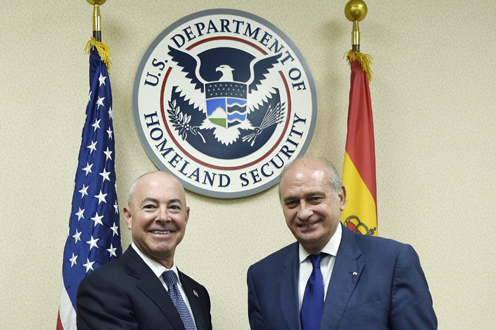
The Minister for Home Affairs also met with the Deputy Secretary of Homeland Security, Alejandro Mayorkas, with whom, in addition to discussing the fight against Jihadi and ETA terrorism and stepping up police cooperation between Spain and the United States, he also spoke about the fight against illegal immigration and migratory pressure that both Spain and the United States suffer on their borders.
In relation to this issue, Jorge Fernández Díaz and Alejandro Mayorkas exchanged lines of action and operational mechanisms to combat illegal immigration more effectively, such as, for example, the US Coast Guard and the Customs and Border Protection services.
The Spanish Minister for Home Affairs remarked that the fight against illegal immigration requires "a long-term, sustained commitment and close cooperation" between the Member States of the European Union and the main countries of origin and transit of the migratory flows. To that end, the minister specified that Spain has maintained an action plan against illegal immigration based on prevention at origin, operational cooperation in third countries of origin and transit, the fight against criminal networks that deal in trafficking immigrants, and improving control of all borders.
Jorge Fernández Díaz informed Alejandro Mayorkas that Spain has designed and implemented highly advanced initiatives and projects on domestic border control, such as the Comprehensive Border Surveillance System (Spanish acronym: SIVE), deployed along the entire length of the Spanish coastline affected by illegal immigration and that its effectiveness has turned it into the model for the European Border Surveillance System (EUROSUR).
PNR system: data protection of air traffic passenger name records
On this matter, Jorge Fernández Díaz underlined the importance given by Spain to PNR records to effectively fight serious crime and terrorism. In this regard, the Minister for Home Affairs reminded the Deputy Secretary of Homeland Security of the activities implemented by the Spanish Ministry of Home Affairs to guarantee that the European Parliament gives the go-ahead to the conclusion of the Agreement on PNR between the European Union and the United States. Furthermore, Jorge Fernández Díaz pointed out that the use of pre-existing instruments at an EU-level should be optimised, together with those instruments currently being developed such as "Smart Borders" in the fight against terrorism.
Jorge Fernández Díaz informed Alejandro Mayorkas that Spain considers it a priority to step up efforts to update certain legislative instruments that allow new types of terrorism and terrorist conduct to be effectively prosecuted. To this end, Spain has headed up a proposal to update the 2008 Framework Decision on the fight against terrorism in the European Union by introducing "pasive training" with the aim of ensuring that legislation does not allow terrorists to go unpunished.
Bilateral meeting with Directors of CIA and FBI
The Minister for Home Affairs, Jorge Fernández Díaz, met with the Director of the CIA, John O. Brennan, and with the Director of the FBI, James B. Comey, to tackle various issues such as cyber-crime, the fight against Jihadi and ETA terrorism and stepping up police cooperation on training, among other issues.
At both meetings, Jorge Fernández Díaz conveyed the importance of a close and intense collaboration between Spain and the United States in the fight against terrorism and highlighted the need for "the active exchange of information" on the mesh of Jihadi terrorist networks capable of operating in Europe and in the United States, as well as against the interests of both countries in the rest of the world.
In relation to the fight against cyber-crime and cyber-terrorism, the Spanish Minister for Home Affairs pointed out that the Spanish National Security Strategy includes cyber-security on the list of priority actions of the Government of Spain in terms of security issues. To this end, the Ministry of Home Affairs of Spain has strengthened the capacities of the State law enforcement agencies and has boosted the Technological Investigation Unit of the national police forces, the Guardia Civil has significantly strengthened its capabilities to combat cyber-crime by strengthening its cyber-terrorism unit - the Telematic Crime Group (Spanish acronym: GDT) - and the National Centre for the Protection of Critical Infrastructures (Spanish acronym: CNPIC) has created the Office for Cybernetic Coordination (Spanish acronym: OCC) that acts as an information processing unit, a national contact point and as support for critical operators of the State law enforcement agencies on this matter, explained Jorge Fernández Díaz.
At these meetings, the Minister for Home Affairs, Jorge Fernández Díaz, expressed his satisfaction to the Director of the FBI, James Comey, at the excellent cooperation between the FBI and the Spanish National Police Force and the Guardia Civil, which he described as "very intense and satisfactory".
In this regard, the Minister for Home Affairs asked the Director of the FBI to increase the exchange of information between the two countries with the aim of further improving our level of operational collaboration and establishing joint investigation teams that allow both members of the FBI and officers of the Spanish National Police Force and the Guardia Civil to take part in the operational phase of investigations under way in both the United States and Spain.
Finally, Jorge Fernández Díaz made the proposal to James Comey to continue with the exchange of training activities so that both members of the FBI and members of the Spanish National Police Force and the Guardia Civil can participate at the training academies in each country on officer training courses and specialised judicial police force courses, on the fight against terrorism, criminal science and cyber-crime, to be organised by both police forces on a regular basis.
Ministerio