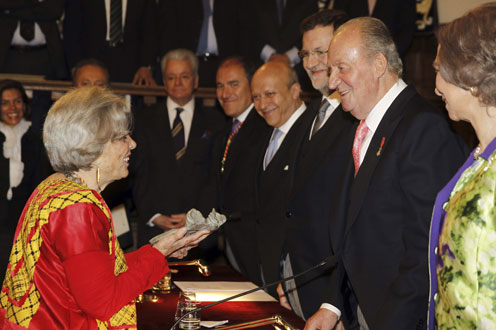
In the Main Hall of the University of Alcalá de Henares
Their Majesties the King and Queen of Spain present 2013 Cervantes Prize to Elena Poniatowska
News - 2014.4.23





The ceremony, which was held in the Main Hall of the University of Alcalá de Henares, was presided over by Their Majesties the King and Queen of Spain. The award ceremony was also attended by the President of the Government, Mariano Rajoy; the Minister for Education, Culture and Sport, José Ignacio Wert; the State Secretary for Culture, José María Lassalle; and numerous figures from the world of politics and culture.
The Ministry of Education, Culture and Sport bestows the Miguel de Cervantes Award (plus 125,000 euros) to those writers who contribute through works of outstanding quality to enriching the Hispanic literary legacy. The prize was bestowed for the first time in 1976 to Jorge Guillén and there have been 38 prize-winners since then. In 1979, the Prize was given ex aequo to Jorge Luis Borges and Gerardo Diego. Since then, the rules state that the prize may not be divided, declared void or awarded posthumously.
The panel that decided to award the prize to Elena Poniatowska on 19 November consisted of José Manuel Caballero Bonald, laureate in 2012; José Manuel Blecua Perdices, member appointed by the Spanish Royal Academy; Renée Ferrer, nominated by the Paraguayan Academy of the Spanish Language; María Pilar Celma Valero, by the Conference of Vice-Chancellors of Spanish Universities (Spanish acronym: CRUE); Diego Valadés Ríos, by the Union of Latin American Universities (Spanish acronym: UDUAL); María Dolores López Enamorado, by the Director of the Cervantes Institute; Fernando Rodríguez Lafuente, by the Minister for Education, Culture and Sport; José Luis Rodríguez García, by the Spanish Federation of Journalists' Associations (Spanish acronym: FAPE); Ana María Hernández Vallen, by the Latin American Federation of Journalists (Spanish acronym: FELAP); and Nagwa Mehrez, by the International Association of Hispanists.
The panel awarded the prize to Elena Poniatowska "in recognition of a brilliant literary career in various genres but particularly for her narrative works and her exemplary dedication to journalism. Her outstanding work is firmly grounded on a commitment to contemporary history. She is the author of numerous iconic works that describe the 20th Century from an international and inclusive perspective. Elena Poniatowska is one of the most powerful voices in modern-day Spanish literature".
Biography
Elena Poniatowska Amor (Paris, France 1932) is the daughter of a French father of Polish origin and a Mexican mother. At the age of 21, she made a name for herself as the author of a new form of journalism that mixed information with literature in the Excélsior newspaper. She currently works at the La Jornada newspaper. She was the first woman to receive the National Journalism Prize in 1978 and is a scholar emeritus of the National Fund for Culture and the Arts.
She has written more than 40 books (essays, stories and accounts translated into over 20 languages), including Hasta no verte Jesús mío [Here's to You, Jesusa] about the life of a Mexican woman soldier (1970 Mazatlán Novel Prize) and La piel del cielo [The Skin of the Sky], which won the Alfaguara Novel Prize in 2001 and the prize awarded by China to the best novel in the Spanish language in 2002.
La noche de Tlatelolco [The Night of Tlatelolco], considered a classic and translated into English in 1975, is a historical account about the Student Movement of 1968 - a chronicle of the massacre that took place on 2 October 1968 in the Plaza de las Tres Culturas, Tlatelolco. This powerful account is still the best-selling book on the subject. Following the publication of this book, Elena Poniatowska was awarded the Xavier Villaurrutia Prize but she refused to accept it in an open letter to the Excélsior in which she asked President Luis Echeverría the following question: Who will award prizes to the dead?
In December 2002, she received the National Arts and Science Prize - the most prestigious award given by Mexico. In 2006, she received the lifetime achievement award from the International Women's Media Foundation for a career spent in journalism committed to the values of honesty and courage that this foundation upholds.
She published Amanecer en el zócalo [Dawn in the Zocalo] in 2007 - a historical account about the post-election campaign on Avenida Reforma. That same year, she was awarded the Rómulo Gallegos Prize (the highest award presented by the Venezuelan Government) for her novel entitled El tren pasa primero, which tells the tale of the Mexican railway workers during a critical period in the history of Mexican trade unionism and criticises the corruption among the leaders who sold out to the government.
In 2007, the Government of Mexico City created the Elena Poniatowska Ibero-American Novel Prize in her honour and, in 2012, gave the name of Elena Poniatowska to a train on line 12 of the Collective Transport System - Metro - in tribute to the writer's prolific career. Furthermore, earlier this year, the Government of Mexico City officially opened the Elena Poniatowska School at the Villa Mujeres Centre for Social Integration Assistance (Spanish acronym: CAIS) in the Patera Vallejo area of the Gustavo A. Madero district of the city.
As a journalist and a writer, she has received such honorary titles as La Legión d'Honneur [Legion of Honour] in 2004 - the most important distinction presented by the Government of France - and Doctorates in Humanities from the New School of Social Research in New York, the Manhattanville College and the Florida Atlantic University in the United States, as well as the Mary Moors Cabot Prize for journalism at Columbia University. In Mexico, she has been honoured with a doctorate from the National Autonomous University of Mexico (UNAM), the Autonomous Metropolitan University (UAM), the Mexican State University, the Autonomous University of Puebla, the University of Sinaloa and the University of Cuautitlán Izcalli. She has also been a guest speaker and lecturer at universities in the United States, Europe and Asia.