Spanish Ministry of Agriculture, Food and Environmental Affairs does not accept that concrete blocks were sunk in Gibraltar for environmental reasons and to protect marine life
News - 2013.8.30





The Ministry of Agriculture, Food and Environmental Affairs (Spanish acronym: MAGRAMA) rejects claims that the concrete blocks were dropped into the waters near Gibraltar for environmental reasons or to protect marine life. For that reason, the ministry filed a complaint with the Environmental Prosecutor in July that has since been passed to the European Commission for study.
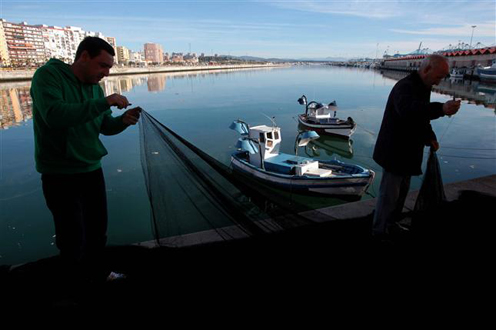
The sinking of concrete blocks in Gibraltar (some 70 blocks near La Línea de la Concepción) was undertaken with no control, authorisation or prior environmental study. The action has led to the destruction of a fishing ground in which activity was undertaken legally. In spite of claims from Gibraltar to the contrary, trawl fishing was never practiced.
Furthermore, the blocks have been dropped in the vicinity (at a distance of only 200 metres) of a Special Area of Conservation (SAC) that was approved on 30 November 2012 by the Government of Spain in accordance with EU regulations: the "Estrecho Oriental of the Mediterranean Biographical Region".
No objection to artificial reefs, but certain guarantees must be provided
The Spanish Ministry of Agriculture, Food and Environmental Affairs has no objection to the creation of artificial reefs. Spain has a long history of creating artificial reefs and is a leading expert in the field. However, the sinking of concrete blocks in Gibraltar was not carried out with a view to creating an artificial reef. Such action would require an analysis of the area in which the reef is to be created (which species and habitats exist in the area), how the process should be undertaken and how the environmental effects should be assessed. None of this took place prior to the sinking of these concrete blocks in Gibraltar.
With the arguments being used by Gibraltar, it would be possible to sink anything in any marine location and have it be considered an artificial reef. This is not how artificial reefs are created in Spain.
To begin with, this action has led to the destruction of the fishing ground and would therefore never have been allowed anywhere else. Furthermore this was carried out without due regard to the environmental damage that may have taken place.
These concrete blocks have been dropped into Spanish waters in violation of the Spanish Coastal Act (Laws 22/1988 and Law 2/2013), the Marine Environment Act (Law 41/2010 on Protecting the Marine Environment) and the applicable fisheries and fisheries sector-related regulations (such as merchant navy regulations).
Official complaints
Together with its official complaint regarding the sinking of these concrete blocks, the Spanish Ministry of Agriculture, Food and Environmental Affairs filed another official complaint with the Environmental Prosecutor on Thursday regarding a possible environmental offence involving the use of rock and concrete by the Gibraltarian authorities to build breakwaters, reclaiming terrain from the sea in a protected natural area.
Comments
Furthermore, the Spanish Ministry of Agriculture, Food and Environmental Affairs rejects the arguments put forward by Gibraltar as they lack even the slightest scientific rigour. In particular, the following comments are made regarding the supposed benefits to the environment and fishing activity:
- The concrete blocks may indeed provide shelter for fish species but it is highly doubtful they will be used as spawning grounds as they do not form part of the natural habitat in the area.
- Seagrass meadows form on soft substrate - not hard, as do molluscs. These blocks are therefore eliminating the natural soft substrate habitat (sand and mud). Other types of marine communities typical of hard substrates will form on these blocks, which will replace the naturally existing communities.
- The fishing activity carried out in the bay consists of legal shellfishing and drift net fishing. Claims that trawl fishing is undertaken are false. Those being adversely affected here are the non-industrial fishermen, who are those that benefit the most from genuine artificial reefs. The fishing activity is carried out legally. The minimum depths of 35m for surrounding nets and 50m for trawl nets, which are far greater depths than exist in the area where the concrete blocks were dropped - only a few metres, as admitted by Gibraltar.
- Marine resources will not be maximised but will rather be replaced by others, which will also create an obstacle to its sustainable use.
- As regards the design and construction of the modules "following a series of Spanish guideline documents", it would be necessary to know exactly which studies or information these groups were based on to make such statements.
- The area in which the blocks were dropped does not suit either one of the two types of reef. This is a sandy sea floor at a depth of between 4 and 6 metres, where the only fishing resource is a shellfish bed. Claims that this is a reef created to provide protection are therefore rejected.
- Claims that this is a reef for production are also rejected, as the only habitat subject to possible regeneration (a shellfish bed on a sandy sea floor) is destroyed by the very act of dropping the concrete blocks.
- In the notification to sailors using the Port of Gibraltar issued after the blocks had been dropped, it is stated that the water column is reduced to 1.5 metres. Therefore, navigation has been completely hampered and the hydrographic conditions have been altered.
- There are no records of a reef ever being created in Europe at such a shallow depth.
- It is not stated in any environmental document that the location in question will be an essential site for the regeneration of fish populations.
- There is no information regarding which scientific articles the sinking of these concrete blocks was supposedly based on. Seagrass meadows form on soft substrate. Changing the substrate makes such formation impossible. Furthermore, no previous experiment involving the transplantation of marine phanerogams has been successful.
- Nothing is said of other shallow areas that have been reclaimed from the sea by the authorities of Gibraltar - rendering fishing grounds unusable - and where seagrass meadows could have been regenerated.
- It is false that "the sea floor is of a sandy composition and there are no habitats or species protected by the EU within the area occupied by the artificial reef". Habitat "1110 - Sandbanks which are slightly covered by sea water all the time" is indeed a habitat included in Annex 1 of the Habitats Directive.
- The Spanish Ministry of Agriculture, Food and Environmental Affairs has no knowledge of the project and environmental study carried out and believes that numerous applicable Spanish laws have been violated as this action was taken in waters belonging to the Kingdom of Spain (Spanish Coastal Act, Spanish Marine Environment Protection Act, Spanish State Sea Fisheries Act, etc.). However, in any event, it represents a contravention of the United Nations Convention on Environmental Impact Assessment in a Transboundary Context (Espoo Convention) established in Espoo (Finland) on 25 February 1991 and which came into force in 1997. The convention establishes the need for national governments to mutually notify and consult all major projects under study that could possibly generate adverse environmental impacts crossing the border.
- The area affected was mainly used by the non-industrial fishing fleet engaged in activity using fishing dredges and fixed nets, not trawl fishing methods per se. Up to a dozen boats in rotation have regularly used the area.
- It is false that "the area does not constitute a maritime transportation route, a military exclusion zone or a recreational area" as numerous vessels of all sorts use the area in question.