




The Minister for Science and Innovation will lead a delegation from Spain formed by the Director-General of the Centre for Environmental, Technological and Energy Research (Spanish acronym: CIEMAT), Cayetano López; the coordinator of the Spanish involvement in the AMS project and Director of the Basic Research Department at the CIEMAT, Manuel Aguilar; the Director-General of the IAC, Francisco Sánchez; and IAC Scientist Ramón García, among others.
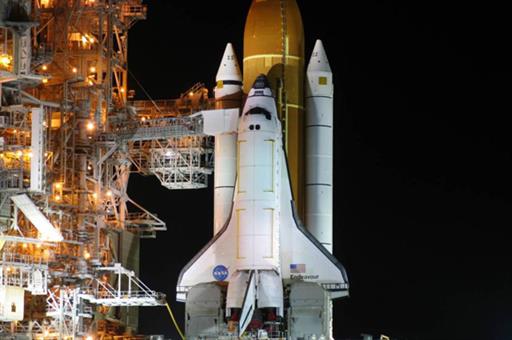
The space shuttle will be carrying the Alpha Magnetic Spectrometer (AMS-02), an advanced research instrument that Spain has helped develop and that will be installed on the International Space Station (ISS). The device will enable the largest ever scientific project involving cosmic rays to be carried out.
The AMS-02 is also the first scientific instrument of far-reaching implications that Spain has helped develop to travel to the ISS. Its main objective will be to determine whether or not remains of the initial anti-matter that, according to the Big Bang Theory, should have existed in the early Universe are still present today. The mission represents the largest ever scientific project to be carried out in search of anti-matter and dark matter in the Universe.
This advanced instrument will measure the composition and flows of cosmic rays that, after travelling across the Universe for millions of years, penetrate the Earth's atmosphere with a frequency of some thousand particles per second per square metre.
The mission will provide highly valuable information regarding the dose of radiation that crews on future very-long-distance space travel would experience. Furthermore, it could also provide experimental evidence of the existence of a Universe made of anti-matter and could equally help define the nature of dark matter and determine its properties.
Spanish involvement in the project has been coordinated by the Centre for Environmental, Technological and Energy Research (Spanish acronym: CIEMAT) through the Director of its Basic Research Department, Manuel Aguilar, and received assistance from the Astrophysics Institute of the Canary Islands (Spanish acronym IAC); two institutions run under the Ministry of Science and Innovation.
The contribution made by Spain to the AMS project has been valued in economic terms at 11.4 million euros; approximately 4% of the total corresponding to the material cost of building the instrument in which 16 countries took part.
Scientific and technological cooperation between Spain and the USA
Before attending the launch, Cristina Garmendia plans to meet with the current Director of the Kennedy Space Centre - former astronaut and Commander of the Endeavour, Robert Cavana. This will conclude a series of meetings held this week with various US scientific institutions and authorities aimed at strengthening the scientific and technological cooperation between Spain and the USA.
Cristina Garmendia also visited the Oak Ridge National Laboratory (ORNL) this week; one of the most prestigious neutron science research centres in the world and located in the State of Tennessee. She also visited various University of Florida installations in the city of Gainesville; a university that currently has close ties with Spanish research centres in the field of astronomy.
Various specific studies carried out by NASA and the European Space Agency (ESA) on the space sector clearly show that the space sector provides a high return on institutional investment in terms of improving technological capabilities and the induced increase in economic activity. For that reason, a strong space sector represents a key aspect in promoting R&D and, consequently, in improved productivity and job creation in any country.
Furthermore, advancements in the space sector have been providing services to society for a number of decades in such fields as public safety, environmental management and communications.
The space sector in Spain has been growing strong since 2004, generating a turnover in 2009 of more than 600 million euros and providing some 3,200 people with highly-qualified jobs. This makes Spain the fifth-largest European country in terms of public investment and size of its industrial sector.
Spanish industry leads several high-profile international projects such as AMERHIS, a new advanced concept of useful load for telecommunications that was launched into space in 2004, and SMOS, which was launched in 2009 to provide global maps of soil moisture and ocean salinity, key parameters for climate studies.
Furthermore, Spanish scientists are currently involved, to varying degrees, in all the scientific missions being carried out by the European Space Agency (ESA).
Spanish space technology will also travel to Mars in 2011
This new advancement in the technological capabilities of the Spanish space sector to be materialised on Friday 29 April in Cape Canaveral can be added to the agreement signed recently between the National Institute for Aerospace Technology (Spanish acronym: INTA), the Centre for Industrial and Technological Development (Spanish acronym: CDTI) and NASA to develop the Mars Science Laboratory mission to Mars, the launch of which is planned for the last quarter of this year, also from Florida. This mission will carry Spanish technology to another planet for the first time.
Ministerio de Ciencia e Innovación