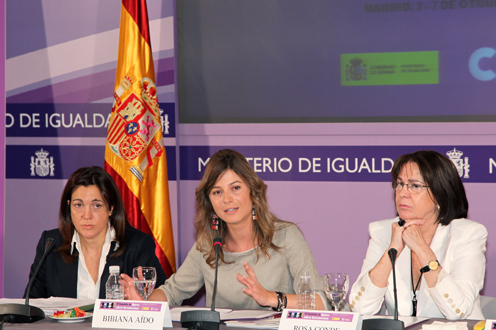




The Minister for Equality highlighted the important steps that have been taken over the last 12 months. "A year that has not been easy and in which we women have had to demonstrate how much we know about crises and crisis resolution. Because we know that the profitability of equality reveals itself in higher rates of employment, a greater contribution to the GDP, higher fiscal revenue, in sustainable birth rates and in greater social cohesion. Because we know that the most egalitarian countries are the most productive countries", explained the Minister.
Bibiana Aído referred to education as "one of the most powerful instruments we have in our arsenal for achieving real equality. Education empowers people, makes them free and liberates them, it enables their participation in society and provides access to a dignified job", she said.
The Minister for Equality also indicated the important role being played by Governments and international organisations in terms of equality. She welcomed UN Women, "a new organisation that will accompany us along this path, adding its efforts to the essential work of governments and institutions, and demanding accountability for their actions from them all".
For her part, the State Secretary for International Cooperation indicated that societies and women in particular "have a great deal to lose if inequality persists. For that reason we are especially glad to have been able, through the six-monthly presidency of the European Union, to place equality policies at the heart of the regional agenda for the first time".
Along these lines, the Executive Director of UNIFEM highlighted the importance that this year has for the equality agenda, with several commemorations of international agreements and the holding of conferences related to progress in terms of women's rights. Furthermore, she stressed the particular significance represented by the creation of the United Nations body UN Women, which "will combine all work undertaken on issues of gender equality and will undoubtedly enable progress to be accelerated under the leadership of Michelle Bachelet".
Along the same lines, the Director of the Carolina Foundation indicated that "this annual meeting has enabled the consolidation over the years of a network of feminists and representatives from international organisations in countries throughout the region". Rosa Conde mentioned the implementation of a virtual platform at http://mujeres.redcarolina.net, which forms part of the Carolina Network, to extend the work of this community that is so committed to equality beyond these physical meetings.
The conferences, organised by the Ministry of Equality and the Carolina Foundation, will last until 7 October and will be attended by Amelia Valcárcel, University Chair of Moral and Political Philosophy at UNED [Spanish Open University]; Cristina Perceval, from the Argentinean Ministry of justice; Olga Amparo Sánchez, from the Colombian Committee of Congresswomen; and Irene León, Director of the Social Participation, Studies and Action Foundation of Ecuador.
In addition, the participants will also enjoy talks with well-known personalities such as María Teresa Fernández de la Vega, First Vice-President of the Government of Spain; Teresa Cunillera, First Deputy Speaker of the Lower House of Parliament; and Isabel Martínez, Secretary-General for Equality Policies.