Grande-Marlaska calls on the European Union for legislative changes to "streamline" procedures during migration crises
News - 2026.9.17
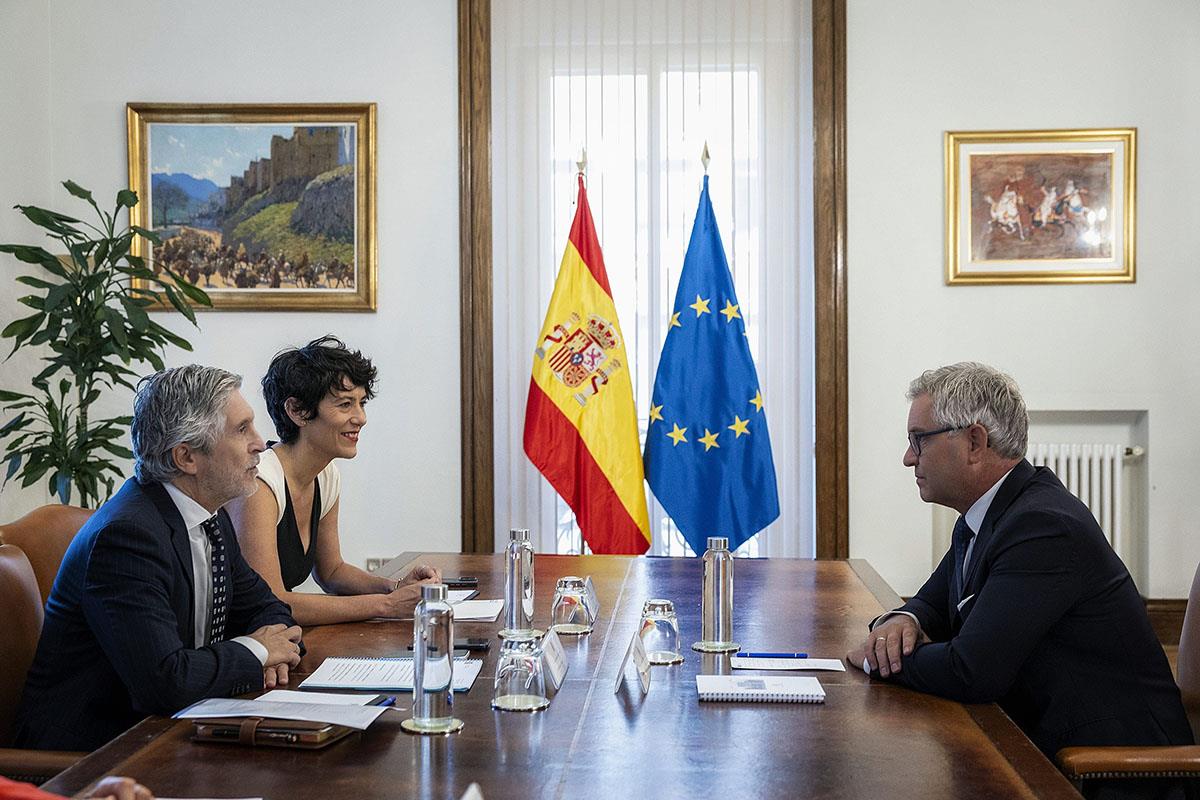 The Minister for Home Affairs, Fernando Grande-Marlaska, and Minister for Inclusion, Social Security and Migration Elma Saiz, during the meeting with the European Commissioner for Home Affairs and Migration, Magnus Brunner






The Minister for Home Affairs, Fernando Grande-Marlaska, urged the European Commission to push for new legislative measures to "speed up return procedures and international protection in migration crises", such as the one triggered by the mass arrival recorded in Ceuta on 30 July.
Grande-Marlaska, alongside the Minister for Inclusion, Social Security and Migration, Elma Saiz, conveyed this request to the European Commissioner for Home Affairs and Migration, Magnus Brunner, during a meeting held at the Ministry of Home Affair's headquarters in Madrid.
The ministers expressed interest in the legislative reforms announced by the President of the European Commission, Ursula von der Leyen, who, in her State of the Union address, highlighted the need to promote a new European framework for responding to migration emergencies in order to deal with exceptional situations.
Marlaska denied to Brunner that there have been any secondary movements of migrants from Ceuta to the mainland. "It is an unfounded risk and concern," stressed the minister, who asked the European Commission to convey this message to EU member states in order to "avoid baseless falsehoods".
The minister also highlighted the efforts made by Spain to manage an "extraordinary and unprecedented" situation at an EU external border. "We have shown that the measures taken are proving effective, but the consequences of a crisis on this scale cannot be resolved immediately", he emphasised, pointing out that the return of more than 90% in such a short period is unprecedented in the EU.
"Spain is ensuring that there are no secondary movements, is taking action to return those who entered Ceuta irregularly, and will continue to assume its responsibilities regarding international protection under the Dublin system", the Minister for Home Affairs told the European Commissioner.
Financial support from the European Commission
Grande-Marlaska and Saiz expressed their gratitude to Brunner for the approval of €114.7 million in emergency financial aid granted by the European Commission, under the Asylum, Migration and Integration Fund (AMIF) and the Instrument for Financial Support for Border Management and Visa Policy, aimed at increasing reception and screening capacity in the autonomous cities and preventing further irregular entries.
The proposal includes, amongst other measures, works on the breakwaters at Benzú and El Tarajal (Ceuta) and a new Temporary Reception Centre for Foreign Nationals (CATE) for each autonomous city, with a total capacity of 1,600 places.
The ministers called on the European Commission to take into account "the exceptional nature and reality" of Ceuta and Melilla when defining the future multiannual financial framework (2028-2034) and to recognise, in the allocation of funds, the efforts made by Spain in managing "one of the EU's most complex external borders".
Grande-Marlaska reaffirmed the commitment to cooperate with Frontex, which has extended Operation Minerva until the end of December, and with Europol, which has deployed a representative from the European Centre against Migrant Smuggling to Ceuta. "Cooperation with Europol on the monitoring and analysis of social media and in the fight against human trafficking is yielding good results", the minister added.
Non official translation