Social Security surpasses 3,550,000 foreign contributors in August, adding over 480,000 in a year
News - 2026.9.14






Social Security recorded an average of over 3,550,000 foreign contributors in August and also reached a new high in the seasonally adjusted series, surpassing the 3.5 million mark for the first time. Specifically, the system recorded an average of 3,551,759 foreign registered workers in August, 39,535 more than the previous month and 482,490 more than a year ago. Foreign worker registration thus grew by 15.72% year-on-year, compared to 3.1% for the system as a whole.
Discounting seasonality and the calendar effect, Social Security now has 3,526,093 foreign contributors, after adding 479,004 in the last 12 months.
The trend in foreign affiliation continues to show sustainable growth. Since June 2022, the number of workers from other countries has risen by more than 1.2 million. In fact, 50.9% of the jobs created since the implementation of the labour reform correspond to foreign workers.
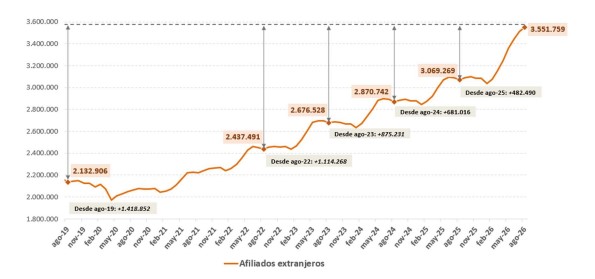 System Total. Unadjusted data.
This growth is also taking place in a labour market in which the foreign workforce is becoming increasingly diverse, both in terms of sectors of activity and in terms of types of employment and forms of participation. Their entry into the labour market is reflected both in labour-intensive activities and in sectors requiring higher skills, as well as in self-employment.
Impact of regularisation
Foreign worker registration has shown particular momentum during the first eight months of the year, with growth accelerating since late April - coinciding with the launch of the extraordinary regularisation process for foreign nationals.
If we take a snapshot of the labour market as at 31 August, the number of foreign nationals registered with Social Security as a result of this process stood at 337,917, out of a total of 22.4 million national insurance contributors.
Of these, 269,627 (79.8%) were covered under the General Social Security Scheme, while 16,912 (5%) were self-employed workers.
By gender, 203,418 were men (60.2%) and 134,499 were women (39.8%).
Average contributors
Of the average 3,551,759 foreign workers registered in August, 2,030,849 were men and 1,520,910 were women. Women now account for nearly 43% of all registered foreign workers.
Around 27% of foreign workers registered with Social Security come from European Union countries.
By nationality, Morocco remains the country with the highest number of registrants in the Spanish Social Security system, with 407,350 contributors. It is followed by Colombia (368,901), Romania (336,681), Venezuela (248,550), Italy (222,158), Peru (140,467), China (137,872), and Ukraine (84,564).
Sectors of salaried workers
While they represent 15.9% of all registered workers, the contribution of foreign workers is particularly significant in some sectors of the General Social Security Scheme.
In Hospitality, they represent 33.6% of contributors; in Agriculture, 28.1%; in Construction, 27%; in Administrative Activities, 20.2%; and in Transportation, 18.5%.
They also account for a significant proportion of the special schemes: they represent 47.6% of those in the Special Scheme for Domestic Workers and 39.2% in the Special Agricultural Scheme.
Predominantly on permanent contracts
It is worth noting the high proportion of foreign workers on permanent contracts - 86.8% of the total - which is almost 30 percentage points higher than the average for the 2017-2021 period, prior to the labour reform (58.9%).
At the same time, the temporary employment rate for this group of workers has fallen to 14.1%, while the percentage of Spanish workers on temporary contracts stands at 13.2%.
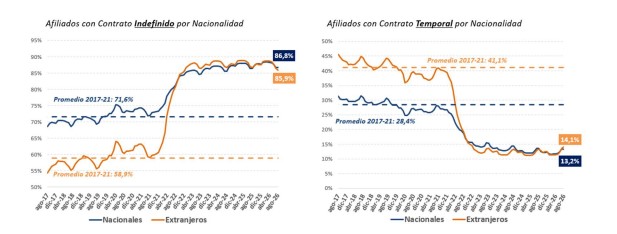 % of total contracts. General Social Security Scheme. Unadjusted data.
537,660 foreign self-employed workers
On the other hand, the number of self-employed workers continues to grow and stands at 537,660, which is 10.3% more than a year ago.
It is worth noting the growing presence of foreign entrepreneurs in highly skilled sectors such as Telecommunications and Computer Programming; they now account for more than 33.5% of the workforce registered in this sector - meaning one in three self-employed workers falls into this category. Their presence is also significant in other areas, such as Household Activities (26.4%), Hospitality (25.7%), Administrative Activities (19.8%), Construction (19%) and Real Estate Activities (18.5%).
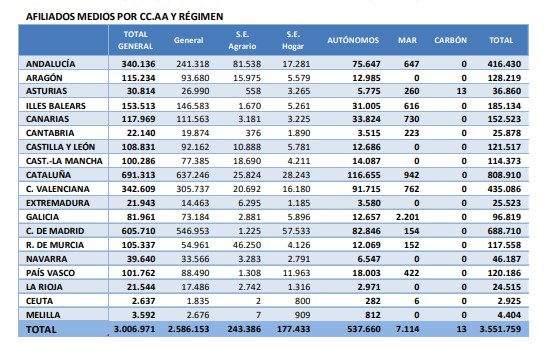
Non official translation
Headquarters of the Ministry of Inclusion, Social Security and Migration