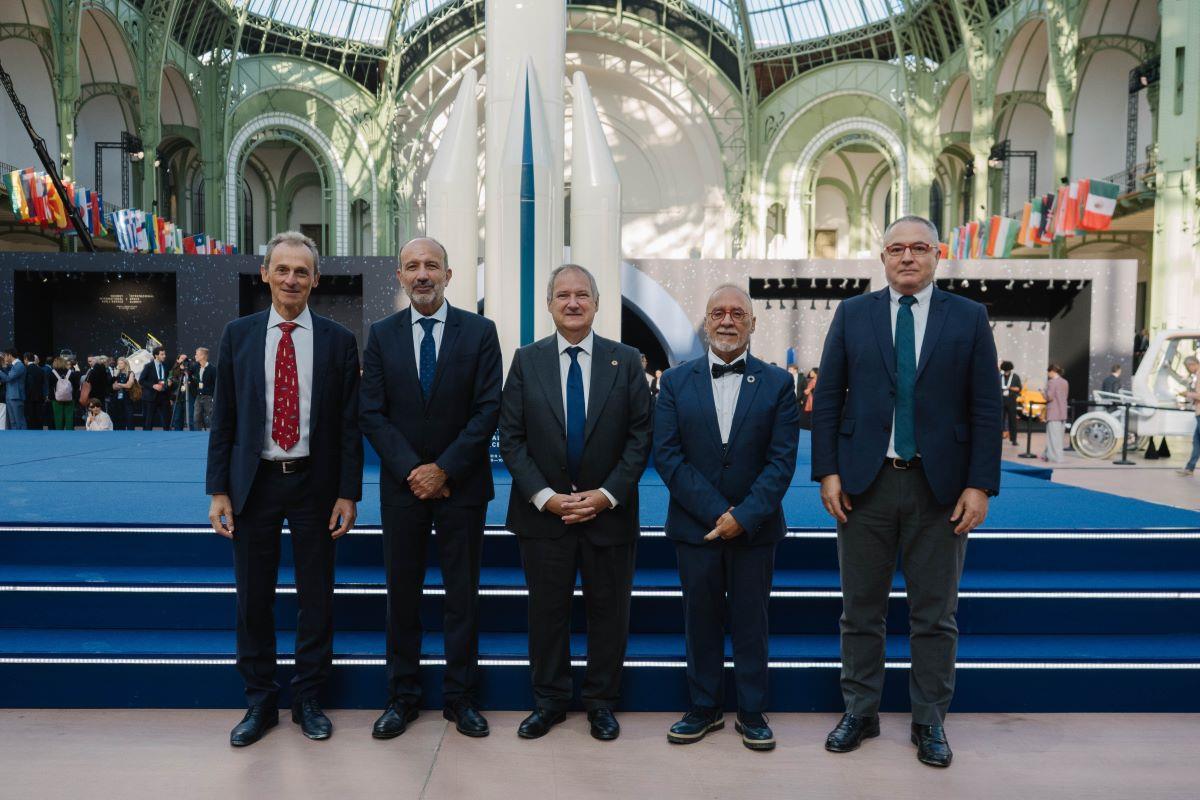
 The Minister for Industry and Tourism, Jordi Hereu, in the group photo after the International Space Summit






Speaking at the International Space Summit in Paris, the Minister for Industry and Tourism, Jordi Hereu, highlighted Spain's role as one of the key players in the European space sector, thanks to its growing investment, the development of its space industry and the contribution of top-class scientific and technological talent.
The Minister noted that Spain has, for the first time, become the fourth-largest contributor to European Space Agency (ESA) programmes, alongside Germany, France and Italy. This follows a commitment of €1.854 billion for the 2026-2030 period, representing 8.46% of the total investment by member states, made through the Spanish Space Agency (AEE), which operates under the Ministry of Science, Innovation and Universities (MICIU).
This development strengthens Spain's capacity to participate in strategic programmes relating to exploration, Earth observation, secure communications and the development of new space technologies, Minister Hereu emphasised.
Jordi Hereu also highlighted that the Spanish space industry is spearheading some of the continent's most ambitious projects, citing as an example the Spanish company PLD Space, based in Elche, which has become a European leader in the development of launch vehicles, following the success of the MIURA 1 and the ongoing progress of the reusable orbital rocket MIURA 5; this initiative is set to strengthen Europe's capacity for independent access to space.
As a result of the Government of Spain's commitment to the sector, demonstrated through its contribution to the ESA, PLD recently secured a €158.9 million contract under the European Launcher Challenge to bolster European capabilities for sovereign access to space.
The development of this technology positions Spain as a strategic partner within the European space ecosystem and demonstrates the national industry's ability to compete in a highly technological global market.
Significant growth in Spain's industrial sector
Spain's commitment to the space sector is reflected in the remarkable growth experienced by its industrial base in recent years. Between 2022 and 2024, the Spanish space sector's turnover rose by 21.4% to reach €1.293 billion, while direct employment grew by 38%, increasing from 5,533 to 7,636 workers.
This trend has been accompanied by a major mobilisation of public investment - nearly €2.5 billion channelled through the PERTE Aerospace programme, drawn from both the Recovery and Resilience Mechanism and national resources, including government programmes and Spain's contribution to the European Space Agency (ESA).
These figures highlight the catalytic effect of Spain's space and industrial policy on strengthening technological and industrial capabilities and creating skilled jobs.
The strengthening of Spain's presence in space is also underpinned by a new generation of professionals, such as the Spanish astronauts Pablo Álvarez and Sara García. According to Jordi Hereu, their inclusion symbolises Spanish scientific and technological excellence and serves as an inspiration for future generations of researchers and engineers.
The combination of public investment, scientific talent, industrial capacity and new infrastructure places Spain at a pivotal moment to consolidate its leading role in the European aerospace sector, contributing to Europe's technological leadership and strategic autonomy in the coming decades, the Minister for Industry added.
This summit has highlighted Europe's role as a space power, against a backdrop in which space has become a strategic domain both for the provision of services to citizens and our security.
In this regard, the minister emphasised the need to continue strengthening Europe's strategic autonomy in the space sector, alongside an industrial policy that enables industrial capabilities to be developed and consolidated in a balanced manner, with particular attention to fostering entrepreneurship and the vital role played by small and medium-sized enterprises (SMEs) and mid-cap companies in our country.
Non official translation