Yolanda Díaz outlines to her French counterpart the labour measures designed to protect people from the climate emergency
News - 2026.9.9
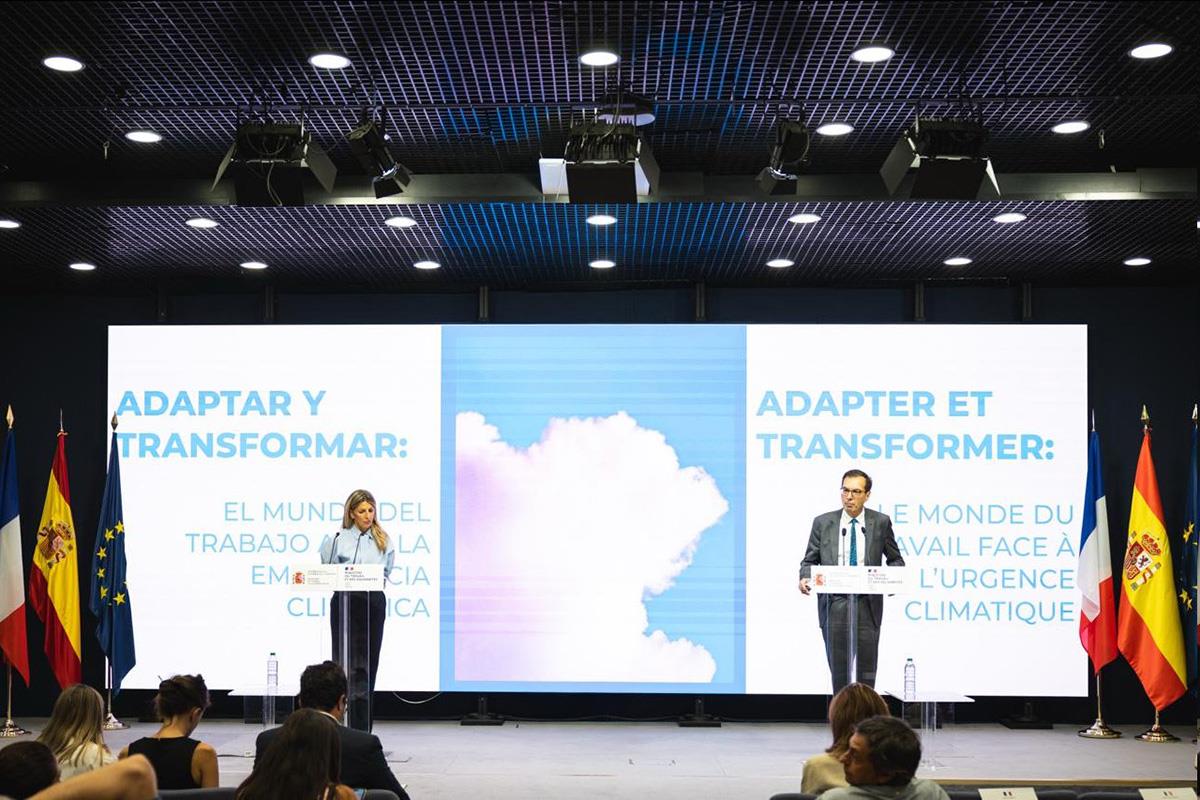 The Second Vice-President of the Government of Spain and Minister for Labour and Social Economy, Yolanda Díaz, and the French Minister for Labour, Jean-Pierre Farandou, during the joint press conference






The Second Vice-President of the Government of Spain and Minister for Labour and Social Economy, Yolanda Díaz, has welcomed the French Minister for Labour, Jean-Pierre Farandou, to Madrid. He is visiting Spain alongside French trade union and business representatives, to gain first-hand insight into the labour measures introduced by the Government in response to extreme heat and to understand how Spain organises its workforce in the face of rising temperatures and other phenomena associated with the climate emergency.
At the meeting with her French counterpart, Díaz outlined Spain's experience of how the heat affects workers, public services and the people who provide them. With regard to the regulatory measures being adopted, she emphasised that "we must carry out all this work through social dialogue and in accordance with values that are inherent to Europe", particularly now, given the rise of far-right denialist rhetoric.
The working day itself was also a key topic in the context of the climate emergency: "Setting clear working hours helps us to improve productivity, health and wellbeing. Companies are well aware of this. "Adapting and defining the working day is essential to our lives," explained the Minister for Labour.
Interest in the construction sector
Following the meeting, Yolanda Díaz, alongside the French Minister for Labour and trade union and employer representatives from Spain and France, visited ADIF's facilities at Atocha-Almudena Grandes station to see first-hand how working conditions outdoors are being managed and how construction work is progressing in the face of rising temperatures.
The construction sector is one of the hardest hit by heatwaves, which is why this visit by the French delegation is so important: to learn about the labour measures implemented by Spain to adapt, amongst other things, workers' working hours to the impact of weather phenomena associated with the climate emergency, particularly in the face of extreme heat.
Spain as a model
Throughout the current parliamentary term, the Ministry of Work and Social Economy has adopted a wide range of policies and measures to protect workers from extreme temperatures and other adverse weather conditions resulting from the climate emergency; these are now being closely monitored at international level.
Notably, in 2024, Spain pioneered the regulation and implementation of paid climate leave of up to four days a year in the event of a disaster or a serious and imminent risk arising from adverse weather conditions, specifically when it is impossible to reach the workplace or travel along roads to get there, in compliance with travel recommendations, restrictions or prohibitions issued by competent authorities.
As highlighted during the press conference, another key aspect is the linking of this climate leave to alerts issued by official meteorological agencies.
Non official translation