Spain has added over 679,000 Social Security contributors over the past year, representing year-on-year growth of 3.1%
News - 2026.9.2
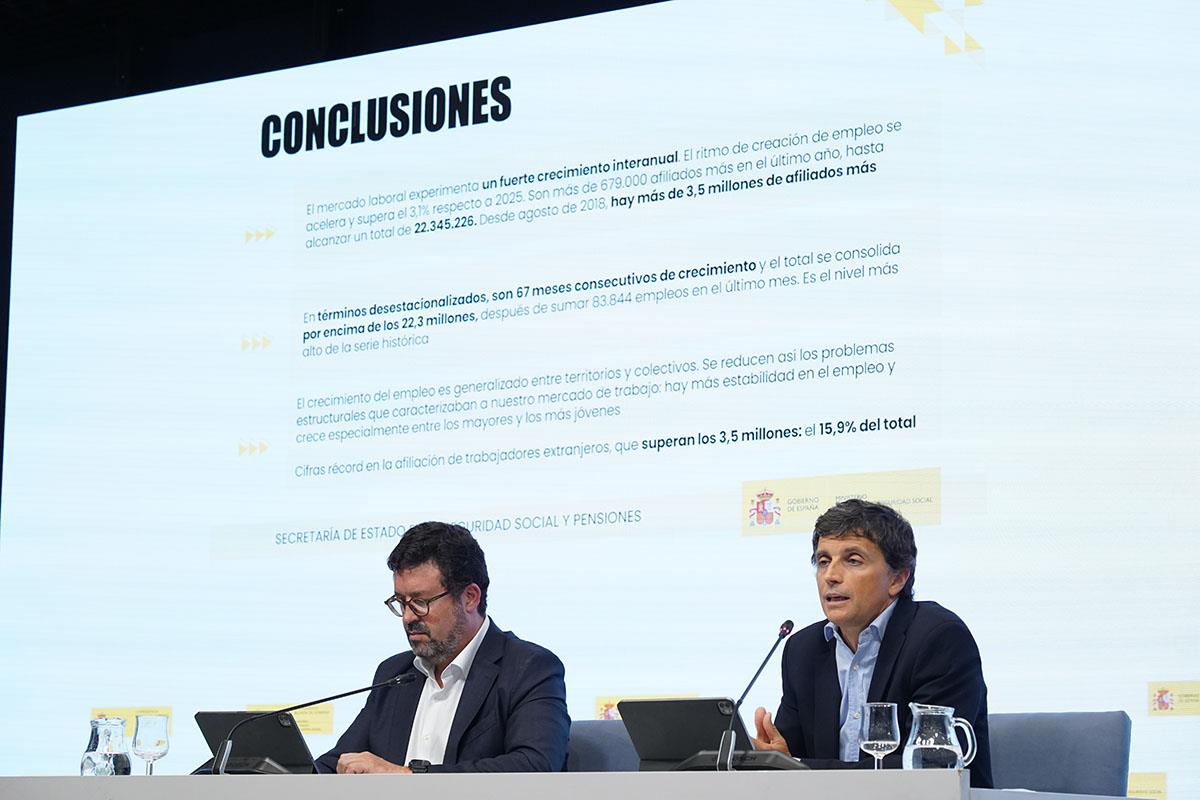 The Secretary of State for Social Security and Pensions, Borja Suárez, during the presentation of the data






Employment growth continued in August. Over the past year, the Social Security saw an increase of 679,023 contributors in the raw data series, a year-on-year rise of 3.13%. This is the largest increase in August since 2021, a year that was heavily influenced by the impact of the pandemic.
The average number of people in employment fell by 162,840 compared to July, a figure well below that of previous years, given that August is typically marked by seasonal fluctuations. In total, there are 22,345,226 contributors in the raw data series. Compared to 2018, there are over 3.5 million more contributors.

Adjusting for seasonality and calendar effects, August saw an increase of 83,844 contributors, bringing the total to 22,371,964. This marks 67 consecutive months of growth and reaches the highest level in the series.
"August has seen record employment growth, as we can see from both the seasonally adjusted and raw data on a year-on-year basis", explains Elma Saiz, Minister for Inclusion, Social Security and Migration. "We have been adding contributors month after month for over five and a half years in the seasonally adjusted series, which undoubtedly means our labour market is in excellent health."
Growth in the number of registered foreign workers has been particularly dynamic. So much so that, on average, the Social Security system recorded 3,551,759 foreign nationals in August - 39,535 more than in July and 482,490 more than a year ago. "Furthermore, there is one particularly significant figure. Almost 340,000 people registered this month are the result of the special regularisation process for foreign nationals", explains Minister Saiz.
Registrations through the regularisation process
If we take a snapshot of the labour market as at 31 August, the number of foreign workers with regularised status registered under the special scheme stood at 337,917.

By country of origin, Colombia has the highest number of registered individuals resulting from the regularisation process (97,376), followed by Venezuela (66,733). These two countries account for almost half of the total as at 31 August.
Of these 337,917, 79.8% (269,627) were covered by the General Social Security Scheme, whilst 16,912 (5%) were self-employed. Furthermore, by gender: 60.2% were men (203,418) and 39.8% were women (134,499).

Average affiliation by activity sector
The sector that has seen the strongest growth over the past year, taking into account the total number of contributors in the General Social Security Scheme and the Special Regime for Self-Employed Workers, is Construction (+6.47%). This is followed by: Real Estate Activities (+5.84%), Water supply (+5.5%), Arts, Sport and Entertainment Activities (+4.44%) and Publishing, Broadcasting and Content Production and Distribution Activities (+4.42%).
In the case of the General Social Security Scheme, the average number of registered workers has risen by 3.38% year-on-year (614,890 contributors). This percentage has been significantly exceeded in sectors such as Agriculture, Livestock, Forestry and Fisheries (+7.91%), Construction (+7.61%), Water Supply and Sanitation (+5.55%) and Arts, Sport and Entertainment (+4.26%), amongst others.
Over 63,700 more self-employed workers in the last year
Membership of the Special Regime for Self-Employed Workers has seen a year-on-year increase of 1.9%, with the highest growth rates recorded in: Electricity, Gas, Steam and Air Conditioning Supply (+15.57%), Telecommunications, IT Programming, Consultancy and IT Infrastructure (+13.64%), Real Estate Activities (+9.26%) and Publishing, Broadcasting and Content Production and Distribution (+7.85%).
Overall, the number of self-employed workers stands at 3,469,416, which is 63,705 more than a year ago and 220,141 more than in August 2018.
There are 1.8 million more women registered than in 2018
Employment amongst women stands at around 10.5 million (10,489,342). Specifically, there are 321,186 more women registered with Social Security than a year ago and 1,842,220 more than in 2018. Female employment has grown by 21.3% since 2018, compared to 16.3% for men.
Female registered workers represent 47% of total employment, one percentage point higher than in 2018. Their presence in the labour market is growing at a year-on-year rate of 3.2%. At the same time, male employment has also reached a record high, with 11,855,884 registered workers, following an increase of 357,837 over the past year and nearly 1.7 million since 2018.
Record employment levels among young people and those over 55
An analysis of employment trends over the last eight years reveals significant growth among both the oldest age group (those aged 55 and older) and the youngest demographic. Employment among older workers has risen by 51.5%, reaching a total of nearly 5 million, while employment among workers under the age of 30 has grown by 33.4% since 2018; these figures are 32.9 and 14.8 percentage points higher, respectively, than the overall growth rate of 18.6%.

Stability and quality of employment
Since August 2021, there has been a major shift in the types of contracts in the labour market: there are 4,811,840 more workers with permanent contracts and 2,020,332 fewer workers with temporary contracts.
There are increasingly more stable jobs, with more rights and better salaries. The largest increase is among those employed with permanent full-time contracts, with 328,670 more than a year ago; while registered workers with part-time contracts increased by 78,383.
Temporary workers now represent 13.4% of the workforce, compared to 29.3% in August 2021. This improvement is even more notable among workers under the age of 30, whose temporary employment rate is 23.7%, down from 54.9% five years ago.
As for younger workers - those aged 30 and under - their numbers have risen by 34.4% since August 2018. This represents an increase of 970,048, bringing the total to 3,790,266; this far exceeds the average growth rate of 18.6%.

Finally, the ratio of contributors to pensioners stands at 2.5, which is the highest level since 2011.
Non official translation