Spain reaffirms its commitment to shared security at the informal EU Defence Ministers' meeting
News - 2026.9.1
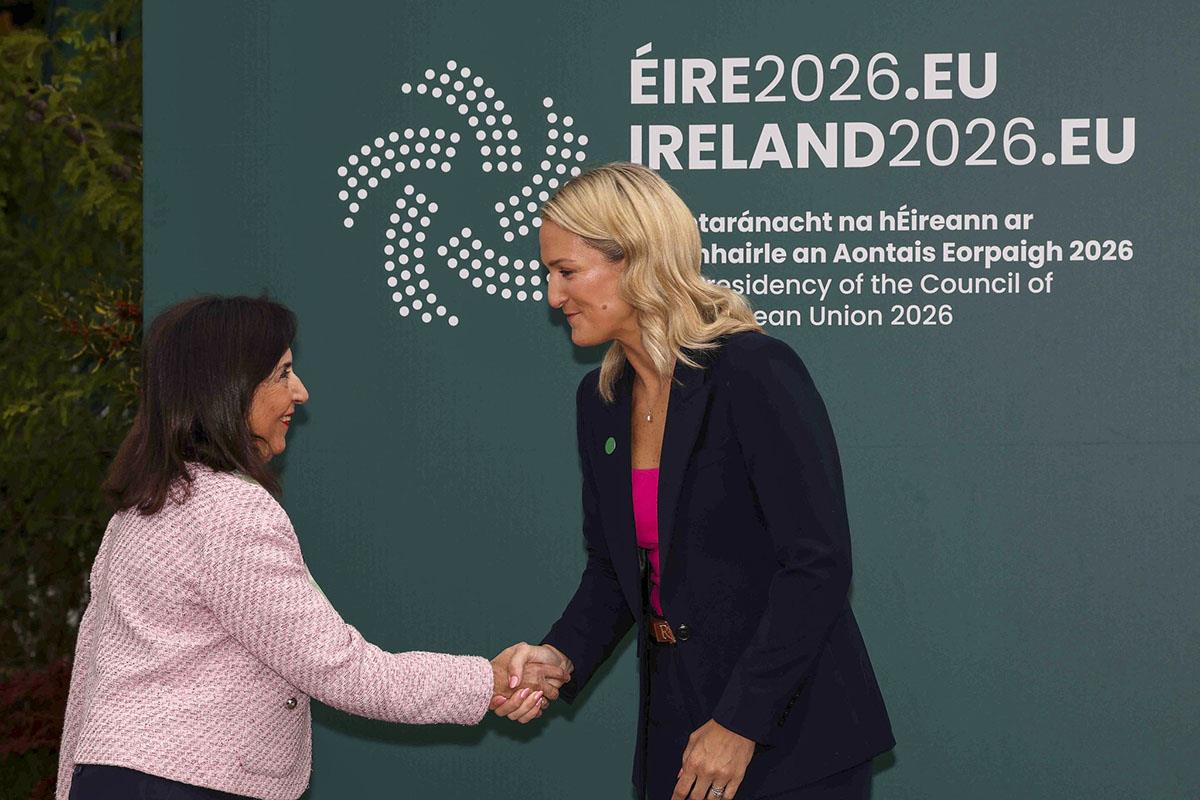 The Minister for Defence, Margarita Robles, greets Minister Helen McEntee at the informal meeting of European Union Defence Ministers held in the Irish town of Wicklow






The Irish town of Wicklow hosted the informal meeting of European Union defence ministers, a key event taking place as part of the Council's rotating presidency. The discussions today centred on three strategic priorities with a direct impact on the defence of the continent: instability in the Middle East, continued comprehensive support for Ukraine and bolstering security in the space and maritime domains.
The EU High Representative, Kaja Kallas, briefed ministerial delegations on unfolding events in the Middle East and the status of preparations for a potential Common Security and Defence Policy mission in Lebanon. This final session, held as a working lunch, also featured a strategic analysis by the UN Under-Secretary-General for Peace Operations. Jean-Pierre Lacroix, who held a bilateral meeting with the minister, outlined the scenarios anticipated as the UNIFIL mission's mandate draws to a close.
During her speech, Margarita Robles reaffirmed Spain's historic and unwavering commitment to peace in the region and, more specifically, to the stability of the Lebanese people during this new phase.
At sea, in the air and in space
With regard to maritime security, the ministers assessed strategies for protecting critical infrastructure in the face of a global landscape of growing, asymmetric threats. In this regard, Robles reaffirmed Spain's active commitment to defending freedom of navigation through its participation in established operations such as 'Atalanta' and in directly countering hybrid threats. Furthermore, she expressed our country's firm support for international initiatives aimed at ensuring security in the Strait of Hormuz, in accordance with the United Nations Convention on the Law of the Sea.
The minister also announced that Spain will assume a greater leadership role in the European plan to protect undersea cables - a commitment that will be realised through the provision of specialised monitoring centres to counter sabotage and hybrid threats in the maritime domain.
With regard to the European Union's Space Strategy for Security and Defence, in addition to highlighting the development of Spanish observation and communications capabilities - including space surveillance - the minister emphasised strengthening the role of the EU Satellite Centre in Torrejón de Ardoz (Madrid) and expressed a readiness to contribute to the deployment of the future secure satellite communications and connectivity system driven by the European Union.
Collaboration between Spanish and Ukrainian companies
European support for Ukraine and industrial cooperation - with particular emphasis on the Ukraine Support Loan and the European Peace Facility - were the focus of another of the sessions. Speaking to the new Ukrainian Minister for Defence, Yevgeni Khmara, who took part via videoconference, Robles welcomed the deployment of both instruments, which are essential for sustaining aid over time, and reiterated Spain's commitment to supporting Ukraine.
During the meeting, which was also attended by NATO Deputy Secretary-General Radmila Scherinska, the minister highlighted the growing involvement of Spanish companies in partnerships with Ukrainian firms to produce drones and air defence interceptors. In her remarks, she underscored Spain's contribution to training the Ukrainian Armed Forces, providing care for the wounded and funding centres for veteran reintegration.
Non official translation