Ministry of Finance allocates €273 million from the EDIL DANA Plan to 95 local authorities to continue reconstruction efforts and bolster defences against future floods
News - 2026.8.27
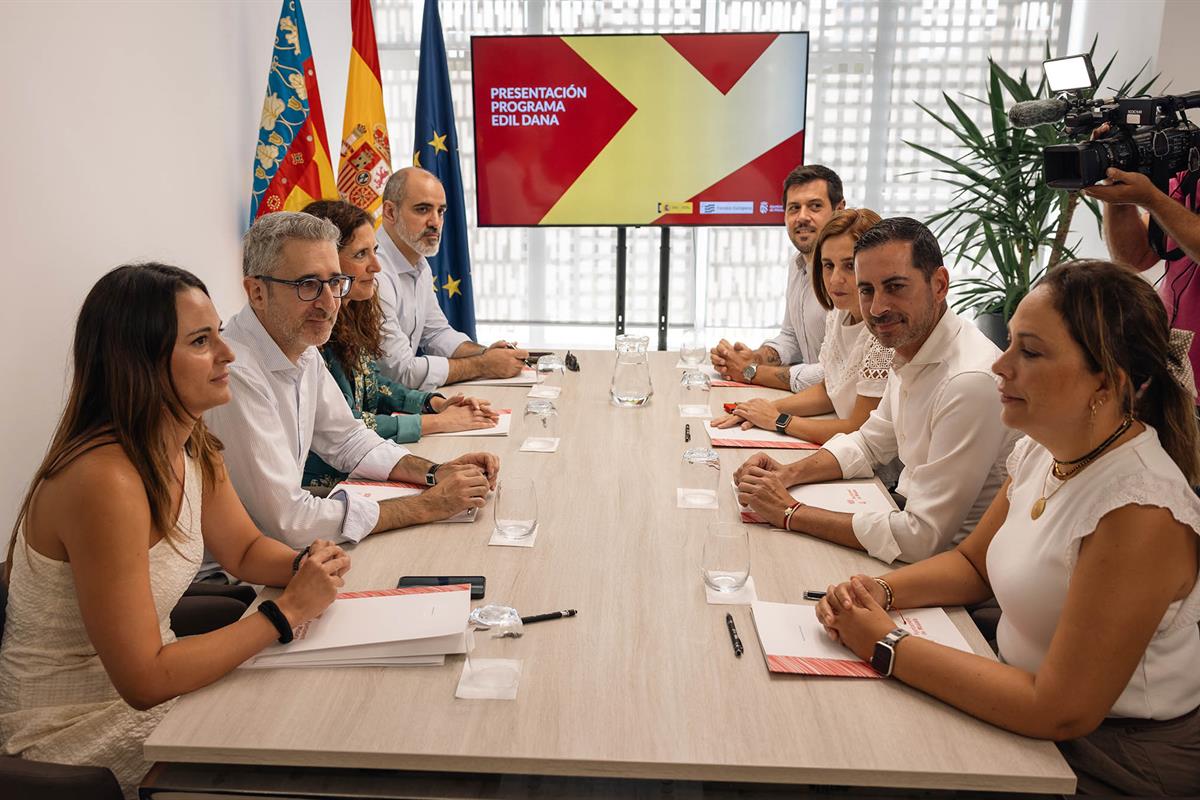 The Minister for Finance, Arcadi España, during the presentation of the EDIL DANA programs, in Mislata (Valencia)






The Ministry of Finance, through the Directorate-General for European Funds, has concluded the call for expressions of interest under the EDIL DANA Plan, allocating a total of €273.2 million in financial aid from the European Regional Development Fund (ERDF).
This funding, which forms part of Specific Objective 2.10 of Spain's 2021-2027 ERDF Multi-regional Programme (POPE) and under the umbrella of the European RESTORE regulation, will mobilise a total public investment of €287.6 million to repair the damage caused by the disaster of 28 October 2024 and enhance regional safety against future flooding.
The Minister for Finance, Arcadi España, announced the approval of this funding during his visit to one of the beneficiary municipalities, Mislata, in Valencia.
Minister España noted that the decision was formally communicated to the beneficiary local authorities this Thursday, enabling them to carry out the proposed projects, which will strengthen municipalities affected by the DANA storm against future extreme weather events.
Arcadi España emphasised that the funded initiatives will "improve the municipalities' capacity, resilience and adaptation to climate change".
Thanks to an exceptional EU co-financing rate of 95%, beneficiary local authorities will be able to immediately implement projects designed using the Integrated Action Plans (PAI) methodology. This ensures that reconstruction goes beyond merely replacing what was damaged; instead, it equips affected areas with resilient, smart and sustainable infrastructure capable of withstanding the impact of climate change.
With this resolution, the Ministry of Finance reaffirms its firm commitment to the local bodies affected by the disaster of October 2024. Through this injection of European ERDF funds, the Government is not only driving a swift and transformative reconstruction of the municipal fabric but also equipping municipalities and associations of municipalities with the necessary tools and financial resources. These measures strengthen structural resilience and resident safety, ensuring that affected areas emerge better prepared, more sustainable and fully protected against the impact of future extreme weather events.
High participation and broad territorial coverage
The call for proposals saw remarkable participation, with a total of 34 applications received and approved:
- 3 Major Cities: Valencia, Torrent and Paterna, which will receive up to €12 million in aid.
- 18 Intermediate Cities: Algemesí, Alfafar, Xirivella, Cullera, Riba-roja de Túria, Manises, Requena, Picassent, Llíria, Alzira, Aldaia, Catarroja, Mislata, Alaquàs, Bétera, Silla, Paiporta and Sueca, which will receive up to €9 million in aid.
- 13 Functional Urban Areas (FUAs), led by town councils, associations of municipalities, and provincial councils, which will receive up to €6 million in aid.

In terms of geographical coverage, the EDIL DANA Plan will cover 95 municipalities, of which 69 are in the Valencian Community and were affected by the DANA, whilst the remaining 26 are municipalities in Albacete and Cuenca, organised through the Functional Urban Areas (AUF), led by the respective Provincial Councils to address the needs of the Letur and Mira zones.
Three pillars of action
Minister Arcadi España explained that the projects selected under the PAI are structured around three main strategic pillars that combine large-scale civil engineering works, digital intelligence and community cohesion:
1. Structural and hydraulic resilience and road connectivity, with the primary aim of slowing, absorbing and channelling rainwater from torrential downpours before it reaches inhabited areas. This intervention combines underground works - such as separating sewage and stormwater networks to prevent backflow and flooding in homes - with nature-based surface solutions that transform municipalities through permeable paving and natural flood-retention plazas.
Notable projects in this area include Avenida Gregorio Gea and the redevelopment of Mislata's Plaza Mayor, the latter of which features technical landscaping designed to act as a controlled flood basin during torrential rain events. The Minister for Finance has visited both projects.
Other projects along these lines include, amongst others, the storm water retention tank in the Parc Central area of Torrent; the large-scale storm water drainage systems along the seafront in Cullera; and the works to protect and reinforce peri-urban watercourses and the Fuente del Jarro industrial estate in Paterna.
2. In addition to this hydraulic defence system, there is a second pillar focused on public safety, early warning and immediate response. Its aim is to anticipate disaster and ensure that municipal services continue to provide assistance, even in the most critical situations. As Arcadi España highlighted, the idea is "to give advance warning and to rely on science when alerting citizens to unfolding weather events".
A key feature is the construction of dual-use Emergency Response Centres (CAEs) - spaces that serve as civic and cultural hubs in daily life but, upon the issuance of an alert, transform into secure, self-sufficient shelters equipped with independent power supplies, medical areas and kitchens capable of accommodating hundreds of people. Furthermore, the investment deploys early warning networks - including radar flow meters on rivers, video monitoring of waterways and audible warning towers - as well as redundant fibre-optic rings and the full virtualisation of IT systems in the cloud to safeguard local governments against a potential "administrative blackout".
3. Finally, the plans set out measures to strengthen social protection, expand the housing stock and revitalise the local economy. These initiatives take the form of the construction of eco-efficient residential buildings for social housing and transitional accommodation for affected families and young people, as well as the refurbishment of doctors' surgeries and sports centres, and the comprehensive reconstruction of traditional markets and commercial areas, ensuring the continued operation of small and medium-sized enterprises and the preservation of jobs in each municipality.
Next steps in management
Following the resolution of the call for proposals, the Directorate General for European Funds sent individual notifications to the beneficiary local authorities this Thursday. This marks the start of the period for submitting the documentation required to designate them as "Light Intermediate Bodies" (OIL) - a status that will enable them to begin selecting and executing projects.
Non official translation