Spain surpasses an average of 22.5 million registered workers for the first time, after creating over 642,500 jobs in the last year
News - 2026.8.4






Social Security has once again reached an all-time high in the number of national insurance contributors. Employment continues to grow at a steady pace and has, for the first time, exceeded 22.5 million registered workers on average (22,508,065) in the original data series, having added 41,727 people in employment in July. This means that, over the last 12 months, the number of people in employment has risen by 642,562; a year-on-year increase that has accelerated to exceed 2.9%, which is the highest rate of job creation since April 2023.
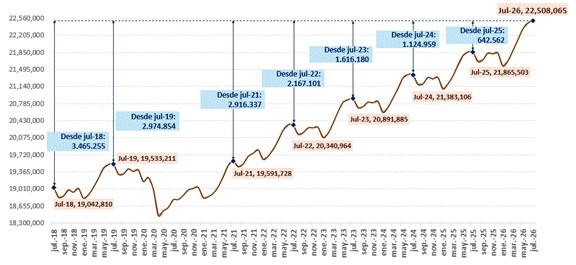
"The labour market has been growing at an exceptional rate so far in 2026. We can see this in year-on-year terms, but also if we analyse the trend over the first seven months of the year, during which there were 663,652 more national insurance contributors", explains Elma Saiz, Minister for Inclusion, Social Security and Migration.
Growth in the number of registered foreign workers has been particularly dynamic. The unadjusted figures show an average of 3,512,223 registered workers - an increase of 66,046 compared to June and 420,875 compared to a year ago. "Taken together, they now account for 15.6% of all registered workers and continue to play a vital role in the dynamism of the labour market and in sustaining the social security system", explains Saiz.
Registrations through the regularisation process
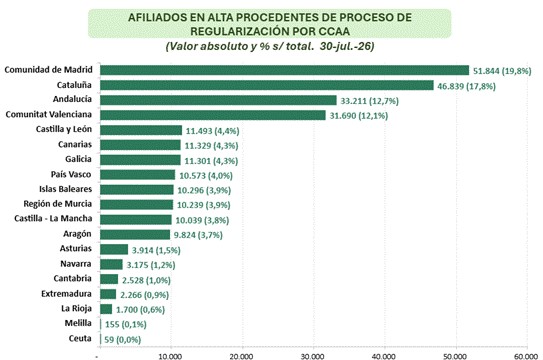
If we take a snapshot of the labour market as at 30 July, the number of foreign workers with regularised status who had been registered under the special procedure stood at 262,475. On that same day, the total number of registered workers was 22,502,259.
Of these 262,475, 81.5% (213,883) were covered by the General Social Security Scheme, whilst 12,675 (4.8%) were self-employed. Furthermore, by gender: 60.3% were men (158,171) and 39.7% were women (104,304).
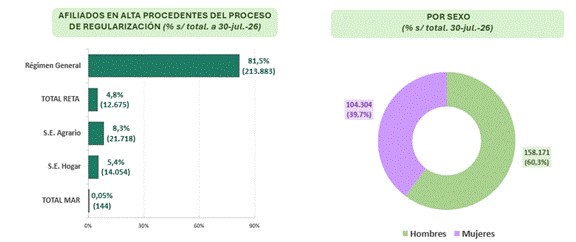
Regularized in registration (data as of July 30, latest available).
66 consecutive months of job creation
After adjusting for seasonality and calendar effects, the number of registered workers stands at 22,288,120, having increased by 79,567 compared with June and by 638,667 compared with the same month in 2025. "This is not an isolated figure. We have been creating jobs without interruption for 66 consecutive months, and that continuity is the best proof of the strength of the Spanish labour market and the confidence our economy inspires", explains Elma Saiz.
Furthermore, the daily registration figures show that for most of the month, between 8 and 30 July (except for the 10th), the figure exceeded 22.5 million.
Affiliation by activity sector
The sector that has seen the strongest growth over the past year, taking into account the total number of contributors in the General Scheme and the Special Regime for Self-Employed Workers, is Publishing, Broadcasting and Content Production and Distribution (6.4 %). These are followed by Construction (6.1%) and Real Estate Activities (5.6%)
In the case of the General Social Security Scheme, the average number of registered workers has risen by 3.2% year-on-year (584,088 contributors). This figure was significantly exceeded in sectors such as Construction (+7.3%); Agriculture, Livestock, Forestry and Fishing (+6.8%); Publishing, Broadcasting and Content Production and Distribution (+5.9%); Water Supply and Sanitation (+5.6%); and Health and Social Work Activities (+4.2%).
Almost 58,000 more self-employed workers over the year
In the case of the self-employed, the year-on-year increase stands at 1.7%, with the highest growth rates recorded in: Electricity, Gas, Steam and Air Conditioning Supply (+15.4%), Telecommunications, IT Programming, Consultancy and IT Infrastructure (+12.7%), Real Estate Activities (+9.2%) and Publishing, Broadcasting and Content Production and Distribution (+8.4%).
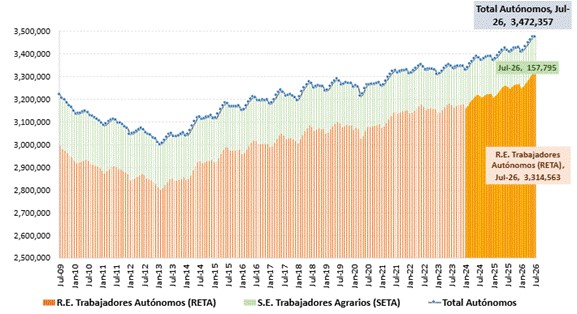
Overall, the number of self-employed workers stands at 3,472,357, which is 57,984 more than a year ago and 205,188 more than in July 2018.
There are 1.8 million more registered women than in 2018
Employment among women grew by almost one percentage point more than that of men and stands at around 10.6 million women in work (10,578,040). Specifically, there are 306,811 more women registered with Social Security than a year ago and more than 1.84 million more than in 2018. The improvement in female employment since 2018 is 21%, while that of men is 15.8%.
Female registered workers represent 47% of total employment, 1.1 percentage points more than in 2018. Their presence in the labour market is growing at an annual rate of 3%. At the same time, male employment has also reached a record high, with 11,930,025 registered workers, after adding 335,751 in the last year and 1.63 million since 2018.
Greater job growth among young people and those over 55
An analysis of employment trends over the last eight years reveals significant growth among both the oldest age group (those aged 55 and older) and the youngest demographic. Employment among older people has grown by 51.7% to a total of almost 5 million, and that of workers under 30 by 33.6% since 2018 (there are 3.9 million), 33.5 percentage points and 15.4 percentage points, respectively, above the overall figure of 18.2%.
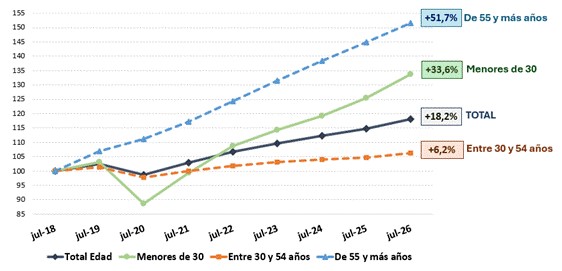
The positive trend in employment has been accompanied by an improvement in the contribution bases compared with pre-pandemic levels, showing growth of 47.5% among young people aged 25 to 29 and 47% among those under 24, from the first quarter of 2018 to the same period in 2026. There has been a 13.5% increase above the average (+33.7%) in contribution bases for those under 30, reflecting the rise in wages in this age group.
Stability and quality of employment
Since July 2021, there has been a major shift in the types of contracts in the labour market: there are 4,893,692 more workers with permanent contracts and 2,034,685 fewer workers with temporary contracts.
There are increasingly more stable jobs, with more rights and better salaries. The largest increase is among those employed with permanent full-time contracts, with 327,471 more than a year ago; while registered workers with part-time contracts increased by 70,087.
Temporary workers now represent 13.4% of the workforce, compared to 29.4% in July 2021. This improvement is even more notable among workers under the age of 30, whose temporary employment rate is 23.7%, down from 54.8% five years ago.
As for younger workers - those aged 30 and under - their numbers have risen by 34.6% since July 2021. This represents an increase of 999,923, bringing the total to 3,893,353; this far exceeds the average growth rate of 14.9%.
Finally, the ratio of contributors to pensioners stands at 2.5, which is the highest level since 2011.
Non official translation

Workers in an office