Social Security contribution hours have risen by 16.9%, and effective contribution days by 15.6%, compared to pre-pandemic levels
News - 2026.7.31






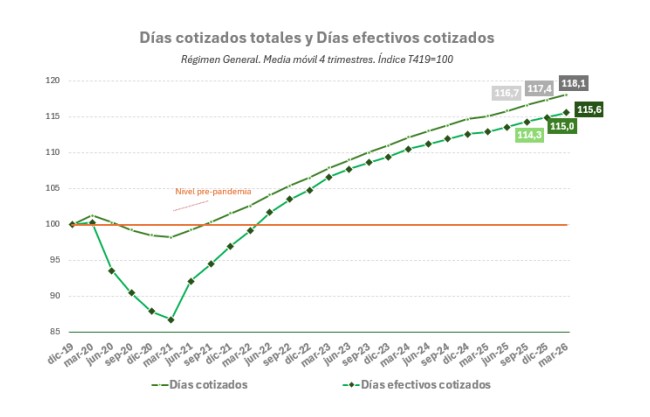
The indicator for Social Security contribution days rose by 18.1% between 2019 and 31 March 2026. When considering effective contribution days, the increase stands at 15.6%, according to the latest statistics published by the Ministry of Inclusion, Social Security and Migration. This information is obtained from the membership registers and the reports on contribution bases held by the General Treasury of the Social Security (TGSS).
In the case of contribution days, the data are calculated on the basis of the time series recorded by the TGSS, which begins in January 2019. This provides a high level of detail, as the information is broken down by gender, activity sector and type of contract.
The Secretary of State for Social Security and Pensions, Borja Suárez, highlights the following: "The start of 2026 confirms the quality of the jobs created in recent months. It sets the course for the present and the foreseeable future: more stable contracts with better economic conditions. So much so that we can confirm that we have overcome some of the structural problems affecting our labour market, such as temporary employment and the under-representation of young people and women".
Effective contribution days exclude days spent on ERTE (Temporary Redundancy), periods of temporary incapacity and other benefits (maternity and childcare leave, and leave due to risks during pregnancy and whilst breastfeeding).
Meanwhile, women continue to show higher growth than men in terms of days with social security contributions during the first quarter of 2026. In fact, when comparing these figures to those recorded in the last quarter of 2019, their share has risen to 48.2% (up from 47.4% six years ago). Meanwhile, the proportion of men has fallen from 52.6% to 51.8%.
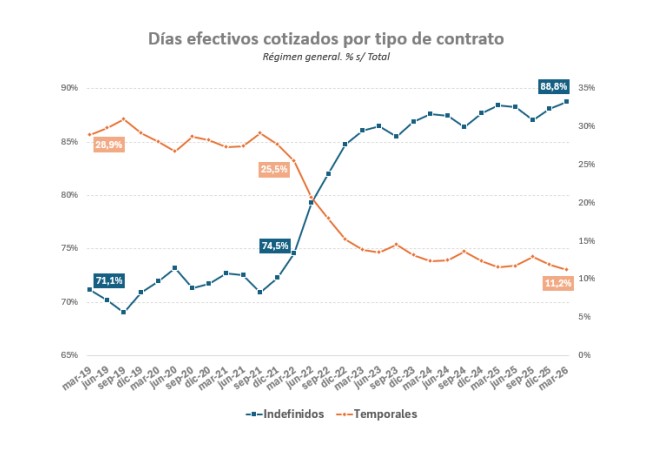
One of the most obvious effects of the labour reform has been to reduce the number of fixed-term contracts in order to create more permanent jobs. Indeed, if we look at the trend in actual contribution days by contract type, the percentage of days contributed by workers on permanent contracts has risen to 88.8%, while the remaining 11.2% corresponds to temporary contracts. These figures compare to 74.5% for permanent contracts and 25.5% for temporary contracts during the same period in 2022.
Statistics on contribution hours and hours actually worked
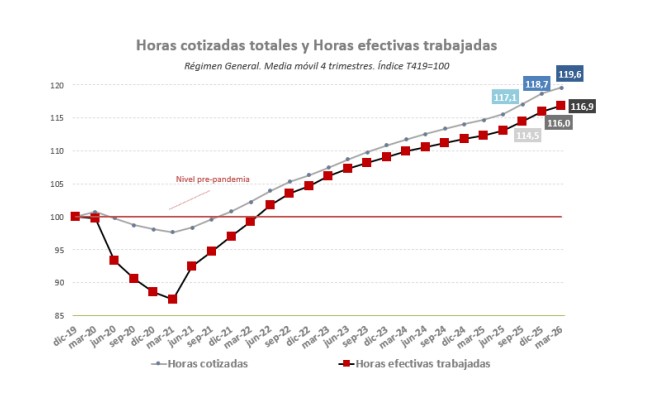
This improvement in job quality is also reflected in the latest data on contribution days and actual hours worked. The index of contributory hours reached its peak in the first quarter of 2026, at 119.6 points, with 100 being the reference figure for the last quarter of 2019 (the reference date, representing pre-pandemic levels, when comparing the data for each of these quarters). In other words, hours for which contributions were made have increased by 19.6% since before the pandemic.
To calculate the actual hours worked, it is necessary to deduct the hours worked by employees on ERTE, those on temporary sick leave, and those receiving other benefits (maternity and childcare, risks associated with breastfeeding, and risks associated with pregnancy).
These contribution hours, adjusted to account for these situations involving the suspension of work, or effectively the actual hours worked, were 16.9% higher in the first quarter of this year than in the last quarter of 2019 (the reference point for pre-pandemic levels when comparing data across these quarters).
Non official translation

Aircraft maintenance technicians at work