Yolanda Díaz announces that the Canary Islands will be the capital of the Social Economy in 2027
News - 2026.7.22
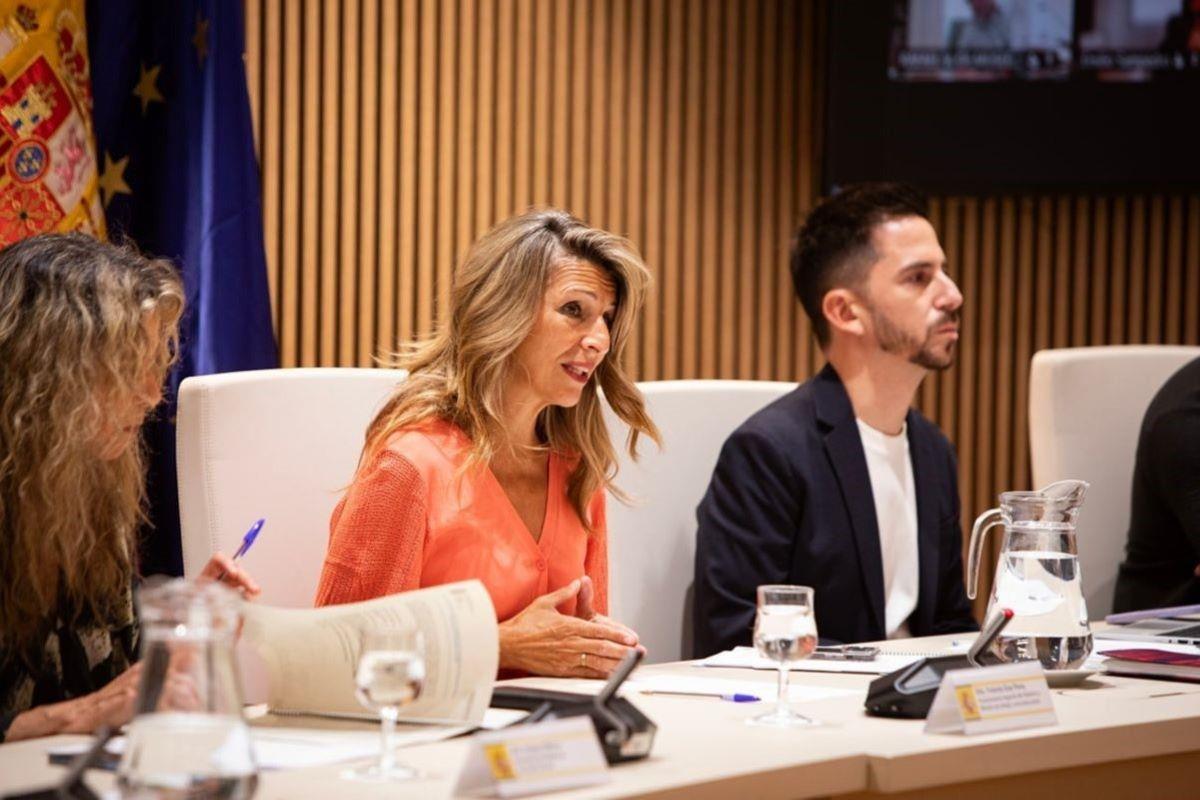 The Second Vice-President of the Government of Spain and Minister for Labour and Social Economy, Yolanda Díaz, in an appearance






The Second Vice-President of the Government of Spain and Minister for Labour and Social Economy, Yolanda Díaz, announced at the Council for the Promotion of the Social Economy, held in Madrid, that the Canary Islands will be the Capital of the Social Economy in 2027, taking over from the Catalan city of Mataró.
Díaz emphasised that, for the first time, the capital status will be based in the geographical south of Spain and will have two venues: Las Palmas de Gran Canaria and Santa Cruz de Tenerife. This joint initiative "is an example of institutional cooperation between administrations of different political persuasions and confirms that collaboration can pool capabilities and advance common objectives in the public interest", he said.
As the minister explained, the decision is based on the long-standing track record of this economic model on the islands. "Starting with cooperatives, agricultural societies and fishermen's guilds - which have historically been essential to the economic life of the Canary Islands - the social economy has, over time, expanded to encompass education, industry, transport and services across the region."
In recent years, the Canary Islands have reinforced this drive through specific measures such as the Canary Islands Social Economy Act and the Canary Islands Co-operative Societies Act; the White Paper on the Social Economy of the Canary Islands, the Commission and the Canary Islands Catalogue of Social Economy Organisations; the holding of the Social Economy Forum; and the forthcoming Canary Islands Social Economy Strategy 2026-2029, as outlined by Díaz.
Objectives of establishing the Capital of the Social Economy
The Social Economy Capital initiative was established in 2021, during the previous parliamentary term, as a measure to promote greater awareness of the social economy - the ecosystem of organisations comprising cooperatives, worker-owned companies, special employment centres with a social mission, social integration enterprises and mutual societies, amongst others. Before Mataró this year, the event had been held in Murcia, Valencia, Donostia, Santiago de Compostela and Teruel. Toledo was awarded this title in 2020, but as the European Capital of the Social Economy.
Díaz added that "the island's isolation, the climate crisis, the difficulty in accessing housing and its role as Europe's southern border - with the need to welcome and integrate those who arrive - call for coordinated, sustainable responses that are closely tied to the local area." "The Canary Islands are well aware of the scale of the challenges that lie ahead."
This role as capital will enable these challenges to be placed at the heart of the debate, drawing on the experience and expertise of Canary Islands organisations. "It will be an opportunity to share solutions, strengthen partnerships and demonstrate how the social economy can provide local, sustainable and long-lasting responses to the challenges facing the archipelago."
The decision has the backing of the organisations representing the social economy in the Canary Islands and Spain, as represented by CEPES, whose commitment and work are essential to continuing to consolidate this ecosystem on the islands.
Non official translation