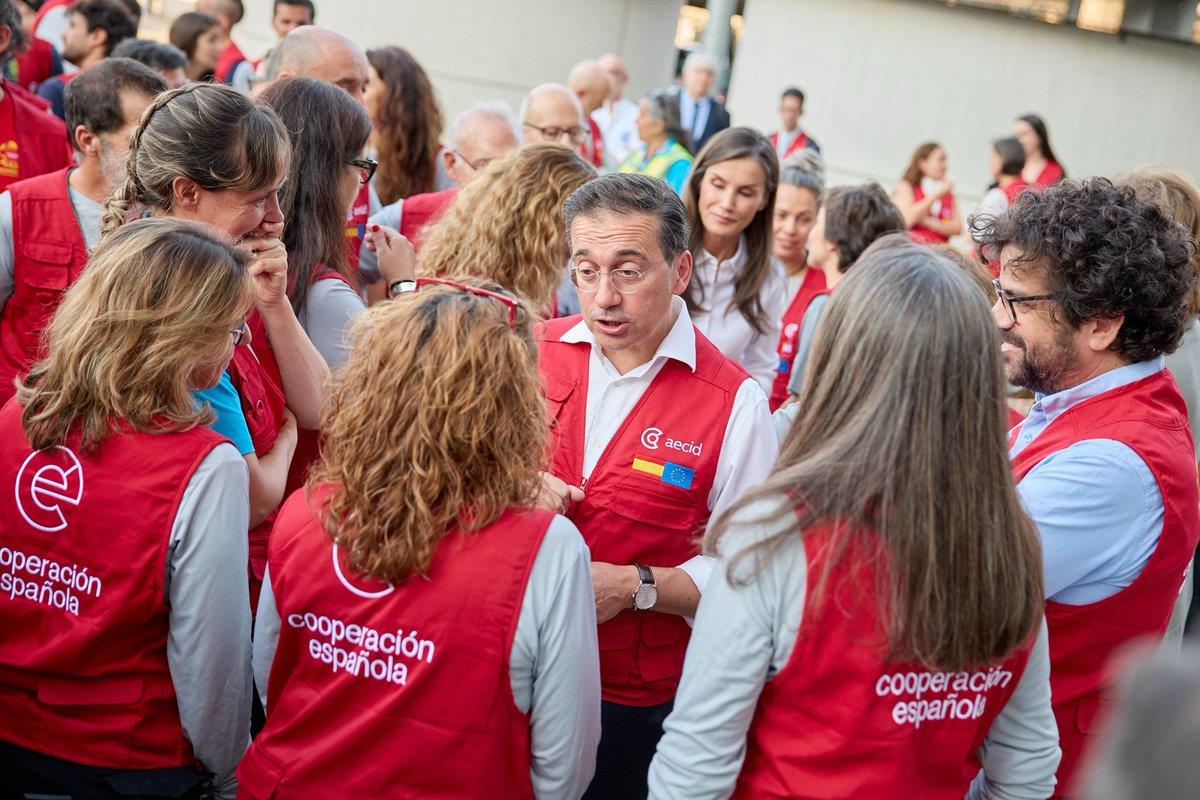
 The Minister for Foreign Affairs, European Union and Cooperation, José Manuel Albares, and Queen Letizia bid farewell to the volunteers






The Minister for Foreign Affairs, European Union and Cooperation, José Manuel Albares, bade farewell, at Adolfo Suárez Madrid-Barajas Airport, alongside Queen Letizia, to the 44 volunteer healthcare professionals, logistics staff and cooks from the Spanish Agency for Development Cooperation (AECID)'s START field hospital, who are flying to Venezuela.
The minister thanked the volunteers for their "enormous support and solidarity in joining this health response", which exemplifies Spain's solidarity with the world. In his remarks, Albares emphasised that the rapid humanitarian response is not only guided by the principles of international solidarity and human rights, "but, in this particular case, is also inspired by a deep bond of fraternity with the Venezuelan people, which shapes our Ibero-American identity".
Spain's response to the crisis in Venezuela
In his remarks, the minister argued that, in the face of a tragedy of this magnitude, the response can only be a collective one. "The international community - through the United Nations system, the European Union, and the array of humanitarian actors - has activated emergency mechanisms that underscore the importance of effective multilateralism, cooperation between states and humanitarian action guided by the principles of humanity, neutrality, impartiality and independence".
Albares announced that a further consignment of Spanish aid, worth 300,000 euros, will be sent shortly. The deployment of the Spanish Technical Emergency Assistance and Response Team (START) complements the assistance already provided immediately by the Government of Spain. Within just 24 hours of the earthquakes in Venezuela, AECID mobilised 1 million euros in emergency aid for the country's population, channelled through the International Red Cross Movement. AECID also worked closely with Civil Protection to deploy 63 personnel and 9 rescue dogs, alongside its own team dedicated to on-the-ground assessment and identification of the most urgent health needs.
"Today we are saying loud and clear to the Venezuelan people that they are not alone," said Albares, while affirming Spain's commitment to supporting rescue, emergency and reconstruction efforts in Venezuela. "We will continue to work with all the international stakeholders involved to ensure an effective, coordinated and coherent response that meets the needs at hand."
Deployment within 36 hours
Once the deployment of staff and equipment has been completed, the field hospital is operational within approximately 36 hours. On this occasion, the START team will be deployed in the EMT1 format, which comprises an Emergency Medical Team with outpatient capabilities designed to provide basic and emergency healthcare without hospitalisation, specifically adapted for contexts requiring strengthened primary care.
START is designed to operate completely self-sufficiently, with its own electricity generation, water supply, logistics and medical supplies, thereby avoiding placing an excessive burden on local services which, in the early stages of an emergency, are often severely affected.
A wide range of personnel deployed
The 44 healthcare professionals, logistics staff and cooks who will be providing support in Venezuela come from various regional governments, local bodies and partner NGOs, such as CESAL and Médicos del Mundo; the minister highlighted this diversity as an example of the effectiveness of Spain's coordinated humanitarian response. A total of 90 professionals are expected to be deployed across the two START rotations initially planned.
Repsol has chartered two flights for the START deployment. The first flight, operated by Iberia, is transporting the 44 health professionals, logistics staff and cooks from the NGO CESAL, as well as personnel from TRAGSA and AECID - including AECID Director Antón Leis - and representatives from development NGOs working on the ground. On a second flight due to depart this Wednesday from Torrejón, where the AECID hangar is located, the START infrastructure will be transported, along with more than 150 pallets of humanitarian supplies and emergency aid.
The START deployment operation is being carried out in coordination with the Venezuelan national authorities, as well as with international response mechanisms such as the EU Civil Protection Mechanism and the World Health Organisation's (WHO) Emergency Medical Teams (EMT) initiative. Experience shows that a coordinated international response is essential to saving lives. Spain is therefore committed to multilateralism and to organised humanitarian action, based on the needs identified on the ground and coordinated with national authorities and international organisations, thereby avoiding duplication and ensuring that ais reaches the areas where it is most needed.
The START response is part of Spanish Cooperation's specialised humanitarian capabilities. Its recent track record demonstrates its ability to adapt to different types of crises, having been deployed to respond to the needs arising from the earthquake in Turkey (2023), the hurricane in Jamaica (2025) and Cyclone Idai in Mozambique (2019).
Non official translation