More than 25,000 people from 17 countries worked in Spain in 2025 through circular migration programmes
News - 2026.6.25
 The Minister for Inclusion, Social Security and Migration, Elma Saiz, during her speech at the event





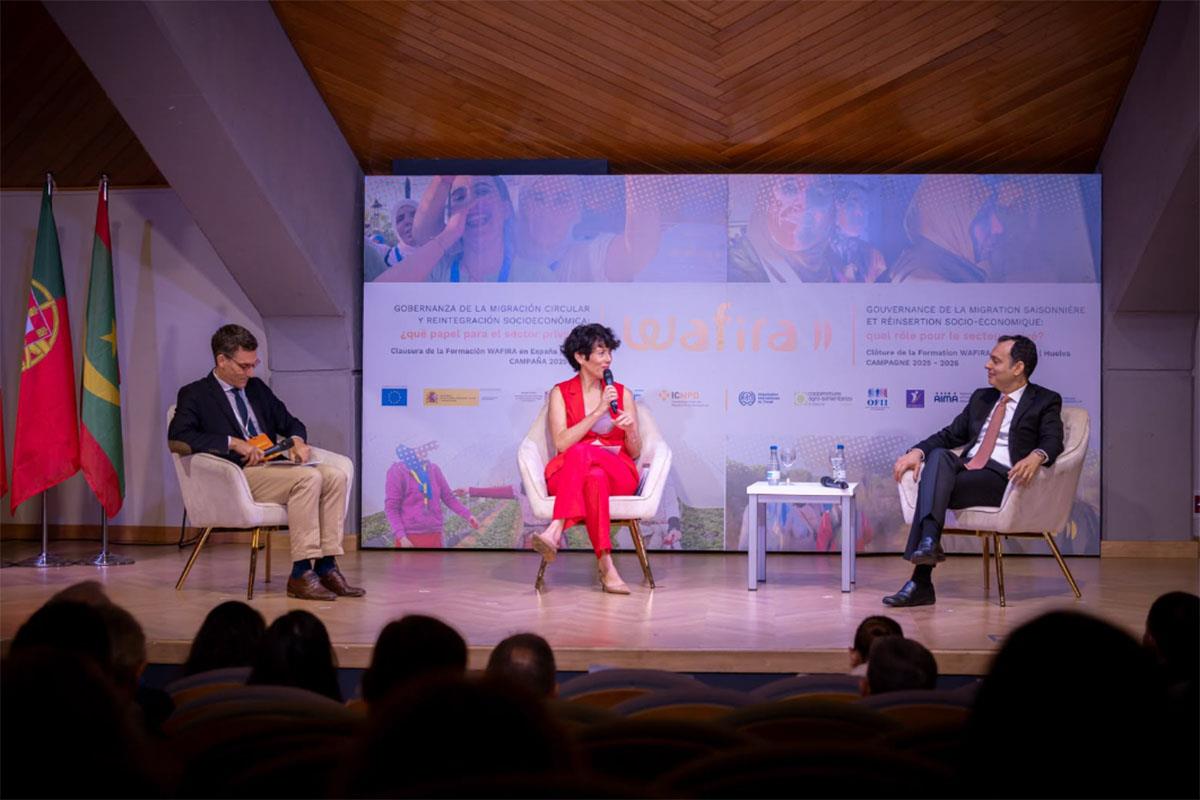
At the conference 'The Governance of Circular Migration and Socio-economic Reintegration': What Role for the Private Sector?, held in Huelva, the minister emphasised the importance of orderly and safe labour mobility as "a tool for creating opportunities, meeting labour market needs and strengthening the ties between our societies".
The event, which is being held in Huelva and is organised by the State Secretariat for Migration in collaboration with Cooperativas Agroalimentarias de Andalucía, also features the participation of the Moroccan Minister for Economic Inclusion and Small Businesses, Younes Sekkouri. "The experience of cooperation on circular migration between Spain and Morocco, spanning over 25 years, serves as a particularly valuable benchmark for further improvement", said Saiz.
Minister Younes Sekkouri agrees that "the excellent cooperation between our countries confirms that circular migration can be a real driver of shared development when it is based on close coordination between institutions, businesses and social partners".
The conference programme includes contributions from social partners and companies involved in circular migration programmes in the Huelva region. Saiz thanked them for their willingness and hard work, recognising them as a key part of a circular model that "we want to roll out to more companies and sectors, so that they incorporate collective management at source as a legitimate tool for managing seasonal staff".
The closing remarks will be delivered by Pilar Cancela, Secretary of State for Migration.
Wafira II, an example of bilateral cooperation
The event will also include a tribute and the presentation of certificates by both ministers to the first female workers at Wafira II, who arrived in Huelva last March. These 225 female workers have completed a comprehensive training programme during the agricultural season.
"Thanks to Wafira, mobility can become an opportunity to acquire new skills, develop economic projects, strengthen local leadership and create new prospects for families and communities," says Minister Elma Saiz. "It is therefore a benchmark and a groundbreaking project within our migration policy."
As Moroccan Minister Sekkouri explains, "With Wafira II, we are committed to providing greater support to working women throughout their migration journey - before their departure, during their stay and upon their return - to transform a professional experience into a sustainable opportunity for economic empowerment." "This ambition can only be realised through collaboration between public institutions and a committed private sector, capable of creating the conditions of trust, protection and innovation necessary for orderly, safe and mutually beneficial human mobility."
Wafira II is the second phase of an international circular migration project led by the governments of Spain, France and Morocco, with the support of the European Union, which aims to support 3,000 Moroccan workers during their employment experience in Europe.
The initiative, which in its second phase extends its scope to six countries - Morocco, Spain, France, Portugal, Mauritania and Cape Verde - seeks to promote labour mobility that is safe, orderly and beneficial for both the migrants and the regions of origin and destination. The project is based on a comprehensive approach that supports participants before departure, during their employment abroad and upon their return, facilitating their socio-economic reintegration in their home countries.
25 years of orderly circular migration
The Collective Management of Recruitment at Source (GECCO) is one of the main drivers of Spanish migration policy and an international benchmark for circular, regular and orderly migration. This scheme, which has been in operation since 2000, enables the planned recruitment of foreign workers from their countries of origin through the collective processing of residence and work permits, with full legal and employment protections.
In 2025, the programme achieved record figures, with 25,767 participants - 25% more than the previous year - from 17 countries and employed across 21 Spanish provinces. "The GECCO scheme demonstrates that it is possible to establish mobility mechanisms that are stable, effective and beneficial to workers, employers and the regions involved," said Saiz.
Morocco is the main country of origin, accounting for 81% of recruitment, with a workforce that is predominantly female, whilst regions such as Huelva host the bulk of the activity. Furthermore, GECCO incorporates key mechanisms for circular migration, such as the seasonal nature of contracts and a commitment to return, thereby promoting safe and sustainable mobility pathways and contributing to the development of both countries of origin and destination.
Non official translation