Home Affairs brings forward the start of the state's summer campaign against forest fires to 1 June
News - 2026.5.21
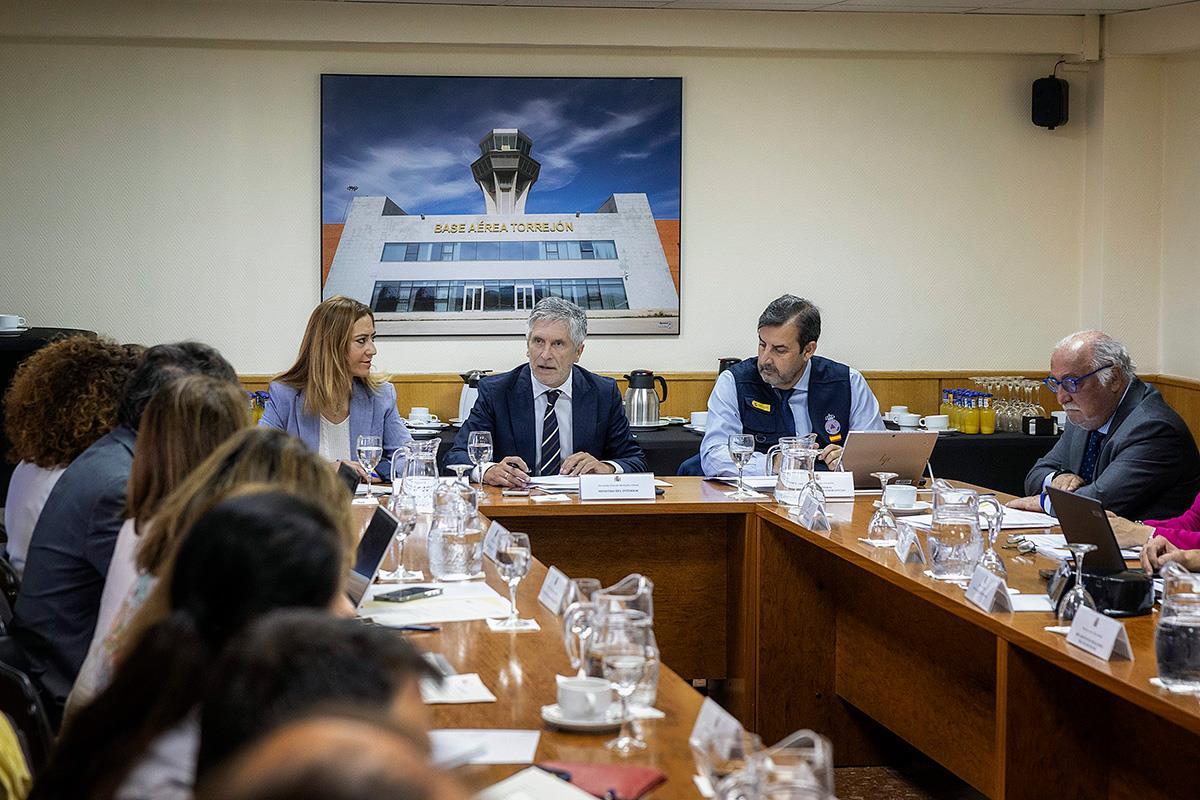 The Minister for Home Affairs, Fernando Grande-Marlaska, during the meeting of the State Coordination and Management Committee of the State Civil Protection Plan for Forest Fire Emergencies





The state campaign against forest fires originally scheduled for the summer period of 2026 is being brought forward to 1 June by decision of the State Coordination and Management Committee (CECOD) of the State Civil Protection Plan for Forest Fire Emergencies which, chaired by the Minister for Home Affairs, Fernando Grande-Marlaska, has assessed the evolution of the risk of fires this summer at a meeting held this Thursday at the Torrejón de Ardoz air base (Madrid).
The CECOD, in which all the member institutions and organisations of this coordination centre participated, evaluated the results of the 2025 campaign, marked by the increase in fires and their greater severity, examined the resources available for this campaign and the weather forecasts for the coming months, after which it decided to bring forward the start of the state campaign for the second year in a row.
During his address, Grande-Marlaska emphasised "the need to anticipate the response of the National Civil Protection System to a scenario marked by an increase in wildfires and their greater complexity, in a context of extreme temperatures and prolonged heat waves".
The CECOD meeting was attended by representatives from the State Secretariat for Security, the General Secretariat for Civil Protection and Emergencies, and the Directorates General for Coordination and Studies, the National Police, the Civil Guard, and the Traffic Division.
In addition, the following are members of CECOD: the Directorate General for Biodiversity, Forests and Desertification and the State Meteorological Agency, belonging to the Ministry of Ecological Transition and Demographic Challenge; the Directorate General for Defence Policy and the Military Emergency Unit of the Ministry of Defence; the National Security Department of the Presidency of the Government and the Environmental Prosecutor's Office of the Office of the Crown Prosecutor.
State-level device
Data recorded between 1 January and 15 May 2026 shows an unfavourable trend, with 127 reported fires compared to 40 during the same period in 2025, representing an increase of 218 percent. During this period, three major forest fires have broken out and six have had civil protection consequences.
These indicators confirm an upward trend in risk that could intensify during the summer months. This fact, coupled with the anticipated rise in temperatures, which suggests a warmer-than-normal summer, and the increase in water stress, has led the CECOD to bring forward the start of the state-level forest fire campaign to 1 June to anticipate the response and ensure the full activation of resources before the critical period.
With regard to the resources provided for this operation, the Ministry of Ecological Transition and Demographic Challenge is contributing its Forest Fire Reinforcement Brigades (BRIF), the Mobile Analysis and Planning Unit (UMAP), the Comprehensive Forest Fire Prevention Teams (EPRIF), and the Preventive Work Brigades (BLP), in addition to 56 aircraft: 31 helicopters and 25 aeroplanes and water bombers.
As for the Military Emergency Unit, it will make available to the state campaign five Intervention battalions with 32 Forest Fire Fighting modules, a Communications Battalion and a Support and Intervention Regiment that will have fifteen heavy intervention vehicles, 25 medium-sized vehicles, nine ambulances with advanced life support, seven minibuses and two teleoperated self-propelled machines.
In addition, the General Directorates of the National Police, Civil Guard, and Traffic have designed the operational deployments of their respective personnel as needed in the event of a fire that requires the confinement or evacuation of affected populations.
All these resources and mechanisms are complementary to those of the autonomous communities, which are the administrations with their own jurisdiction for the prevention, fighting and response to forest fires.
2025 Overview
2025 was characterised by a marked increase in both the number of fires and the forest area affected, with 354,793 hectares burnt, more than triple the average of the last decade, in a total of 8,189 fires recorded.
These figures demonstrate a progressive intensification in the severity and extreme behaviour of the fires. In total, 63 major forest fires were recorded last year, accounting for 86 per cent of the burnt area and mainly affecting Castile and León, Galicia and Extremadura.
Half of these major fires affected between 1,000 and 5,000 hectares, while nine burned more than 10,000 hectares and five burned more than 20,000 hectares, in what are now known as megafires.
The consequences for civil protection were particularly significant, with eight people dead, 86 injured and more than 42,000 evacuated, in addition to damage to infrastructure and disruptions to communication routes. State resources intervened in most of the relevant fires, with the UME taking part in 49 emergencies, highlighting the importance of this state mechanism.
The most critical episode occurred in August, when the simultaneous occurrence of fires forced the State Plan to be activated in the pre-emergency phase and international support to be requested. Spain received assistance from nine countries, with the deployment of air, personnel and ground resources.
Prevention, information and cooperation
International cooperation is one of the key elements of the state's summer fire-fighting system. With the help of the EU Civil Protection Mechanism and bilateral agreements with neighbouring countries, their cooperation, which was key during the most severe events of 2025, will be reinforced this summer.
Likewise, the General Secretariat for Civil Protection and Emergencies will continue to promote prevention and public awareness tools such as access to the Fire Danger Map through the National Alert Network.
In this way, the Ministry of Home Affairs reiterates its commitment to strengthening the capacity to anticipate and respond to emergencies, with the aim of protecting lives, property, the environment and historical, artistic and cultural heritage.
Non official translation