Spain calls for international cooperation against punitive migration policies at the United Nations
News - 2026.5.8
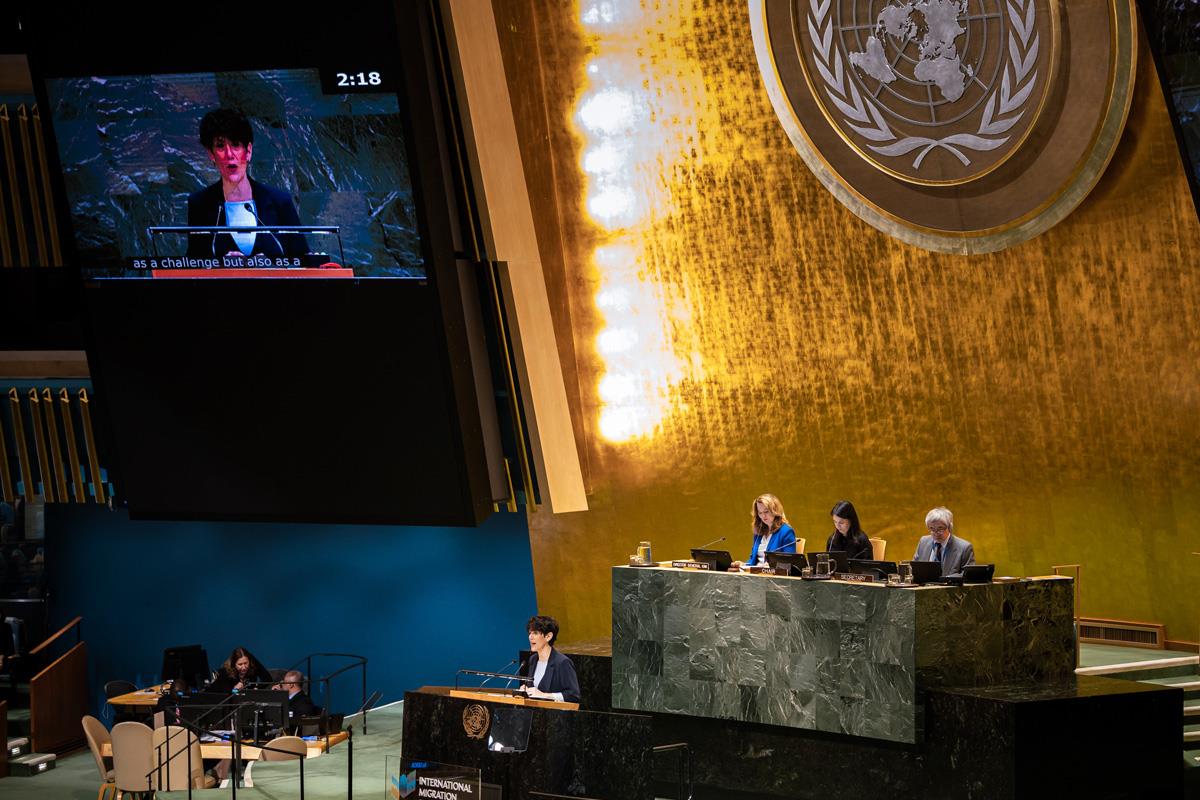 The Minister for Inclusion, Social Security and Migration, Elma Saiz, during her speech at the II International Migration Review Forum (IMRF), held at the United Nations headquarters





"In contrast to reductionist, exclusively reactive approaches or those focused on punitive measures, migration demands international cooperation, shared responsibility, and a shared vision," asserted Minister Saiz during her address to the general debate of the Second International Migration Review Forum (IMRF), held at the United Nations headquarters in New York.
In her remarks, Saiz reiterated the importance of strengthening multilateralism and the role of international organisations, and in particular, the United Nations system, "irreplaceable as a political and normative benchmark."
The forum is the main international platform for monitoring the Global Compact for Safe, Orderly and Regular Migration and is currently bringing together representatives from 133 countries, international organisations, civil society, and multilateral entities at a particularly relevant time for the global debate on migration.
The opening plenary session included speeches by the President of the United Nations General Assembly, Annalena Baerbock; the United Nations Secretary-General, António Guterres; and the Director General of the International Organization for Migration (IOM), Amy Pope, among other institutional and civil society representatives.
In this context, Spain has advocated for the need to move towards migration governance based on international cooperation and the strengthening of regular, orderly, and safe pathways.
In recent years, Spain has established itself as an international leader in migration policies due to a model focused on rights, integration, and the orderly management of migration flows. In this regard, Saiz championed "an approach that places the dignity of migrants and the full respect for their rights at the centre, and that understands migration not only as a challenge, but also as a shared opportunity."
Regularisation and migration governance
During this event, the minister also participated in the side event "Successful regularisation from all angles: Multi-stakeholder lessons for implementation on the ground," jointly organised by the governments of Spain and Colombia, along with international organisations and civil society organisations.
The meeting served to exchange experiences and analyse the impact of regularisation processes from the perspective of social cohesion, the protection of rights, and the functioning of the labour market.
During her address, the minister defended regularisation as a migration governance tool capable of responding to existing labour and social realities, as well as an instrument to combat the underground economy and strengthen integration.
Migration cooperation with Colombia
As part of the bilateral agenda, the Minister met with the Colombian Minister of Foreign Affairs, Rosa Yolanda Villavicencio Mapy, to strengthen migration and socio-labour cooperation between the two countries.
Colombia is currently the country of origin for the largest number of foreign workers registered with the Spanish Social Security system. Over the last decade, the number of Colombian registered workers has increased from around 50,000 to more than 264,000 in 2026, consolidating one of the communities with the largest presence in the Spanish labour market.
According to the latest figures, the Colombian community in Spain is approaching one million people, and, at the same time, approximately 52,000 Spaniards currently reside in Colombia. This makes the meeting of the delegations essential for strengthening relations between the two countries and ensuring the protection and well-being of their citizens.
Rights of migrant workers
Minister Saiz also held a meeting with Ecuador's Deputy Minister of Human Mobility, Saúl Pacurucu, focused on strengthening migration dialogue between the two countries and the need to continue guaranteeing the rights of migrants.
Currently, approximately 415,000 Ecuadorians live in Spain, and around 75,000 are registered with the Spanish Social Security system. At the same time, approximately 60,000 Spaniards live in Ecuador.
Meeting with the International Organisation for Migration
The day's agenda also included a bilateral meeting with the Director General of the IOM, Amy Pope, to discuss cooperation between Spain and the international organisation on migration governance and labour mobility.
During the meeting, both parties agreed on the importance of strengthening the multilateral approach and maintaining a public narrative based on human rights, cooperation, and evidence, in contrast to discourses that oversimplify migration.
The minister also extended an invitation to the IOM to participate in the 5th Migration and Development Forum, to be held in Huelva on 4 and 5 June.
Minister's address at the plenary session
The Minister addressed the plenary session of the 2nd International Review Forum on Migration to advocate for the need to strengthen multilateralism and move towards shared migration management based on rights and international cooperation.
Minister Elma Saiz's address in the General Debate
2nd International Migration Review Forum
Your Excellencies, friends,
In a complex international context, and also within the framework of regional debates where it has not always been possible to reach ambitious common positions, we wish to reaffirm today a clear conviction: migration is a global phenomenon that demands global responses.
Spain has consistently defended a humanist, multilateral, and rights-based approach. An approach that places the dignity of migrants and the full respect for their rights at the centre, and that understands migration not only as a challenge, but also as a shared opportunity.
This stance translates into a firm commitment to strengthening regular, orderly, and safe migration pathways. In practice, this is realised through innovative initiatives that we are developing together with countries in Latin America, the Maghreb, and sub-Saharan Africa, adapted to the specific realities of each context and aimed at generating mutual benefits.
Because effective migration governance cannot be built from a single perspective. It must address the needs of both countries of origin and destination, recognising the diversity of migrant profiles and the particularities of each route.
In contrast, reductionist approaches, exclusively reactive or focused on punitive measures, have proven insufficient. Likewise, addressing this phenomenon through isolated or fragmented actions is not viable. Migration, by its very nature, transcends borders and requires cooperation, shared responsibility, and a common vision.
Therefore, Spain reiterates the importance of strengthening multilateralism as an essential framework for the effective, fair, and sustainable management of migration. In this regard, the role of international organisations, and in particular the United Nations system, is irreplaceable as a political and normative benchmark.
Today more than ever, it is crucial to preserve and reinforce a narrative based on cooperation, evidence, and the values that unite us as an international community.
Spain will continue working constructively to move forward in this direction.
Thank you very much.
Non official translation