The labour market has consistently exceeded 10 million registered female workers over the past year
News - 2026.3.3






Social Security has now had more than 10 million female registered workers for 13 consecutive months, reaching 10,257,248 in February. "In a few days, we will celebrate International Women's Day, and there is no better statistic than this: there are more women working than ever before, and increasingly under better conditions, with more permanent contracts and contribution bases that are increasing month by month", explains Minister Elma Saiz.
Overall, the average number of Social Security affiliates was 21,670,636. The labour market has added 474,482 workers in the last year, 97,004 in the last month alone. "Overall, the month of February has shown very positive results for affiliation," Minister Elma Saiz stresses "Since 2007, only two Februaries have seen greater increases than this one, which has the highest number of employed individuals on record for this month of the year".
Taking seasonality and calendar effects into account, Social Security recorded nearly 22 million contributors in February, specifically 21,930,259, the highest level in the historical series. This represents an increase of 45,220 registered workers in the last month alone and more than 2 million more since before the labour reform.
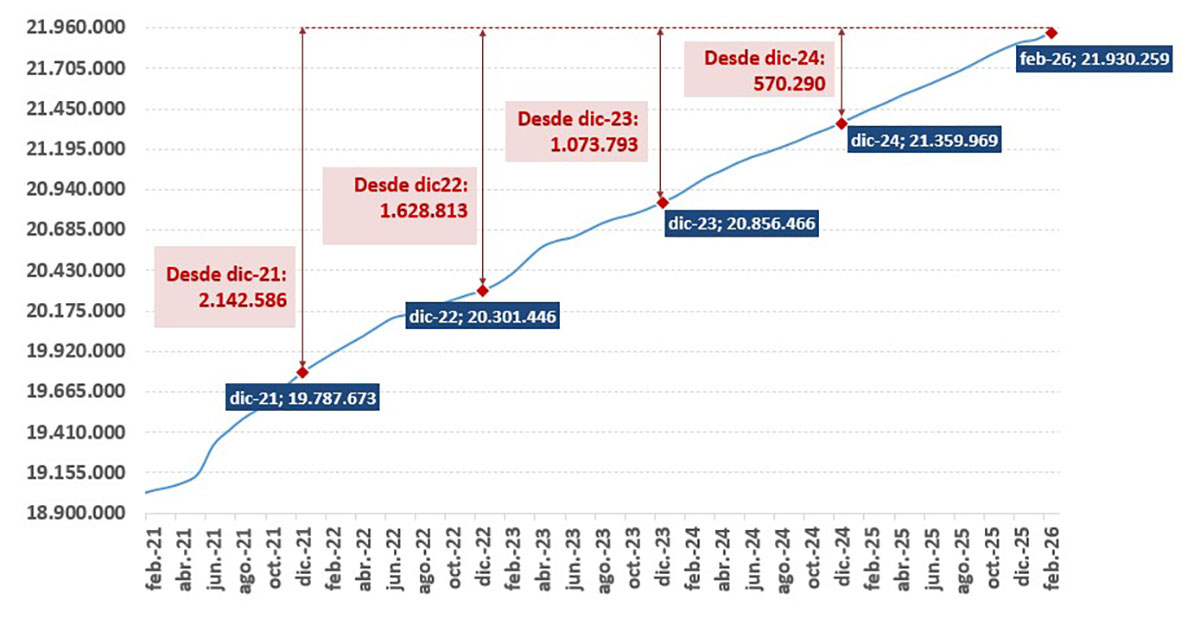
As for foreign workers, their numbers remain at record highs this month, with 3,076,837, which is 202,439 more than a year ago, and now represents 14.2% of the total.
8 March: Women's employment grows
On the eve of 8 March, the performance of women's employment stands out. Specifically, there are 232,871 more women registered as employed than a year ago and almost 1.8 million more than in 2018, bringing the total to nearly 10.3 million employed women. Women's employment has risen by 16.8% since the year before the labour reform, 3.4 points above the figure for men. "We see that the gap is narrowing", explains Minister Saiz.
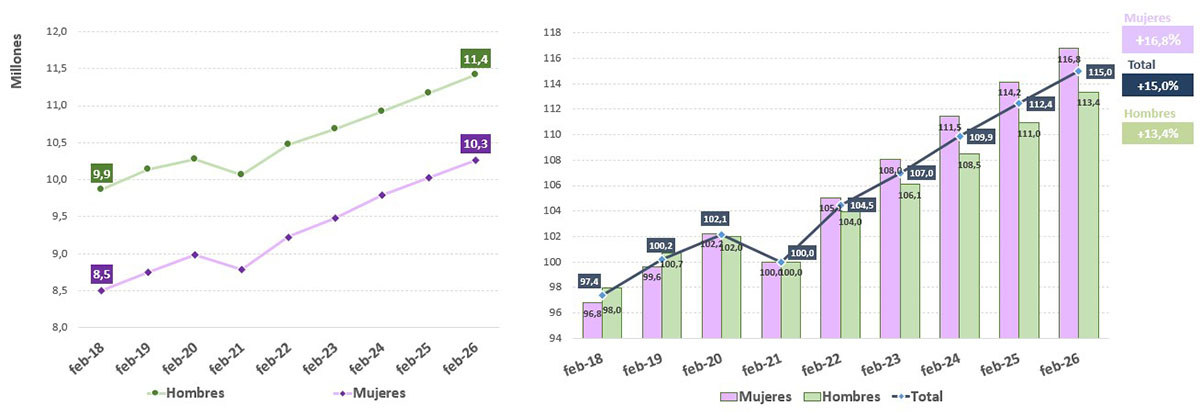
This growth in the number of women registered as employed is evident across all age groups, particularly among younger women (a 35.6% increase in contributors among women under 30) and older women (a 28.6% increase in the 55-64 age group and an 89.2% increase among those over 64).
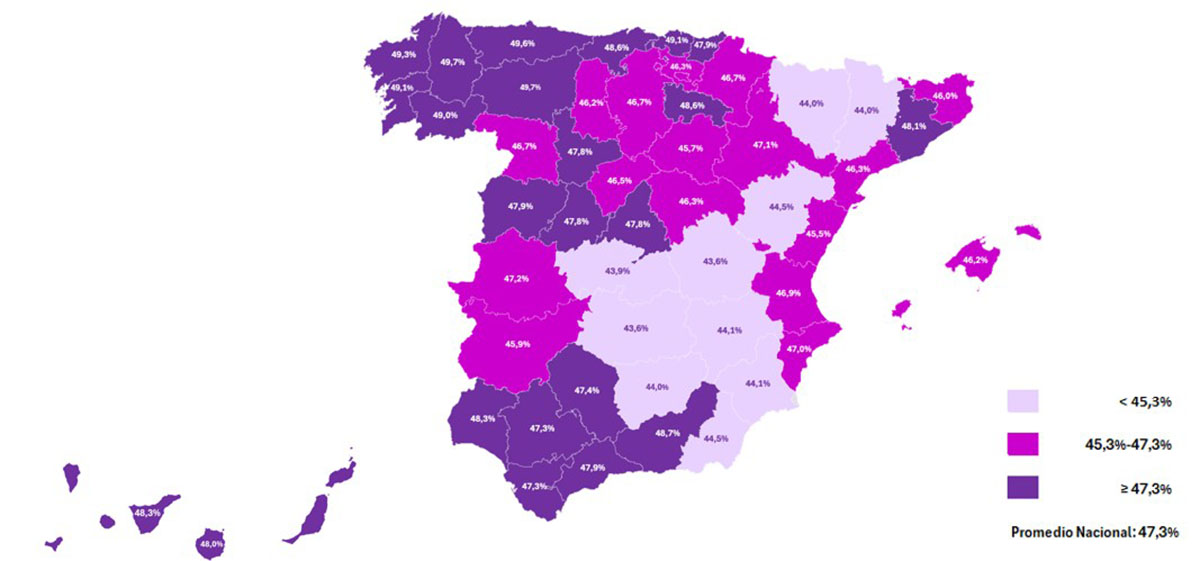
Women now represent 47.3% of all registered workers, one percentage point higher than in 2018. By province, 14 have a rate exceeding 48%.
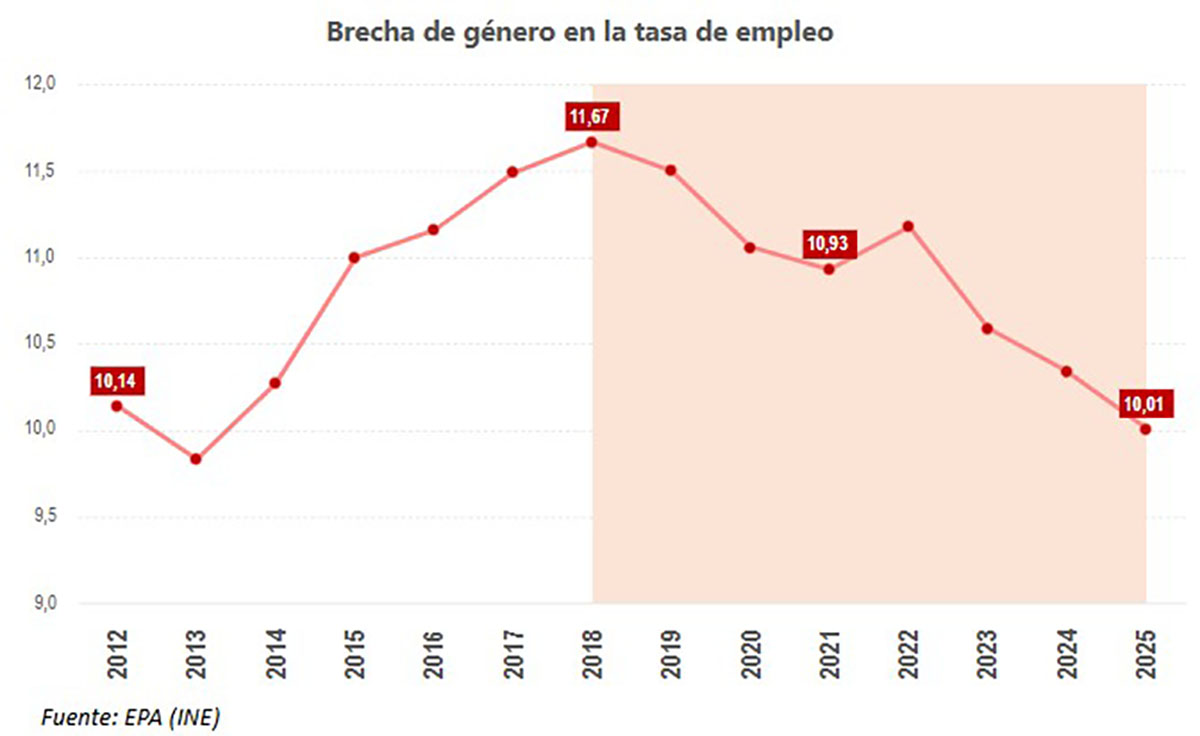
As a result, the positive trend in the number of women registered as employed is contributing to the continued narrowing of the gender gap in the employment rate, with a cumulative decrease of 14% since 2018.
Furthermore, among those currently employed, there are 1.26 million self-employed women, with an increase of 132,053 since 2018. Since 2021, the number of self-employed women has risen by 8.5%, 6 percentage points higher than the increase for men, meaning that 65% of the jobs created in the Special Regime for Self-Employed Workers (RETA) are now held by women.
And their visibility is increasing in high value-added sectors such as Scientific and Technical Activities, etc.
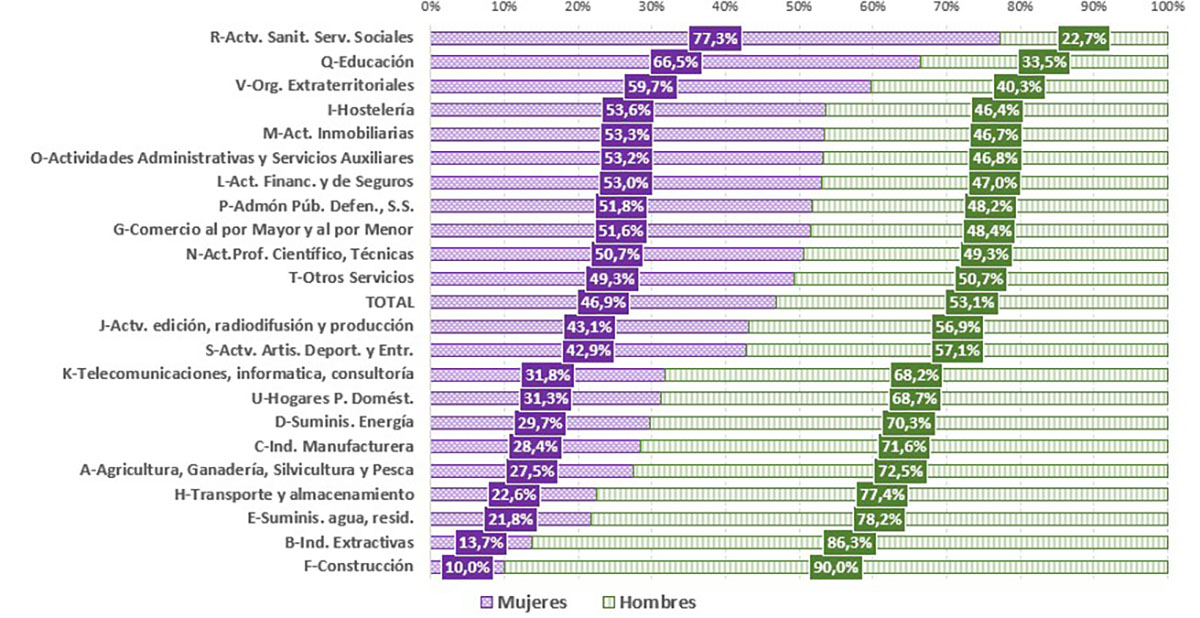
"The quality of women's employment is also improving significantly, as demonstrated by the 25.9% increase in their social security contributions since 2019, that is, 3.6 percentage points higher than for men", says Elma Saiz. "In this way, the gender pay gap is also narrowing".
Labour market
Overall, the average number of registered workers is approaching 21.7 million, with a year-on-year increase of 2.24%. In this context, some sectors stand out for having grown significantly more than the average in the last year. This is the case for Agriculture, Livestock, Forestry and Fishing (4.8%), Water Supply and Sanitation (4.7%), Transportation and Storage (4.6%), Construction (4%), and Real Estate Activities (3.7%).
Also noteworthy is the growth in high value-added activities such as Education (3.5%), Healthcare Activities (3.3%), Publishing, Broadcasting and Content Production and Distribution Activities (3.2%), and Telecommunications and Computer Programming (3.1%), as well as Professional, Scientific and Technical Activities (3%).
For the self-employed, the growth in these sectors is even more significant, with Telecommunications and Programming growing by 10.7% in the last year, followed by Publishing, Broadcasting, and Content Production and Distribution, which has grown by 9.2%.
Overall, the number of self-employed workers, which remains above 3.4 million, has grown by 1.1% in the last year.
More stability and quality in employment
There has been a major transformation in the types of contracts in our labour market since February 2021. This means 4,716,953 more contributors with permanent contracts, and 1,900,668 fewer contributors with temporary contracts. There are increasingly more stable jobs, with more rights and better salaries. The largest increase is among full-time permanent contracts, with 293,011 more than a year ago. Meanwhile, part-time contracts increased by 62,311.
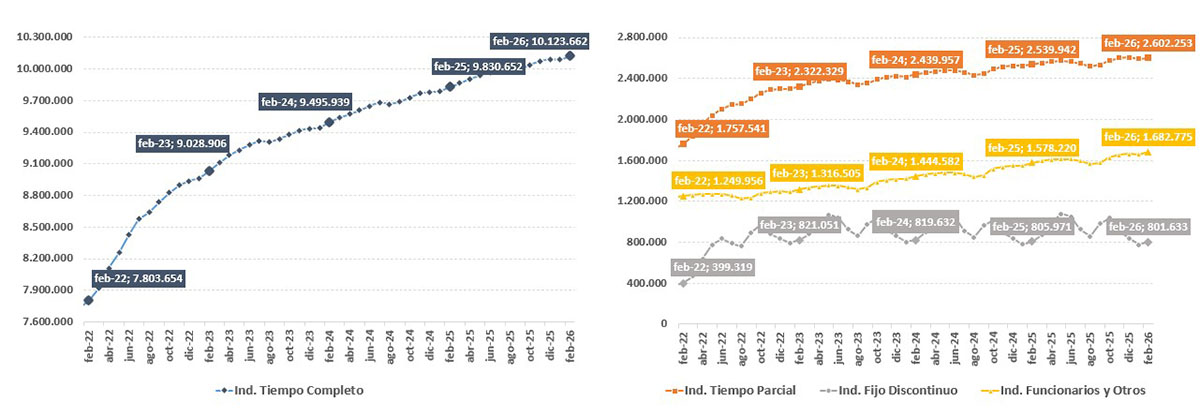
The weight of temporary workers stands at 11.5%, down from 29.5% in February 2019. This improvement is even more remarkable among workers aged 55 and over, who have a temporary employment rate of 9%, compared to more than 21% seven years ago.
Non official translation

Woman working in front of a computer