Applications to reside and work in Spain have increased by nearly 50% since the new Immigration Law Regulations came into effect
News - 2025.11.21





The new Immigration Regulation (Reloex) marks one year since its publication in the Official State Gazette, on 20 November, 2024, just one day after its approval by the Council of Ministers.
Although it came into force six months later, on 20 May, 2025, it is already possible to analyse and draw conclusions about the impact of its main measures on Spanish migration.
One of the most significant findings is the increase in applications for residence permits, both initial and renewals, as well as long-term permits. The number of applications rose from 495,000 between 1 January and 20 May, the date Reloex came into force, to 724,000 between then and 31 October. This represents an increase of almost 50%, or to be precise, 46.2%.
The new Immigration Law Regulations took into account the demands of our labour market, the needs of migrants, and the demographic challenges facing our country. To this end, they have reduced processing times and procedures, eliminated duplications, and strengthened workers' rights, in addition to providing various guarantees for hiring companies.
New residency statuses and standardisation of time limits
The new Immigration Regulations establish five residency statuses, defining and creating new categories: second chance, socio-labour, social, socio-educational and family. In addition to this new structure, they reduce and standardise the required period of continuous residence in Spain for all types of residency permits, from three years to two, except for family residency permits, which do not have this requirement.
They also apply much more flexible renewal requirements than those for the initial permit and those previously in place. Renewal thus allows applicants to reside and work for a further four years.
Six months after the new Reloex system came into effect, the data confirms the consolidation of a regulation that aims to improve people's integration and their entry into the labour market.
So, during the period from 20 May to 31 October, 95,000 people had their immigration status regularised through one of these residency pathways.
The new residence permit for family members of people with Spanish nationality
The approval of the new Reloex has also brought significant changes to the regulations governing the specific regime for family members of people with Spanish nationality. A new residence permit for family members of Spanish nationals has been created, replacing the one based on family ties that was included in the previous regulations.
Among other changes, it broadened the family ties that qualify for this permit, including children up to the age of 26, whereas the previous regulations only included children up to the age of 21. It also included stable partners with whom the applicant maintains a relationship analogous to marriage, at the level of a spouse or common-law partner, and other dependent relatives in the country of origin, such as first cousins.
The regulation also eliminated the requirement to prove financial means (except for dependent relatives) and health insurance, as required by Royal Decree 240/2007 of 16 February, which had been applied until then.
From the beginning of 2025 until the new regulation came into force, 58,000 applications for family reunification were submitted. Subsequently, between May and October 2025, once the new Reloex system was in effect, the number of applications for the new residence permit for family members of Spanish nationals reached 102,000 (a 74.5% increase).
Flexibility in student permits
Changes in the regulations have also improved many aspects related to student permits. One of the most significant changes is that for higher education, where the regulations now grant a permit that remains valid for the duration of the studies. This means that if, for example, a student is pursuing an undergraduate degree, their permit will remain valid for four years.
Furthermore, the regulations introduce the possibility of this permit beginning one month before the start of classes and extending for fifteen days after their completion. This allows students some time to organise their life in Spain and sufficient time to comfortably return to their home country.
Along the same lines of increased flexibility, the student visa now has the same validity period as the authorisation (with a maximum of one year as per EU regulations). Until the new regulation was adopted, it was valid for three months. This improvement introduced by the Reloex allows students who do not yet have a Foreigner Identity Card (TIE) to travel to their home country during holiday periods without requesting a return authorisation, since the visa remains valid.
In 2025, more than 32,000 applications for student residence permits were submitted up to 20 May, while from that date until 31 October, 93,000 applications were submitted In this case, the comparison is mainly due to the fact that the majority of enrolments take place between June and September.
Compatibility of employment and self-employment
The new regulation makes it possible to work as an employee as the main activity while also being self-employed, thus making it easier to balance work and family life. The regulations also clearly define the reasons for changing employers and stipulate that employees can voluntarily change employers after three months.
The new Immigration Regulations have also introduced positive changes to residence and work permits for seasonal workers, which now offer four years of validity, allowing a maximum of nine months of work per year, thereby aligning with the Seasonal Workers Directive. The regulations also introduce greater guarantees for the rights of these workers.
Improvements in circular migration
The new Immigration Regulations have also improved the planning and management of collective circular migration for workers recruited from their countries of origin, simplifying procedures and strengthening workers' rights and guarantees.
The new regulations for collective management incorporate procedural aspects that were previously addressed in the annual order, with the aim of improving guarantees and rights throughout this process and ensuring that recruitment from countries of origin adheres to fair recruitment criteria.
Greater protections for minors residing in Spain
The new Immigration Regulations have also brought about some significant changes regarding minors. Currently, the temporary residence permit for an accompanied foreign minor born in Spain is valid for five years from the date of issuance, after which they may apply for long-term residence.
Furthermore, the minors' permits are no longer tied to the type of permit held by their parents, thus preventing them from finding themselves in an irregular situation as a result of their parents' immigration status.
Exceptional circumstances for victims of gender-based and sexual violence
The new Immigration Regulations, in force since 20 May, 2025, extended guarantees in exceptional circumstances. Within this framework, they broadened the means of proving victim status as a victim of gender-based violence, created authorisation for exceptional circumstances for victims of sexual violence, and included the issuance of a temporary residence permit for exceptional circumstances (based on humanitarian reasons) to the ascendants of women who are victims of gender-based and sexual violence.
Non official translation
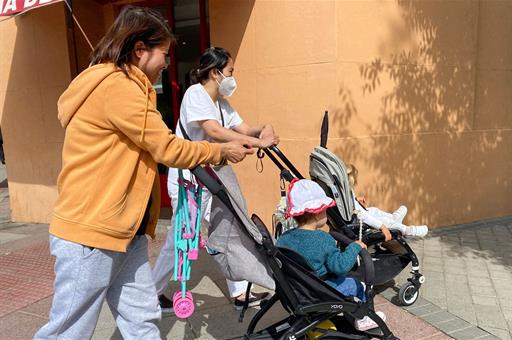
Asian families