Grande-Marlaska advocates "recovering the essence of Schengen" on the 40th anniversary of the signing of the European free movement agreement
News - 2025.6.13
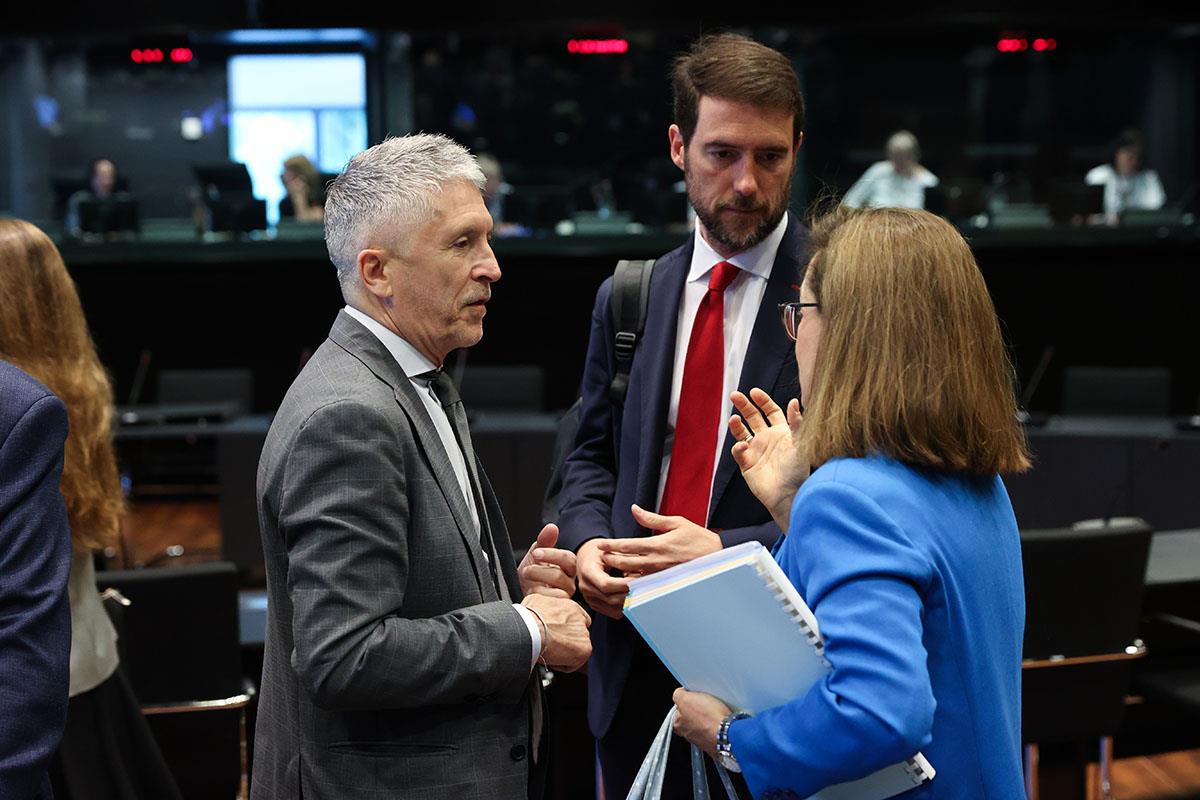 The Minister for Home Affairs, Fernando Grande-Marlaska, during the EU Home Affairs Council of Ministers






Fernando Grande-Marlaska advocated "recovering the essence" of Schengen and "returning to the founding origins" of the European area of free movement, on the 40th anniversary of the agreement signed on 14 June 1985 that abolished border controls between France, Germany, Belgium, Luxembourg and the Netherlands.
"It is no longer possible to imagine any other way of living, travelling, studying or working in the EU than in an area that is genuinely free of barriers and obstacles to freedom of movement", said Grande-Marlaska during his speech at the Council of Home Affairs Ministers held in Luxembourg, which approved a joint declaration with the Schengen associated countries and the European Commission reaffirming the commitment to a European area without internal border controls.
"We must uphold the original spirit and ensure that the new Schengen Borders Code is properly implemented, especially as regards the notification and motivation of the reintroduction or extension of internal border controls, so as not to undermine the main asset of Schengen, which is freedom of movement," the minister said.
Grande-Marlaska acknowledged that the EU today faces "a changing panorama of risks and threats" that is different from that of 1985, but he also stressed that the EU has "never before" had "so many legal instruments, so many cooperation mechanisms, so much technology and so much information at its disposal to deal with them".
Extension of temporary protection until March 2027
The Home Affairs Council has agreed to extend until 4 March 2027 the temporary protection for Ukrainians displaced by the Russian invasion, a decision backed by Spain, which has granted temporary protection to more than 245,000 citizens, making it the fourth country in the EU in terms of the number of beneficiaries it has received, despite its geographical distance from the Ukrainian border.
"We maintain our firm commitment to solidarity towards the displaced and also towards our partners bordering Ukraine in a spirit of shared responsibility, which perhaps has not been the case in other migration crises," said Grande-Marlaska during his speech.
The minister urged the EU to think "about the day after" the end of the invasion. "We must work in the medium and long term and lay the foundations for a coordinated, gradual and sustainable transition over time," he said, "and we must do this hand in hand with the authorities and the Ukrainian communities in our countries.
Bilateral meetings with Denmark, Luxembourg and Moldova
Within the framework of the Council, Grande-Marlaska held bilateral meetings with Kaare Dybvad, Denmark's Minister for Immigration and Integration, in order to learn the details of the upcoming Danish Presidency of the Council; León Gloden, Minister for Home Affairs of Luxembourg; and Daniella Misail-Nichitin, Minister of Internal Affairs of Moldova.
Non official translation