Informal Environment Council
European environment ministers call to strengthen sustainable water management to fight droughts and floods
News - 2021.4.23





Among other effects, the impacts of climate change are mainly manifested in changes to the water cycle. Therefore, particular attention should be paid to those issues related to drought and water scarcity.
Over recent years, the trend seen in Spain has been towards a gradual rise in water scarcity, which has been exacerbated by negative forecasts regarding the impact of climate change on water levels. However, droughts and water scarcity are not the exclusive problem of southern Europe. In fact, countries such as the Czech Republic, Germany and even Finland and Sweden have suffered from water scarcity in recent years. Against this backdrop, mechanisms to guarantee supply must be stepped up, while adapting water use to new hydrological patterns.
To this end, the European Union is working to step up both Europe's adaptation capacity and minimise vulnerability to the impacts of climate change and action at an economic level and in society.
Water planning requires the cooperation and participation of key sectors, principally those that extract, consume and discharge water (both surface and underground water) but which also deal with spatial planning, the financial sector (including insurance) and nature protection. Coordination between sector strategies in such fields as agriculture, energy, transport and water resource protection is fundamental for sustainable and resilient water management.
An example of priority lines of action
The National Adaptation to Climate Change Plan in Spain, approved in September 2020, is an example of the lines of action needed to be addressed as a priority. On the one hand, the integration of climate change in hydrological planning and the management of the integral water cycle must be further enhanced, prioritising the handling of such extreme events as droughts. On the other hand, risks must be reduced by promoting sustainable adaptation practices.
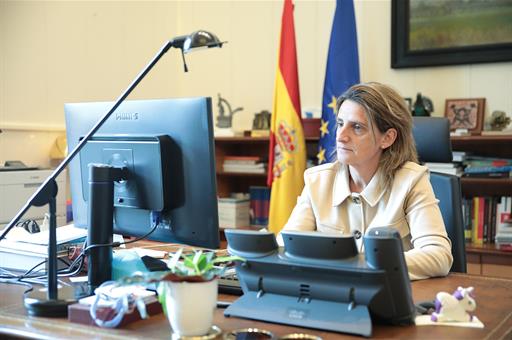
In this regard, the Fourth Vice-President of the Government, Teresa Ribera, pointed out in her speech that "nature-based solutions must play a leading role in adaptation policies". Nature-based solutions are a key tool in tackling the growing impacts of climate change, including the increased risk of drought, high temperatures, heavy rainfall and flooding.
In short, the aim is to adapt water uses to the new hydrological patterns, in such a way as to enhance resilience without renouncing the goals set in the Framework Directive on Water
Measures to achieve this include the use of regenerated water, which has proven to be an alternative water source to combat water scarcity, and which also plays a fundamental role in the transition to the circular economy. Similarly, water efficiency and management in sustainable buildings have a great potential to generate benefits associated with water savings and the security and quality of water.
The meeting was also used to address how to strengthen adaptation to climate change in the run-up to COP26.Teresa Ribera argued during the meeting that "mitigation and adaptation must go hand-in-hand.
European Adaptation Strategy
The new European Adaptation Strategy, approved this year, which Spain actively participated in drawing up, extends the adaptation component of European policies and places a new emphasis on some particularly important issues for Spain, such as agricultural policy, water management and preparation to deal with extreme climate phenomena. One of the new features considered is international action to step up resilience to climate change, strengthen cooperation and contribute to international funding, which Spain is firmly committed to.
"This awareness of our common vulnerability must translate to a new vision of adaptation, which must be conceived of as not merely a domestic challenge, but also as a common goal that we need to respond to on the basis of solidarity and equity", stated Teresa Ribera.
The Fourth Vice-President of the Government also said that despite making progress on creating regulatory frameworks, there are still major delays in terms of implementation and the funding of adaptation projects for more vulnerable countries that require more help. "We must make progress on defining mechanisms that specify the nature of the global aim of adaptation and on formulas to monitor progress. It is important to achieve balanced progress in complying with the Paris Agreement", said Teresa Ribera.
Non official translation