Spain passes over Presidency of Monitoring Committee of Luxemburg Declaration to Portugal and culminates programme under Toledo 2020 Agenda
News - 2020.12.4






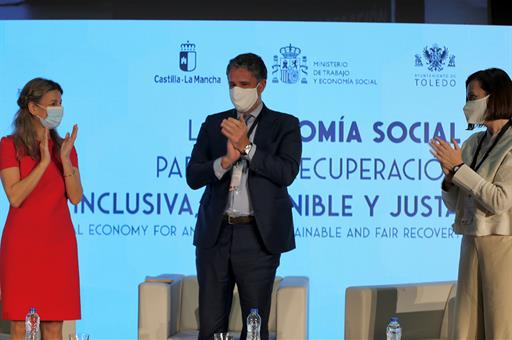
Yolanda Díaz stated that the Toledo Declaration, a text based on consensus signed up to by 16 European States, "gives a new boost to position the social economy as a key factor in exiting the crisis and the transformation of Europe". This is the year in which the highest number of Member States have signed up to a social economy declaration.
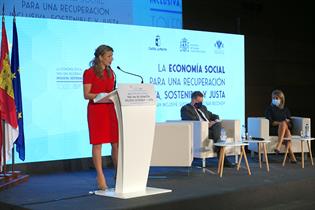
The forum held on Friday also culminates the Spanish Presidency of the Monitoring Committee of the Luxemburg Declaration, which will be held by Portugal next year. The inauguration involved the participation of the President of the Regional Government of Castile-La Mancha, Emiliano García Page, and the Mayor of Toledo, Milagros Tolón, together with the State Secretary for Employment, Joaquín Pérez Rey, and the Director-General for Self-employment, Social Economy and Corporate Social Responsibility, Maravillas Espín, who mediated Friday's sessions.
Yolanda Díaz, in reference to the Toledo Agenda, which was closed off on Friday, stated that "this responds to an internal logic and to an end goal, that of generating reflection, alliances and synergies that lay the foundations for the upcoming Social Economy Strategy 2021-2027".
 With the horizon of the social economy as a national, European and international political priority, the text approved in Toledo is the result of an open, participatory and transparent process in which all Member States took part. The Toledo Declaration contains the genealogy of a sound consensus forged over the last five years, since the agreement was crystallised based on the Conclusions of the December 2015 European Council.
The result is an important text for European citizens and regions that underlines the importance and specific nature of the social and supportive economy for the consolidation of new economic models that place people at their heart. This is also an ambitious declaration that demands, through seven key actions, the decisive commitment of Member States, European and international institutions and organisations to place the social economy model as a priority on political agendas with a view to an inclusive and sustainable future.
International participation
The meeting, held within the framework of the election of Toledo as the European Capital of Social Economy in 2020, included the presence, in addition to the main Spanish and European social economy organisations, of international representatives such as the European Commissioner for Employment, Nicolas Schmit, the Director-General of the International Labour Organization (ILO), Guy Ryder, and the Secretary-General of the OECD, Ángel Gurría, the Italian Minister for Work, Nunzia Catalfo, and the Irish Minister for Social Protection, Heather Humphreys.
Nicolas Schmit underlines Spain's role in the social economy
The European Commissioner for Employment and Social Rights, Nicolas Schmit, thanked the Ministry of Work and Social Economy for the work it has carried out and stressed that "Spain plays a leading role in making the role of the social economy more visible, ensuring that it is not only on the European and international agenda, but that it will become one of the drivers of a just recovery".
The European Commissioner also highlighted that Spain has ensured that more European countries have signed up to the Toledo Declaration and renewed the commitment of previous signatories.
Nicolas Schmit recalled the European Commission's commitment to promoting the social economy and to a "digital and green transition that is just in attenuating the dramatic consequences of COVID-19 on the economy. The request made by the President of the European Commission, Ursula von der Leyen, to draw up an "action plan" to boost the social economy to achieve "a sustainable future" is framed within this commitment.
He also highlighted the "profound commitment" of women to come out of the pandemic. Nicolas Schmit urged all countries to acknowledge the role of the sector in their recovery and resilience plans.
Guy Ryder and the commitment of the ILO
The Director-General of the International Labour Organization (ILO), Guy Ryder, expressed his concern over the economic effects of the pandemic which has brought the world's workforce to its knees, and exacerbated existing inequalities", leaving us with figures "that are increasingly more worrying", particularly for such groups as women, young people, migrant workers and those employed in the submerged economy.
The social economy, remarked Guy Ryder, will not help us create a new normal, but rather a "better normal, that is fairer and more sustainable". The sector has also suffered the effects of the pandemic but has proven to be stronger and more resilient.
Guy Ryder reaffirmed the commitment of the ILO to the role of the social economy in Europe and in Spain, where it accounts for 10% of GDP, acknowledging "its role in creating decent work". The Director-General of the ILO encouraged the work of the High-Level Meeting to "reaffirm public recognition and promote the echo of social and environmental development it represents", underlined Guy Ryder.
Ángel Gurría advocates a change of model
The Secretary-General of the Organization for Economic Co-operation and Development (OECD), Ángel Gurría, stressed the organisation's commitment to social economy bodies in which it "firmly believes" and highlighted the collaboration that allows supportive economic systems to be promoted around the world. According to Ángel Gurría, "it seeks for the social economy to move to being the norm instead of the exception, which we adhere to when doing business", and added that "we want to encourage companies to ensure that their social and environmental performance is at the same level as their economic performance".
To this end, Ángel Gurría advocated a change of model "in which the key word changes from shareholder to agent or stakeholder", he underlined. This international body, explained its leader, "is ready to help all countries promote the social economy as agents of change for a just, inclusive and ecological recovery", stressed Ángel Gurría.
Portuguese Presidency
The Portuguese State Secretary for Social Security, Gabriel Bastos, took over from the Spanish Presidency of the Monitoring Committee of the Luxemburg Declaration, and also stressed the facet of resilience and proximity to the local productive fabric of the social economy, and tied in this productive model to the goals of the European Social Pillar.
In this regard, Gabriel Bastos announced that this dialogue for a social Europe will be the backbone of the Portuguese Presidency of the Monitoring Committee of the Luxemburg Declaration, and announced the holding in the months of March, in a yet to be designated city, and in May, in the city of Porto, of an international meeting on the social economy and its role in the transformation towards an inclusive and just Europe, which lent its name to the meeting held in Toledo on Friday.
The President of CEPES, Juan Antonio Pedreño, pointed to the historic importance of 16 European countries backing the Toledo Declaration, and pointed to the need to boost a European Social Economy Plan.
Non official translation