Within the framework of the Summer Plan approved by the Council of Ministers
Ministry of Health recalls recommendation to avoid harmful effects of high temperatures
News - 2019.6.24





This initiative is framed within the Summer Plan approved by the Council of Ministers on 14 June.
The plan to protect against the health effects of high temperatures will remain in place from June 1 to September 15. During the fortnight before and the month following this period the situation will be monitored in case it is necessary to activate or reactivate the National Plan due to abnormally high temperatures.
The aim of the National Plan is to avoid or mitigate the negative effects that excessive heat can have on people's health, especially those more vulnerable or in high risk groups such as the elderly, pregnant women, children, and the chronically ill, and also anybody who works or engages in strenuous activities in the open air.
In order to minimise the harm that these people may suffer, the Ministry of Health, Consumer Affairs and Social Well-being has issued a list of ten golden rules to follow:
1. Drink water or other liquids frequently, even if you do not feel thirsty and regardless of what physical activity you are doing.
2. Be careful not to drink too many beverages containing caffeine, alcohol or large amounts of sugar, since they can actually cause you to lose more body fluids.
3. While anyone can suffer heat-related problems, pay special attention to babies and young children, the elderly, and people with illnesses that may be aggravated by heat and dehydration, such as heart conditions.
4. Stay as long as you can in cool places, in the shade or with air-conditioning, and cool off whenever you need to.
5. Try to keep physical activity to a minimum and avoid practising open-air sports at the hottest time of the day (between 12.00 and 17.00).
6. Wear light, loose-fitting, breathable clothing.
7. Never leave anyone in a closed parked car (especially babies and young children, the elderly, and the chronically ill).
8. See a doctor if you have symptoms lasting for over an hour that may be related to high temperatures.
- Keep medicines in a cool place; heat may make medicines ineffective or even change their composition and effects.
10. Prepare light meals that help replenish the salts lost due to perspiration (salads, fruit, vegetables, juices, etc.).
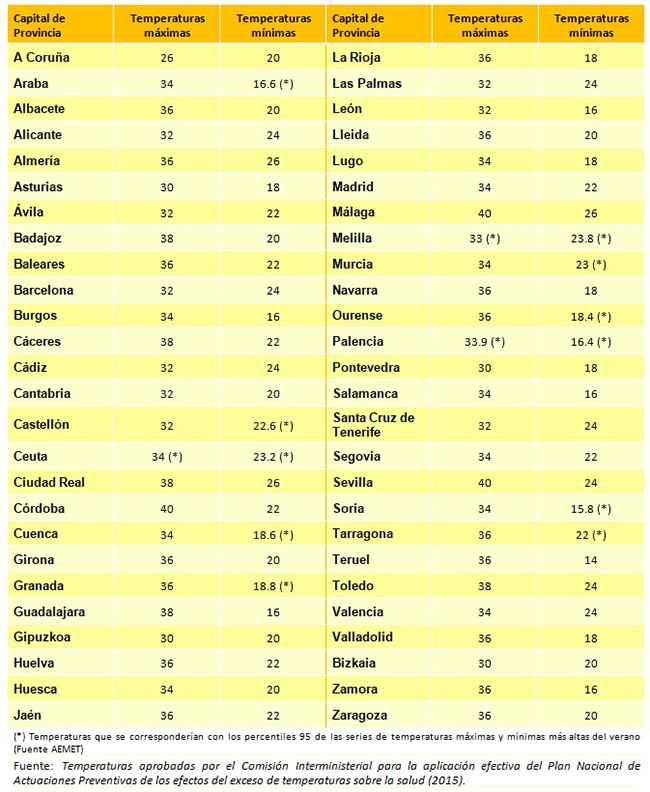
One of the priority actions under the Plan is to alert the healthcare authorities and citizens with sufficient notice of possible risk situations. To achieve this, the Ministry of Health, Consumer Affairs and Social Well-being will provide regional governments, on a daily basis, with the temperature forecasts (maximum and minimum temperatures) prepared by the State Meteorology Agency (AEMET). This information will also be available to citizens on the web page of the ministerial department.
The Plan takes into account the following meteorological variables: the maximum and minimum temperatures for the next five days, the maximum and minimum temperatures recorded on the day before the forecast, and the maximum and minimum temperature thresholds established based on epidemiological studies that associate high temperatures with mortality. This also takes into account the length of the high temperatures as a risk factor for health. The allocation of levels is performed using the following criteria:
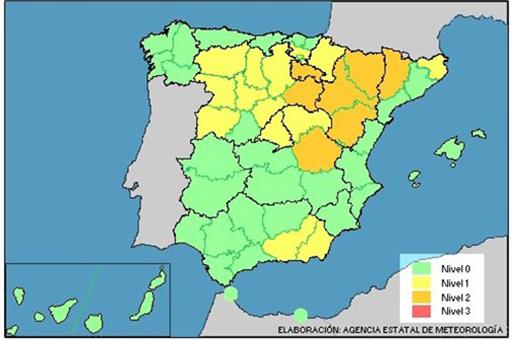
- Level 0 (green), no risk, allocated when the forecast is for none of the five following days to exceed the temperature threshold.
- Level 1 (yellow), low risk, allocated when one or two of the five following days are expected to exceed the temperature threshold.
- Level 2 (orange), medium risk, allocated when three or four of the five following days are expected to exceed the temperature threshold.
- Level 3 (red), high risk, allocated when all of the five following days are expected to exceed the temperature threshold.
This information is updated each day on the web page of the Ministry of Health, Consumer Affairs and Social Well-being. Furthermore, citizens may subscribe, until 15 September, to a service to receive an email and an SMS with the forecast for the temperatures and the risk level in the province requested. Access to these subscriptions can be made through the website of the ministerial department by clicking on the following link: https://www.mscbs.gob.es/en/excesoTemperaturas2019/suscripcion.do
In 2018, level 3 (red or high risk) was activated under the National Plan to Avoid the Harmful effects of High Temperatures on Health on 50 occasions, with Lleida being the province with the highest number of level 3 activations (8). On 2 August, there was a total of 14 provinces with level 3 warnings simultaneously.
Level 2 (orange or medium risk) was activated on 129 occasions during the period the plan is in place, with Granada (18), Pontevedra (10) and Zaragoza (10) recording the highest number of orange alerts. There was a total of 16 provinces with level 2 warnings simultaneously on 31 July.
Level 1 (yellow or low risk) was activated on 392 occasions, distributed among 42 provincial capitals, with Zaragoza (30) recording the highest number. July 30 was the day with the highest number of yellow alerts (25 provincial capitals simultaneously).
During 2018, there was a total of 79 days with an alert of some form, with the following provinces recording the highest number: Granada and Zaragoza con 46, followed by Lleida with 35 and Murcia with 33. The week with the most alerts was 30 July to 5 August, with a total of 113 activations of level 1 (yellow), 78 of level 2 (orange) and 42 of level 3 (red).
From 15 September to 15 October 2018, two activations were recorded for level 1 (yellow) alerts, one in Badajoz and another in Cadiz.
No alert above level 0 was recorded in 10 provinces.
 Ministerio de Sanidad, Consumo y Bienestar Social
Non official translation
Ministerio de Sanidad, Consumo y Bienestar Social