




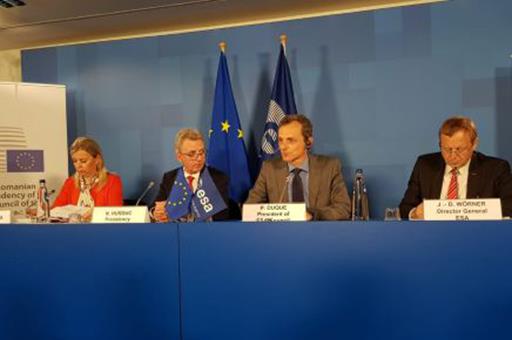
Pedro Duque, the Acting Minister for Science, Innovation and Universities, has co-chaired the ninth joint EU and European Space Agency (ESA) Space Council.
The Space Council has brought together the European ministers responsible for space with high-ranking representatives of the ESA in Brussels, with the theme "Space as an Enabler". The meeting was held in the context of the EU Competitiveness Council, at which the ministers also discussed the role of the EU in global space policy.
The Space Council is a forum that coordinates European space programmes in order to strengthen Europe's position in space, increase its market share and leverage the benefits of its research.
This joint Council was set up to coordinate and facilitate EU and ESA space activities through a Framework Agreement adopted in 2003. Its last meeting was held in 2011.
The ninth joint EU/ESA Space Council was held at the initiative of the ESA's Ministerial Council held in October 2018 in Madrid, also chaired by the minister, Pedro Duque. At that meeting, European ministers agreed unanimously on the need to revitalise the joint EU/ESA Space Council.
The Space Council, which is an essential element for Europe's success in its objectives in space, now has its continuity guaranteed: Germany has announced it will organise the 10th Space Council in the second half of 2020, coinciding with its rotating presidency of the EU.
During his speech in Brussels, Pedro Duque highlighted the importance of "consolidating Europe's leadership in space and implementing the resources needed to achieve this objective."
The minister also highlighted "the need to ensure the complementarity of public investment in space and the establishment of a clear set of objectives and the better use of experience and existing capacities to maximise the return on investment in space activities through the EU and ESA."
"Developing, maintaining and improving space assets is key to guarantee the services and applications that space provides for society, as well as to protect citizens against threats coming from both the Earth and space."
The space economy
The global space economy amounted to 309 billion euros in 2017, with growth that nearly doubled that of the global economy as a whole. The European space industry employs over 230,000 professionals. It manufactures a third of the satellites in the world and in 2016 had sales of 8.2 billion euros, according to Eurospace figures.
The ESA and EU contribute most of the budget that Europe dedicates to space. Specifically, in the period 2021-2027 they will allocate over 40 billion euros to space activities between them.
The revitalisation of the Space Council will mean that these European space activities can be managed in a coordinated fashion.
Spain: a European space power
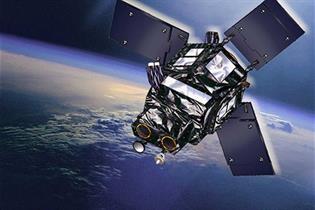 EFESpain has consolidated its position as a European space power, thanks to advances made over the last decade. Currently, our country is responsible for complete space systems, among which are the INGENIO satellite, which will form part of the European Copernicus programme as a "contributory mission".
This Spanish Earth observation satellite, managed by the Centre for Industrial and Technological Development (Spanish acronym: CDTI) will be launched into orbit in the second quarter of 2020. It will provide high-resolution images for use in services such as cartography, urban planning, agriculture, forest mapping and aquifer management.
The next ESA Ministerial Council will be held in Seville in November 2019. It is expected to approve new space programmes amounting to between 10 billion and 14 billion euros. This will provide new opportunities for the Spanish space sector to take the lead in ambitious European initiatives.
Non official translation
Ministerio de Ciencia, Innovación y Universidades