National Archaeological Museum of Spain and Acciona reach a milestone in the preservation of historic heritage with the 3D printing of the Arch of San Pedro de las Dueñas
News - 2019.4.8





This technological milestone comes as a result of the collaboration agreement signed between theNational Archaeological Museum and ACCIONA aimed at using ground-breaking techniques that contribute towards the awareness and preservation of Spain's historical heritage.
At the presentation ceremony, Andrés Carretero, Director of the National Archaeological Museum, highlighted that this milestone "makes the museum one of the most advanced in the world in terms of applying new technologies aimed at the preservation and spread of cultural heritage".
In turn, Juan Ignacio Entrecanales, Executive Vice-Chairman of ACCIONA, which organised the printing of the arch, stressed the importance of the essential collaboration between the private and public sector and its institutions in driving innovation forward. He highlighted "the significance of this joint project between ACCIONA and the National Archaeological Museum, which has showcased the immense potential that these new technologies, such as 3D printing, have for the preservation, presentation, restoration and accessibility of cultural heritage".
The collaboration agreement between MAN and ACCIONA is fully in line with the museum's strategy of harnessing technology to bring historical awareness to its installations and of contributing the very latest advances in the conservation and preservation of historical heritage.
In turn, ACCIONA consolidates its position as an international benchmark in museology with the development and strengthening of its know-how in introducing the most innovative technologies to exhibition areas and museum spaces.
The project and the selected works
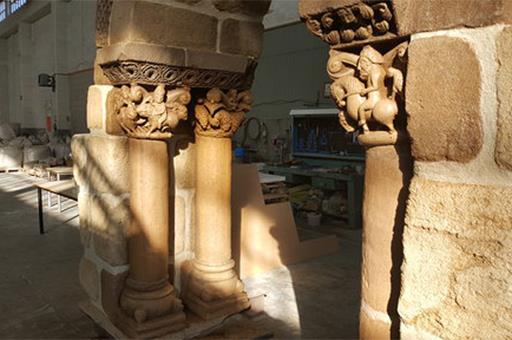
The Arch of Las Dueñas - a Roman arch with a height of 2.2 metres and width of 3.3 metres, dating back to the 12th Century - is one of the most emblematic elements of the Roman collection at the National Archaeological Museum, which brings together both architecture and sculpture.
The reproduction of this work has been carried out using a new 3D concrete printing technique with D-shape technology. The durability of this material means, for the first time, an architectonic reproduction can be placed outdoors, ready to withstand all the elements.
The project also includes 3D scans of a total of 30 works from the mediaeval collection. The selection chosen tries to show some of the most significant mediaeval pieces from the MAN collection, in a far-reaching chronological journey from the 4th to the 15th Century: including works from the Late Roman and Visigoth periods (4th to 7th Century), from the Andalusia and Mudejar collections (8th to 15th Century), and others dating back to the Christian mediaeval world (9th to 15th Century).
The faithful presentation of these models on a tactile screen in the Mediaeval Hall allows visitors to get up close to these pieces in an interactive manner and move them virtually to fully appreciate their artistic value. Furthermore, the digital models of the pieces will be able to provide considerable assistance for future restoration projects, as this technology will facilitate the faithful complete or partial production of these pieces through 3D printing.
Outstanding works:
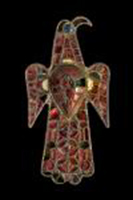 Ministerio de Cultura y DeporteEagle-shaped brooch. Alovera (Guadalajara). Bronze. Glass. (6th Century)
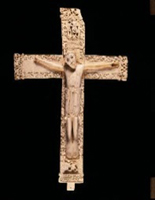 Ministerio de Cultura y DeporteCrucifix of Fernando I and Sancha. Leon. Ivory. (Mid-11th Century)
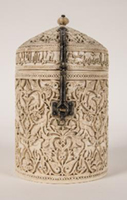 Ministerio de Cultura y DeporteZamora Pyxis. Zamora Cathedral (produced in the Madinat al-Zahra workshops). Ivory, Silver. (964 A.D.)
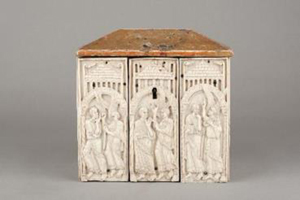 Ministerio de Cultura y DeporteArk of Beatitudes. Leon. Ivory, wood. (11th Century)
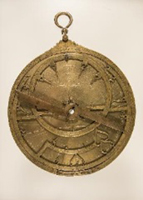 Ministerio de Cultura y DeporteAstrolabe by Ibrāhim ibn Sa'īd al-Shalī. Toledo. Brass. (1067 A.D.)
3D printing: an innovative technique for construction and preservation
3D printing, or additive fabrication, facilitates the creation of three-dimensional objects by the laying down of successive layers of material. This technique allows the creation of highly complex 3D digital models.
When applied to construction, 3D printing allows the digitalisation of construction processes, making possible the fabrication of pieces with a complex geometry and design without the need to use moulds, thereby automating and increasing productivity in construction environments.
In the field of preserving Historical and Cultural Heritage, the combination of digitalisation of the pieces and 3D printing from a high definition scanned model opens a path to scientifically documenting historical heritage assets, using these models in the task of preservation, as well as being able to create replicas in the future from their digital twins.
3D printing has therefore become an ally to historical heritage. The possibility of obtaining exact replicas allows the public to get up close to identical reproductions while avoiding further deterioration to the original piece. Furthermore, this technology allows for the placing of reproductions in the original sites, assuring the preservation of the originals in more suitable surroundings.
Non official translation
Ministerio de Cultura y Deporte