Minister for Home Affairs announces in Ceuta that works to reinforce border will begin in coming weeks
News - 2019.2.23





These works will begin once the State enterprise Engineering Systems for Defence of Spain (Spanish acronym: Isdefe) has presented the ministerial department with a detailed study in which, after diagnosing the current situation of the border infrastructures, makes its technical proposal to resolve the problem.
The minister explained, among other things, that the height of the fencing will be raised 30% - to 10 metres - in those zones where most breaches have taken place and that all the razor wire will be replaced by a feature that will crown the top of the fence and thus guarantee security in a less gory fashion.
According to Fernando Grande-Marlaska, the aim of this work is to ensure a more secure, more modern border using more advanced technological resources. He pointed out, in this regard, that these border infrastructures were built in 1988 and highlighted that the last major reform undertaken dates back to 2005, since when only minor actions have been implemented, principally for maintenance purposes.
The minister explained that these works to reinforce the borders in Ceuta will particularly affect those stretches of the two borders that are most deteriorated, both due to the passage of time and in those places that have been most affected by attempted breaches.
The project to modernise the border will also mean reinforcing the security of the breakwaters, improving the fibre optic network, the installation of a facial recognition system at border crossing points and improvements in the closed circuit television system, which is already being implemented.
Support for law enforcement agencies
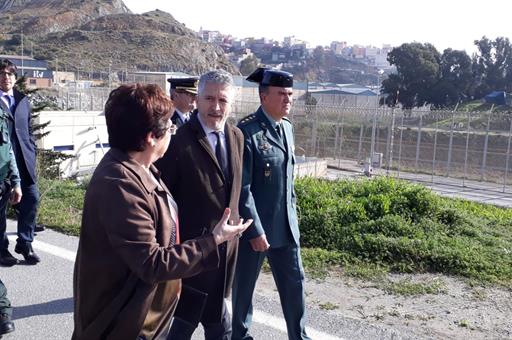
During his visit, the minister expressed his support for the daily work carried out by the Guardia Civil and National Police officers in the autonomous city. Fernando Grande-Marlaska visited the El Tarajal border crossing, as well as the border fence to see first-hand the work of the members of the State law enforcement agencies.
He also met with the Mayor and President of the Autonomous City, Juan Jesús Vivas, and with the Government Delegate in Ceuta, Salvadora Mateos. His trip concluded with visits to the National Police Headquarters and to the Guardia Civil Command Post in Ceuta.
Fernando Grande-Marlaska also underlined the good relations at present with the Moroccan authorities, and stressed the importance of their collaboration in the control of migratory flows and in the fight against terrorism and organised crime. "Morocco is a reliable partner with which we maintain constant, fluid and loyal cooperation. It is a country that also suffers from great migratory pressure", he remarked.
Non official translation