5th centenary of the Magellan-Elcano expedition
Three years of celebration and over 200 activities for 500th anniversary of first circumnavigation
News - 2018.9.12






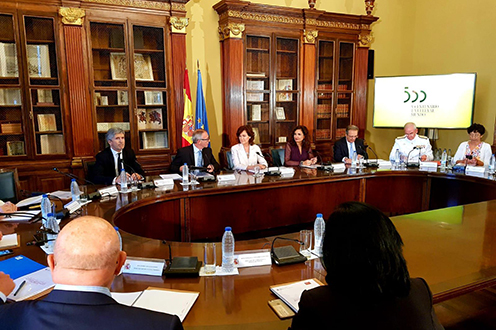
The schedule of activities was officially presented at the meeting, an ambitious agenda that will remain open to proposals until 2022. The centenary website was also launched, which contains an interactive journey about that great maritime adventure and texts from experts in sailing, anthropology and science, as well as extracts from the piece entitled 'The First Voyage Round the World' by Antonio Pigafetta, the official chronicler for the voyage.
A celebration open to all: send in your ideas
Of the more than 200 ideas submitted so far, the National Commission has selected 74 based on originality, relevance, rigour, cultural interest, and national and international impact.
They include a touring exhibition entitled 'The Longest Journey' promoted by AC/E and the Ministry of Culture, a major exhibition about the maritime adventure; and an exhibition dedicated to the expedition at the National Library of Spain based on document collections kept by the library itself. In terms of the performing arts and musical performances, two of the leading proposals are a project entitled 'Sphaera Mundi-Naumon' by La Fura dels Baus, which will travel around the world with an eco-ship full of action; and an opera entitled 'Magellan: There can be no Rose without Thorns', in collaboration with Placido Domingo.
There will be plenty of nautical activities, such as a circumnavigation of the replica of the Nao Victoria owned by the Nao Victoria Foundation; the 2019-2020 route onboard the Juan Sebastián Elcano training ship; and the 'Following in the Wake of Elcano' project by the world champion Alex Pella, who will circumnavigate the globe in his trimaran to commemorate the epic journey.
What was life like on board a ship in the 16th century? A website for 21st century travellers
The 5th centenary invites us to travel back from the 21st century to the yet undiscovered world of the 16th century with the curious eyes of a traveller, the restlessness of a researcher and the adventurous spirit of a seafarer. It does this via an interactive website that enables visitors to travel the globe along the route taken by Magellan and virtually sail the oceans while following the personal log of the official chronicler for the expedition, Antonio Pigafetta. Furthermore, it shows the evolution of cartography and enables the magnificent nautical charts from the 15th and 16th centuries to be geolocated on modern interactive maps.
The website includes personal messages from various researchers at the CSIC, anthropologists, biologists, geographers and historians such as Carlos Martínez Shaw, with collaboration from the Royal Geographical Society, the Naval Museum, the Royal Archive of the Indies and the National Museum of Anthropology. The story is therefore not told in a linear sense but rather from different and unusual perspectives.
A journey that made history
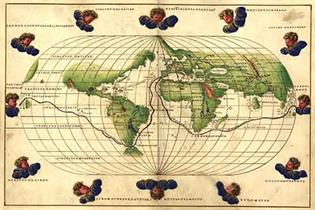 Ministerio de Cultura y DeporteWith support from the Crown of Spain, the Magellan-Elcano expedition set sail from Seville on 10 August 1519 to find a new route to the Spice Islands. It was not until after three years of tough sailing that the Nao Victoria (the only ship to complete the expedition of the five that originally set sail) captained by Juan Sebastián Elcano returned to Sanlúcar de Barrameda (Cadiz) on 6 September 1522. Ferdinand Magellan had died a few months earlier at the Battle of Mactan but he and Elcano had already made history: they had circumnavigated the globe for the first time in the history. They had forever expanded the known world, its cultures, its species and spices, its interconnectivity and its biodiversity.
The Magellan-Elcano voyage is not only an event of immeasurable importance in the history of international navigation but it was the milestone confirming that the Earth is round and the first great expansion of the Spanish language, beginning the processes of globalisation and building a global world.
Weigh anchor and hoist the sails, let the voyage begin!
Any member of the public or organisation interested in submitting their ideas can do so now via the official website for the 5th centenary at http://vcentenario.es
Non official translation
Ministerio de Cultura y Deporte