An unprecedented success for global underwater archaeology
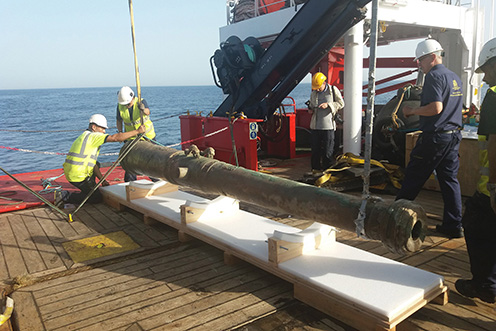
Spain has recovered two large tonnage Renaissance cannons from the wreck Las Mercedes, at a depth of more than 1,130 meters
News - 2017.8.30






The expedition was organised by the Ministry of Education, Culture and Sport, with the collaboration of the Higher Council for Scientific Research (Spanish acronym: CSIC) and the Spanish Oceanographic Institute (Spanish acronym: IEO) (both bodies answering to the Ministry of Economy, Industry and Competitiveness) and the Spanish Navy, has also led to the recovery of other exceptional pieces of documentary interest, such as a bronze griffin, a perforated copper sheet used as a ventilator, and three bronze pulleys with wooden remains still to be analysed.
Work has begun on cleaning, desalinating, conserving and studying the remains recovered. All the pieces, together with those extracted during the expeditions in 2015 and 2016 from the remains of the Las Mercedes wreck, will be incorporated within around two years to the permanent exhibition at the National Museum of Submarine Archaeology (Spanish acronym: ARQUA) in Cartagena.
The whole process of extracting the pieces was carried out in accordance with the criterion of their unique nature, as well as the information that they may provide about life on board the frigate. In the case of the two culverins, they appear to be expressly referred to in the freight manifest of the frigate Mercedes in the General Archive of the Indies (Seville).
The archaeological campaign has also complied with the goal of increasing knowledge about the wreck, mainly with respect to the state of conservation of the materials and the changes in them; registering the dispersion of the remains of the frigate; continuing the positioning of all the archaeological remains, and making progress on the interpretation and analysis of the vessel.
Prospecting has been carried out on extensive areas to the east and north-west of the wreck, with a side-scan sonar, and bathymetric and seabed perforation studies have been carried out to complete the cartography of the zone of the wreck.
A complex recovery operation with the underwater remote operated vehicle (ROV) LIROPUS
The LIROPUS underwater remote operated vehicle (ROM) belonging to the Spanish Oceanographic Institute was used to recover the culverins and other pieces. It was installed in the oceanographic research vessel Sarmiento de Gamboa, run by the CSIC through the Marine Technology Unit (Spanish acronym: UTM). As well as the great weight of the bronze culverins of approximately two tons each, the other major challenge faced has been their size.
The IEO had previously prepared the recovery manoeuvre by selecting cables manufactured from extremely light synthetic materials with a very high resistance to traction. They were lowered to each side of the culverins, allowing them to be raised to the surface. Their location, lying on a bed composed of very thick clay-like sediment made recovery more difficult, due to the additional effort needed to raise the culverins off of the bed.
A water pump launch had also been designed and adapted to one of the titanium arms of the ROV underwater vehicle, designed for cleaning and preparing the recovery manoeuvre without damaging the culverins or impacting the environment.
Santa Bárbara and Santa Rufina: two unique culverins
The following information is known about the two large Renaissance culverins recovered:
1. Santa Bárbara. Date: 1586. Made of bronze, it measures 4.3 metres and weighs nearly three tons (around 2,800 kg).
It was commissioned in 1586 by Fernando de Torres y Portugal, the Count of Villar Don Pardo and Viceroy of Peru between 1585 and 1589. The Viceroy's palace still stands in the city of Jaén. In 1986-88 it was converted into the Museum of Popular Arts and Customs. The cannon is an exceptional piece that also documents a Viceroy who is little known. After his mandate, he was the object of unfair smear campaigns by the Inquisition, with which he had clashed.
The culverin has numerous decorative fields in relief, made up of mythological friezes dedicated to Abundance, the barracks for which the Count of Villar's commission was, the coat of arms of Castile-Leon, the name of the cannon, Santa Bárbara, and the name of the craftsman who cast it: Bernardino de Tejeda. It has two handles in the form of dolphins, which are also repeated on its breech.
2. Santa Rufina. Date: 1601. Made of bronze, it measures 3.8 metres in length and weighs around two tons.
It was commissioned by Luis de Velasco y Castilla, the Viceroy of New Spain (Mexico), and from 1595 to 1603, of Peru. In both positions he tried to improve the living conditions of the indigenous population.
There are reliefs with various decorative fields, the barracks with the family crest of Luis de Velasco, the coat of arms of Castile-Leon, the name of the cannon: Santa Rufina, and the name of the same master caster:
Bernardino de Tejeda.
All this information makes both pieces historic documents of first-class importance for improving our knowledge of the major master casters in Spain in the 16th century.
International collaboration and cooperation
This expedition followed closely the parameters of the UNESCO's International Convention on the Protection of Underwater Cultural Heritage, and was based on institutional cooperation at a national and international level.
Of note is that experts from the Ministries of Culture of Portugal and Mexico participated as observers of the expedition, as for Spain international collaboration in the protection of underwater heritage is considered a case of good practice.
The success of the three expeditions in 2015, 2016 and 2017 is a good example of Spain's capacity at a scientific and technological level to protect its underwater heritage, even in the most difficult marine environments. So far no country had managed to carry out a systematic archaeological investigation on a shipwreck at more than 100 metres of depth, nor had managed to extract such heavy, large or small pieces. In both cases, technology and methodology was used that was extremely careful with the heritage involved.
In addition, the excavation also issues a very serious warning to the large treasure-hunting companies that had so far worked exclusively on wrecks sunk at great depths with their high technology.
Non official translation
Ministerio de Educación, Cultura y Deporte