75th meeting of the Spanish Historic Heritage Council
Four assets included on Tentative World Heritage List
News - 2014.11.18





The work sessions were used to discuss a number of issues concerning intangible cultural heritage, the European heritage programmes and the so-called 'cultural 1%' in Spain. All four of the candidates presented for selection were added to the UNESCO Tentative World Heritage List that Spain will present in 2015: 'Los Bosques de Hayedos: patrimonio común de Europa', 'Madinat Al-Zahra', the 'Pórtico de Ripoll' and 'El Sitio del Retiro y el Prado en Madrid'. These assets will need to be on the Tentative List for at least 12 months in order to become candidates to the UNESCO World Heritage List.
Bosques de Hayedos: patrimonio común de Europa [Beech Forests: common European heritage]
This bid is an international project to expand the World Heritage asset entitled 'Primeval Beech Forests of the Carpathians and the Ancient Beech Forests of Germany', which was added to the World Heritage List in 2007 following an initiative by Slovakia and Ukraine, and was expanded in 2011 to include beech forests in Germany.
Germany promoted an international scientific study of all those European beech forests that met the requirements for inclusion in the proposal: those in Spain, Italy, Bosnia Herzegovina, Croatia, Slovenia, Bulgaria, Albania, Kosovo, the Former Yugoslav Republic of Macedonia, Serbia, Greece, Montenegro, Switzerland, Austria, Romania, Ukraine, Poland, the United Kingdom, Belgium and Sweden. In the case of Spain, the Beech Forests of Aztaparreta and Lizardoia (Navarre) and the Beech Forests of Ayllón (Madrid and Castile-La Mancha) would initially join the project.
The European beech is one of the most important forest components in the temperate deciduous forest biome and represents an outstanding example of recolonisation and forest ecosystem development since the last ice age, a process that is still ongoing today. They represent key aspects of the processes that are essential to the long-term conservation of natural beech forests and illustrate how a single forest species has managed to establish absolute dominance over a wide variety of environmental factors.
Madinat al-Zahra
The archaeological remains corresponding to the ancient caliphal city of Madinat Al-Zahra (some 5.5 kilometres to the west of Cordoba) have also been included. This city was founded in 940 by Caliph Abd al-Rahman III as the seat of power for the recently created Caliphate of Cordoba. It was only in existence for a short time, until its destruction in 1010 by the revolts that led to the end of that particular Caliphate. Even so, the splendour of its ruins features heavily in 11th Century Andalusian poetry. Following gradual abandonment and Christian occupation, the city slipped into oblivion. In Arab culture, it has since become an intangible mythical reference to an ancient golden age in the lost western fringes of Islam.
The excavations that began in 1911 launched an archaeological recovery of the city, a task that has continued to date and for which a long future seems likely.
The city is nestled in a landscape of outstanding beauty. Located in the foothills of the Sierra Morena, it overlooks the plains in the valley of the River Guadalquivir and offers some spectacular panoramic views. The urban area is laid out on three terraces that clearly reflect the hierarchy of this ancient State. The upper terrace houses the residence of the Caliph. The middle terrace contains the forums for representation, with gardens and homes for the dignitaries. The lower terraces form the city proper, with the Aljama mosque, the urban hamlet, a few State-owned industries and public spaces.
The 11% of the excavated area so far has focused on the forums for representation and the Alcazar (with its reception rooms and large gardens), as well as the Aljama mosque located in the Medina. Beyond the boundaries of the archaeological site, the major road and aqueduct infrastructures that once served the city have also been investigated and recovered.
Its exceptional and universal nature stems from both its unique values in the field of decorative arts, architecture, urban planning and regional planning (including some of the first and most important Islamic gardens we know of) and from the fact it bears unparalleled witness to urban culture and life at a time when Cordoba was the main cultural hotbed in Western Europe and the Maghreb.
Madinat al-Zahra is a fine example of urban and landscape integration designed for enjoyment and to highlight the natural features of the location. This integration of the surrounding landscape is manifest in both the monumental shaping of the terrain and in the use of local stone, water and vegetation.
Finally, the proposal also highlights the exceptional nature of this asset due to the fact that, following its short reign as the centre of a vast empire and a place for receiving embassies from the Christian and Muslim kingdoms of Europe, Asia Minor and North Africa, its sudden disappearance transformed it into a legend that fed a wealth of literature in which a kind of paradise lost was evoked throughout the Arab-speaking world.
The Pórtico de Ripoll [Portico of the Santa María de Ripoll Monastery]
The monastery in Ripoll was built as a private religious centre for the family of Count Wifredo el Velloso at the meeting point between various counties. The count himself was the first to be buried there when he died in 897.
The 12th Century portico at the monastery is an undeniable benchmark in Romanesque art. It takes the shape of a triumphal arch providing access to the temple of Santa María and, beneath biblical symbols, is a tribute to the conquests of Counts Ramón Berenguer III and IV, and the Counts of Barcelona. It can be found on the main façade of the church beneath the two twin bell towers that were built for the church's consecration in 1032.
The portico overhangs with seven decorated archivolts and their corresponding columns. The sculptures on the entrance arch depict passages from the New and Old Testaments, and culminate at the top with a representation of heaven. The façade, which is covered with numerous carved figures, surrounds the portico and is divided into six registers supported by a base. One particular feature that makes this asset exceptional is that the stonemasons took their inspiration from a magnificent single-volume codex that came from the Monastery of Ripoll itself in such a way as to recreate the miniatures that appear in the document.
Although the author or authors of the portico are unknown, it is clear that a "workshop or workshops of Ripoll" existed, had an important influence on the surrounding area and produced other works. Hence the Pórtico de Ripoll bears exceptional testimony to an extensive cultural exchange during the Mediaeval era when Romanesque art was spreading through Europe and represented a gateway to Europe for classical and Muslim culture, while also absorbing the cultural influence of other Mediterranean countries.
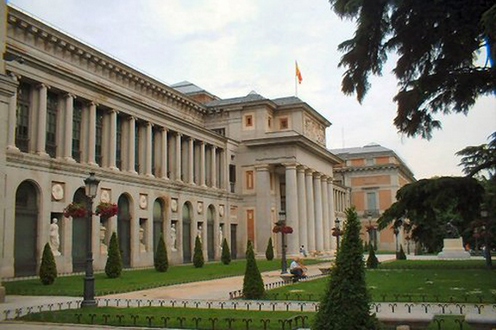
Sitio del Retiro y el Prado in Madrid
To a great extent, the proposed area coincides with the old Real Sitio del Buen Retiro created by Felipe IV in the 17th Century. The value of the unique urban landscape in the centre of Madrid that is the Sitio del Retiro y el Prado resides in its singular overall unity, which reflects an extraordinary assembly of its component parts over very different periods in history. This evolution over more than three centuries can firstly be seen in the gardens, which follow successive baroque, neoclassical, romantic and landscaping patterns. On the other hand, numerous architectural styles also stand out. All this has been stitched together over time into a whole that offers a unity of space, concept and perception that remains firmly rooted in the sensitivity and consciousness of the people. Far from corresponding to a fossilised image from times gone by, the spirit of this space becomes crystal clear in the cultural and social characteristics of modern day.
The Sitio del Retiro also marks the start of grid-based urban planning in the Castro Expansion Plan, which was closely related to the plan implemented in Barcelona. Both these plans stemmed from the rise of cities in Spanish territories in America and are a fine example of 19th Century urban planning.
The origins of the Sitio del Retiro date back to the reign of the Catholic Monarchs of Spain, who relocated the ancient San Jerónimo el Real to a higher, well-aired location with a good water supply on the eastern edge of the city. In 1630, Count-Duke of Olivares supported the creation of a palatial area in what were the outskirts of Madrid at the time, worthy of becoming the stage for the Golden Age of Spain. Various other projects were carried out following the arrival of Felipe V (the first monarch of the Bourbon dynasty). During the reign of his son, Fernando VI and his wife Bárbara de Braganza, lavish importance was given to musical representation, opera and dance. The great monarch of the Enlightenment, Carlos III, undertook a magnificent transformation on the western side of the Real Sitio by converting the old meadows of Jerónimos and Atocha into the so-called Salón del Prado, a space to clearly demonstrate the glory of that enlightened monarchy. The reigns of Fernando VII and Isabel II also left a mark on these places, as did the various stages of history leading up to modern times.
The Salón del Prado is a fine example of a heavily tree-lined urban avenue dotted with a series of fountains that pay tribute to nature, beauty and knowledge while also complementing and providing access to the buildings, thereby creating a truly exceptional landscape.
The Real Sitio del Buen Retiro was a highly representative setting for the universal culture of the Spanish Golden Age in which such individuals as Calderón de la Barca, Quevedo, Lope de Vega, Velázquez and Zurbarán developed their art and was a place used for the celebration of theatre, concerts, festivals, bullfighting and naumachia (sea battle re-enactment) in the El Retiro lake, which remains to this day.
That culture is reflected today in the globally unique collection of museums, beginning with the Prado Museum (the result of royal art collecting that began at the Salón de Reinos, which still exists today) and complemented by such others as the Thyssen Bornemisza Museum and the Reina Sofia Art Centre, which houses the "Guernica" by Picasso - an icon of 20th Century art.
EFE